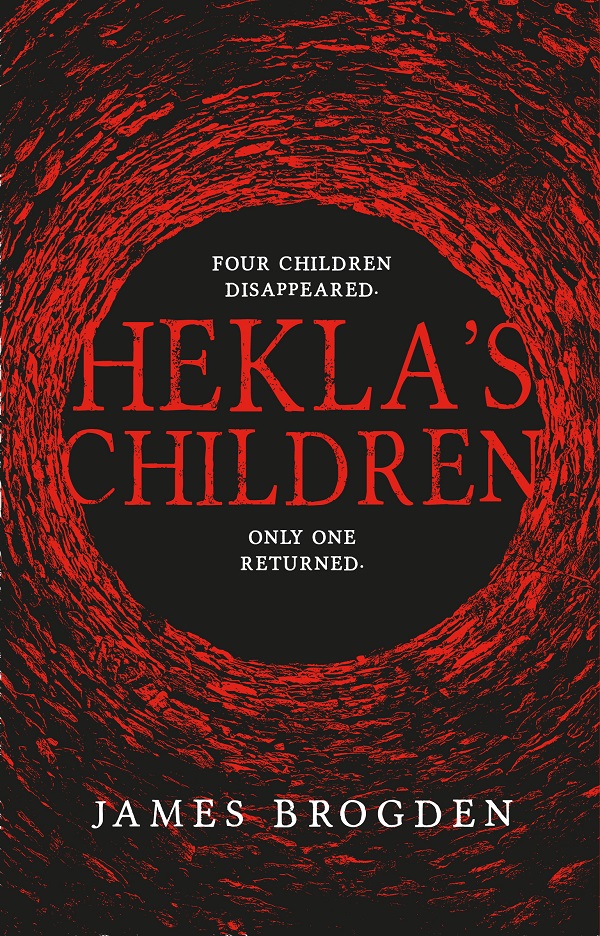
 Today at SFFWorld we welcome James Brogden, whose latest horror novel is getting rave reviews and generating a lot of interest in the UK. Over to James to explain more:
Hello, James! Welcome to SFFWorld. Many thanks for doing this.
No worries.
Q: We’re speaking as your latest novel, Hekla’s Children, is being published in the UK. Can you tell us a little about it?
Hekla’s Children starts with the discovery of a ‘Frankenstein’ mummy in an ancient peat bog – by which I mean a mummified corpse that has been assembled from parts of other bodies for ritual purposes. This also works as a pretty good metaphor for the novel itself. It’s part horror story, part timeslip adventure, and part urban-mythic fantasy. The title comes from an Icelandic volcano which erupted apocalyptically at the end of the Bronze Age and (probably) caused a global cooling event which affected whole civilisations and kicked off the prehistoric events at the heart of the story. Not that this is meant to be a historical fantasy – it’s grounded very much in the modern world – but a big concern of the novel is the legacy of the past, both on a geological and personal scale, and how we struggle to reconcile ourselves with its demands. It’s also about archaeology and rock-climbing and dads and daughters and love and custard cream biscuits.
Q: As a teacher who has been known to run the odd fieldtrip in my ‘other life’, should I be worried?
I’d say there was something wrong with anybody who didn’t worry about the responsibility of taking other people’s kids off into the wild for adventures. It’s a scary thing – it’s fun, but you can’t get complacent, and that’s where in the book Nathan makes his big mistake.
Q: What do you think that writing Hekla’s Children has added to your repertoire? What are you proudest of writing in this book?
The novels I’ve written so far have either been very much in the urban fantasy vein – i.e. ley lines in the alleyways, city-based magic etc – or steampunk adventure, but there has always been a strong horror element in it all, because that’s always been my first love. When it came to writing Hekla I was conscious of wanting to write something more strictly horror, a little purer to the genre – demonic possession, cannibalism, that sort of thing. Repertoire-wise it feels closer to the kind of thing I’ve been wanting to do for a while.
Q: What came first in Hekla’s Children – the world or the characters?
Characters. Always the characters. With the Tourmaline books I had a great time building an alternative steampunk reality and its complex supernatural and political interactions with our own – but for Hekla I wanted a smaller canvas, something which worked on the level of one problematic relationship and the fallout from that. Many of the novel’s pivotal events occur in the shadow world of Un, which changes to reflect the souls of those who journey through it, so in a very literal sense the characters shape their world.
Q: Onto wider issues now. How long have you been writing professionally for?
Since 2012, when Snowbooks published ‘The Narrows’. Coincidental with that I sold my first short story to Dark Horizons, so even though I’d been writing for decades, this was when it all started to kick off – a bit like the proverbial waiting hours for a bus and then three coming along all at once.
Q: Going back to the beginning, what interests in the genre did you have before writing your own? How much have they influenced your writing?
I’ve been reading fantasy and horror ever since I could read. My mum got me into science fiction – especially John Wyndham – my dad got me into fantasy via Tolkien, and when I moved to the UK in 1985 my cousin-in-law introduced me to some guy called James Herbert…
Q: You’ve said already that you have had other books published. You have also written a number of short stories as well. In the past, it was rather expected that authors started with short stories and then progressed to novels. How have you found the transition to novels? Do you think you need a grounding in short stories before tackling novels?
I don’t think you necessarily need to have written short stories first, because they’re very different beasts, although they do start from the same place. Some ideas remain neat and self-contained and do all that they need to do in a few thousand words; some grow and spread almost by their own efforts as consequences and implications of plot and character come to light. The novel I’m currently working on started out as a tiny little 500-word short for a Hallowe’en competition but then things creep in like ‘Oh, what if this happens?’ and then ‘but that means this has to happen’ and ‘I’ve just read a really cool thing which fits nicely onto this…’ and before you know it you have a whole novel thing waving at you and grinning and demanding to be written. If magpies wrote novels that would be me. ‘Ooh, shiny thing, come into my story.’ Some very professional and organised people are forcing me to learn the importance of creating a detailed outline beforehand, which is a good thing because it avoids having to solve all sorts of plot holes and contradictions and makes the process much smoother.
I also quite deliberately used the writing of short stories as a way of developing my understanding about the process of publishing – how to approach editors, how to write to a brief etc – and a fair bit of shameless networking. I’ve met some lovely, talented, and supportive people who work for small and independent presses in the past 5 years, and I know that Hekla wouldn’t have seen the light of day without them.
Q: What kind of books do you read for pleasure, any favourite authors? Can you read for pleasure? (I know a lot of authors who can’t!)
I can’t think of anything worse than being a writer who is unable to read for pleasure; it seems to me that something’s broken there. Presumably what they mean is that their critical faculties are always switched on to nuances of characterisation, language and theme, and that this makes it hard to enjoy something purely as entertainment. Maybe it makes me a very lazy reader, but I can’t do that. I get sucked into a good story and suspend all critical faculties and go along for the ride. I’m terrible at second-guessing plot twists in movies, for example, when my friends will say “I can’t believe you didn’t see that coming!” The one thing that will bump me out of a book and make me lose interest in it is when characters do things which are dumb or contradictory just to set up a plot point – coming back to what I said about characters first.
For the same reason I tend to avoid reading things which slavishly or lazily follow well-trodden genre tropes. They’re simply not interesting to me (says the man who’s just said that he’s trying to write something more ‘purely’ horror). I like stories which breathe new life into old ideas, or take the world and skew it weirdly, or blur the boundaries between genres – something which, for example, might start off as a fairly standard-seeming psychological thriller but quietly morph into something with an unsettling supernatural edge.
So looking at my reading shelf at the moment I’ve got lots of Graham Joyce, Sarah Pinborough, Adam Roberts, Joanne Harris, Neil Gaiman, and Christopher Priest. New readers I’m discovering are Adam Neville, Ren Warom, Tim Lebbon and (much too late) J G Ballard.
Q: That’s a great list. With a certain amount of folk-history as part of the setting, I suspect that there’s a degree of real-world research involved in writing a book like Hekla’s Children. Am I right?
You have NO idea. My research shelf is stacked with books on the archaeological history of Birmingham, bog mummies, megalithic landscapes, bushcraft and old Ordnance Survey maps. And it’s the tinest things which cause the biggest headaches. The simplest question – like, what did farms look like in 1000 BC? – unpacks a whole host of assumptions like did they even have chickens? (as it happens, no). These are the things I need to get right in my own head, even if they never make it into the final edit. You can get away with a certain amount of leeway with the fantastical aspects, just as long as they’re internally consistent, but I’m a details freak when it comes to things like exactly how does a bitten-off finger get treated? Can you actually make a spear-head out of a garden trowel? Even now I’m going back through it and finding tiny, tiny little historical details which I wish I could change, because I’m half-convinced that I’m going to get a flood of complaints from irate archaeologists.
Q: Do you read around other fiction when you’re planning a novel? For example, Hekla’s Children made me think of the folk-fantasy of Robert Holdstock, the British-style horror of James Herbert and even the British culture shown in John Wyndham’s novels. Do you think it’s better to take an idea on fresh or do you like to homage classic influences and books that you’ve loved?
All good spots. I re-read Mythago Wood and Lavondyss while writing Hekla, because I’ve loved Holdstock’s work for years and I think there is that rich vein of peculiarly British fantasy which we do well as a culture. Wyndham is always an influence, as is Clive Barker. It’s not possible to do something completely 100% fresh and original – which isn’t to say that you shouldn’t try, but the influences are always there and readers will always find them even if they’re unintentional. So I have no qualms about saying that yes, this is an homage to Holdstock, but also to Joan Lindsay’s ‘Picnic At Hanging Rock’ which gave me the core of the ‘disappearing students’ narrative. I grew up in Australia, and those influences are in there too.
Q: This is your fourth novel, I believe? Congratulations! As each new book appears on the shelf, does the fact that another book’s complete become a motivator or a hindrance in your next writing?
Absolutely a motivator. I can see all of the mistakes and compromises and the darlings which had to be killed to get each book on the shelf, and every time I look at them I think about what I want to do differently next time, or better, or not at all.
Q: And what’s next?
I’m currently working on a follow-up for Titan – we’re still kicking around title ideas at the moment but it’s based on the legend of Bella in the Wych Elm, which is a local urban myth from my part of the Midlands about a woman’s corpse which was found stuffed into a hollow tree towards the end of World War 2. It’s going to be part murder-mystery, part ghost-story, and part-something-else-altogether which will probably come out of the mix all on its own.
Obviously we wish you all the best with your next developments.
Many thanks for your time, James.
Cheers!
Thanks to Titan Books in helping us organise this interview. James’ novel Hekla’s Children is out in the UK now. The SFFWorld review of Hekla’s Children is HERE.