Welcome to SFFWorld Jacey, many thanks for giving us some time here. We’re writing these questions as Nimbus, the third book in your Psi-Tech series is about to be released.
First of all for those not familiar with your Psi-Tech series can you tell us a bit about it? What do you feel makes it unique?
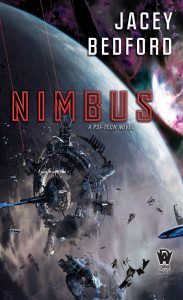
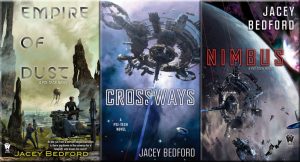
There are three books: EMPIRE OF DUST / CROSSWAYS / NIMBUS. With the release of NIMBUS on 3rd October 2017 the trilogy is complete. Here’s the background. It’s set five hundred years in the future. Megacorporations more powerful than any individual planetary government are racing each other to grab colony resources, always on the quest for more and more platinum, the catalyst which enables jump gate travel. A small but significant quantity is lost in foldspace with each jump. Platinum isn’t uncommon, of course, but to put availability into context, all the platinum refined on earth to date would not fill an Olympic swimming pool to more than the depth of about a foot. If the megacorporations wish to maintain their colony networks they’re going to need a lot more platinum.
The megacorps rely on psi-techs, implant-enhanced humans with psionic powers including telepathy, navigation and the ability to mesh mind and machine. Created and trained at a high cost, the psi-techs are tied to their megacorp by unbreakable contracts… though there are rumours of Sanctuary where desperate psi-techs can go to seek freedom.
The Psi-Tech Trilogy is a mixture of space opera and corporate politicking, with a light touch of romance. It’s character-led. Cara Carlinni is on the run from Alphacorp after discovering a dangerous secret. The first book deals with her meeting up with Reska (Ben) Benjamin and committing to fighting another corrupt megacorp, the Trust. When Alphacorp and the Trust join forces things go south fast, and if Cara and Ben don’t find a solution a whole colony will be wiped out.
In the second book, CROSSWAYS, Cara, Ben and their renegade bunch of psi-techs, now escaped from the Trust, have taken refuge on the vast, rogue space station, Crossways, home to a loose coalition of criminals, but the Megacorps know how to hold a grudge. What could possibly go wrong?
What makes the Psi-Tech Trilogy unique? Well, on top of all that, it has void dragons in the liminal space between jump gates. ‘Dragons in space?’ I hear you say. Well, they might be, and they might not. You’ll have to make up your own mind.
What new goals did you set for yourself with the third book, Nimbus?
CROSSWAYS ends with a massive space battle, so NIMBUS begins with the aftermath. I had my starting point, and I knew the ending, but I had to wrap up all the ongoing threads, not just for Cara and Ben but for the whole diverse cast of characters. Something which began in EMPIRE OF DUST and had a small but significant part in CROSSWAYS comes to the forefront in NIMBUS. There’s something out there in the depths of foldspace that’s unlike anything humankind has met before.
How do you feel your characters have evolved throughout the series? Has everything turned out as you initially planned when you started the series?
Evolution first. In EMPIRE OF DUST, Cara starts out with definite trust issues and has to learn to work with and rely on the psi-techs of the Free Company. Ben learns, in reverse, that not everyone is as trustworthy as they appear. His best friend becomes his worst enemy.
Has it turned out the way I planned? Well, the short answer to that is both yes and no. I always had the broad story arc in mind. I knew right from the beginning how I wanted the third book to end, however I’m more of a pantser than a plotter, especially in the detail, so my characters occasionally do something unexpected. When that happens it’s usually my subconscious telling me that I’ve missed something, and that the way I’ve created the character has caused them to go off at a tangent. In that case, it’s worth following them up a blind alley because sometimes I find something really interesting up there. There’s one thing that happens at the end of NIMBUS (and I can’t tell you the detail because of spoilers), but it only became clear to me at the very last minute that one character has been deluded all along and another is not what he seems. When I looked back, that’s the way I’d written these two right from their first appearances on the page (in different books) and I hadn’t put two and two together myself. That ‘oh, yes, of course’ moment was a revelation – and then blindingly obvious once I applied internal logic. Finding that made me very happy.
What is it with Space Opera you find so fascinating?
I like the scope. You can literally do anything within the space opera genre. The big problem is (in the words of Douglas Adams) space is big, so you have to find a way of navigating vast distances in a timeframe that befits a human story. Without FTL drives you need wormholes or some way to fold space or – in my universe – jump gates. They were no more than a story-convenience to start with, then something that existed in the void between those jump gates made itself known to me, and that sent everything in a different direction. Instead of one problem, my protagonists now had two, but they couldn’t tackle one until the other was resolved.
You also have to tell us a bit about Rowankind, your historical fantasy series?
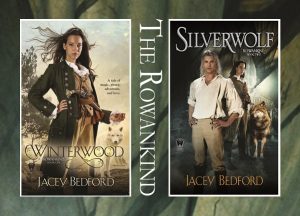
There are two books available now: WINTERWOOD and SILVERWOLF. The third book, ROWANKIND, is due in late 2018. It’s 1800. Mad King George is on the British throne. The Industrial Revolution is in full swing. Bonaparte is hammering at the door. And anyone practising unlicensed magic will be executed by the Mysterium. Ross (Rossalinde) Tremayne is a cross-dressing captain of a fierce little privateer ship, accompanied by her crew of barely reformed pirates and the jealous ghost of her dead husband. And she’s also an unlicensed witch. She pays a deathbed visit to her estranged mother and acquires a magical winterwood box, a task she doesn’t want and a half-brother she didn’t know she had. She has to learn how to open the magical box in order to right a wrong perpetrated by an ancestor 200 years earlier. The first book sees her meet Corwen (something her late husband’s ghost is not happy about) and complete the task. In SILVERWOLF Ross and Corwen have to cope with the aftermath of their own success, and this time we meet Corwen’s complicated family and see how the events in the first book are rippling outward to affect the whole country. I’m currently writing ROWANKIND, the third book in the trilogy, pulling together loose ends from the first two books and heading towards a satisfying conclusion.
Do you have a different approach when you “attack” different genres?
Not really. My writing is character-led and people are people whether they’re getting into trouble in the 1800s or the 2500s, with magic or with science.
The real differences come in the worldbuilding. I obsess over research whether it’s getting the street map of London correct in 1800, or what a corpse looks like after it’s been exposed to the vacuum of space. Obviously when I write historical fantasy there’s an underlying basis of fact that I can use as a framework, though I can make changes to history as long as I follow the story’s own internal logic. In the Rowankind trilogy, history pretty much happened as written until the Spanish Armada in 1588. That’s when things began to change. My story is set over two hundred years later, when one small change has led to a servant class, called rowankind, being inserted into many households.
In the Psi-Tech Trilogy I still have to take history into account. My jumping off point is present day, of course, but I’ve written a future history which involves development of the jump gate system and a period called the Great Colony Grab in which the Megacorporations came to power. After humanity is established in space, there’s a major setback for Earth when a meteor on a collision course is broken up, resulting in three meteorite hits that knock the USA and China off the superpower map and allow Africa and Europe to come into ascendency during a century of rebuilding.
How do you go about the marketing aspect and especially related to your online presence? Anything you’ve seen work better than other things?
I’m based in the UK, and my publisher is in the USA, so there’s not much I can do in person. I attend three or four cons a year in the UK, and this year I went to the Helsinki Worldcon. I always volunteer for author panels and I’m happy to talk about aspects of writing.
Luckily for me, the serious marketing is taken care of by my publisher, DAW. One of their publicists sends out review copies and arranges interviews and guest blog spots, which is wonderful. I also make my own arrangements to do blog swaps with author friends. I’m always aware that I need to keep my online presence lively, so I have a website at www.jaceybedford.co.uk which also links to my mailchimp mailing list, and a blog at wordpress. I tweet @jaceybedford and have an author page on Facebook. I’m also on Goodreads as an author and a reader. After all, I was a reader long before I was a published author and I’ve never lost my delight in books.
There’s only so much you can do as far as marketing your own books online. An endless stream of buy-my-books posts can get very wearing and cause people to switch off, so in my blog I usually talk about aspects of the writing and publishing process that – though personal – are useful to other writers and beginning writers. There’s no one true way to write, but I talk about things that work for me. I make sure I post at least every other week. I blog every book I read and every movie I see at https://jacey.dreamwidth.org, but this is just my personal blog. I’ve been book-blogging since 2009, long before I got my first book deal. I also look after the Milford SF Writers’ blog and post to it on occasions, though it’s largely a team effort: milfordsfwriters.wordpress.com
As far as social media goes, I’m always horribly aware that I can get lost in Facebook and Twitter, so I try not to overdo it, especially when I’m writing a first draft. I’m not one of those people who live on their phone. In fact, that would be impossible because I work from home and my village has minimal phone signal. We didn’t even have a fast broadband connection until last year. As compensation we have lovely scenery, so I can’t grumble.
What’s next, do you have more new and exciting projects you are working on at the moment?
Ooh, yes. I’m currently working on a standalone novel called THE AMBER CROWN, which is set in Livonia, an analogue of the Baltic States around 1650. I’ve messed about with both history and geography, though not enough to make it unrecognisable, I hope. It’s a political fantasy with magic and it’s written from the viewpoint of three main characters: Valdas, the disgraced bodyguard who failed to protect his king from assassination; Lind, the assassin, good at his job, but pretty messed up in every other way; and Mirza, the witch of a band of Atsingani travellers.
***
Jacey Bedford
Jacey Bedford is a British writer, published by DAW in the USA. She writes both science fiction and fantasy and her novels are published by DAW in the USA. Her short stories have been published on both sides of the Atlantic in anthologies and magazines, and some have been translated into an odd assortment of languages including Estonian, Galician and Polish.
She’s a great advocate of critique groups and is the secretary of the Milford SF Writers’ Conference, an intensive peer-to-peer week of critique and discussion held every September in North Wales. (http://www.milfordSF.co.uk)
She lives in an old stone house on the edge of Yorkshire’s Pennine Hills with her songwriter husband and a long-haired, black German Shepherd (a dog not an actual shepherd from Germany). She’s been a librarian, a postmistress, a rag-doll maker and a folk singer with the vocal harmony trio, Artisan. Her claim to fame is that she once sang live on BBC Radio 4 accompanied by the Doctor (Who?) playing spoons.
You can keep up with Jacey in several different ways:
- Blog: jaceybedford.wordpress.com
- Facebook: https://www.facebook.com/jacey.bedford.writer
- Twitter: @jaceybedford
- Pinterest: https://uk.pinterest.com/birdsedge/
- Or via her writing website: http://www.jaceybedford.co.uk, which includes a link to her mailing list
* * * * * * *
Interview by Dag Rambraut – SFFWorld.com © 2017