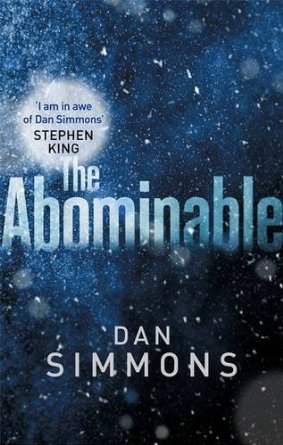
 The Abominable by Dan Simmons
Published by Sphere/Little, Brown, October 2013. (Review copy received)
ISBN: 978-0751550283
666 pages (in ARC copy.)
Review by Mark Yon
The Abominable is rather like the mountainous landscapes it portrays, a novel that is in turns, brilliant, all-enveloping, treacherous and chilling.
It is also a book that begins as part of a great conceit. It is a story-within-a-story, a plot that begins as if it is Dan Simmons recanting a tale given to him by a mountaineer, Jacob (Jake) Perry, uncovered as Simmons was researching his other snow-tale, The Terror.
The story then shifts to 1924, as if transcribed by Jake, successfully blurring reality and fiction. In June ‘24 George Mallory and ‘Sandy’ Irvine disappear whilst climbing Everest. This much is true: until recently their bodies were missing, and it is still a mystery as to whether the two climbers may or may not have made it to the summit and died on their way back.
The Abominable takes this real event but then overlays it with Simmons’ fictional creations. In this tale we follow what happens in the time after the loss of Mallory and Irvine, when Perry and two other experienced climbers, Jean-Claude Clairoux (usually named J.C.) and their leader Richard Davis Deacon (‘the Deacon’), who together attempt to return to the Himalaya the season after in an unofficial ‘rescue mission’ – or rather to find out what happened to another climber, Lord Percival Bromley, who was lost on the mountain whilst trying to find Mallory and Irvine.
The Deacon-Clairoux-Perry expedition is one funded by Lord Percival’s mother, Lady Elizabeth Marion Bromley, and not sanctioned by any Mountaineering Society, which is why details of it (according to Simmons) to this day remain less known, if known at all. The rest of the book is then spent attempting to climb Everest, with consequences for all involved.
Dan’s book is one that moves glacially, yet inexorably towards the ending. In the first part of the book we get to know the backgrounds and thoughts of the main characters, their training in the Alps around The Matterhorn and in Wales, the social situation that affects their attempt (which involves trips to Lincolnshire, Switzerland and Nazi Germany), and perhaps, most importantly, the danger, excitement and challenge presented to climbers determined to push themselves to the physical limits. There is beauty and risk, and Dan does well to try and give the reader some ideas as to why climbers do what they do. This can be complicated, but Dan writes wonderfully about such matters.
As you might expect, much of the feel of the book is created by a lot of technical talk, which gives the impression that it is really a climber talking of his passion. There’s enough belaying and traversing for any climber, I think. I’d be interested to hear what M John Harrison (SF writer and experienced climber himself) would make of this novel. I think he’d like that aspect of the novel.
However, it is well enough written to be followed by a non-climber (such as myself) without losing the plot or sheer impossibility of some of the events that are here. I soon got to the point where I was engrossed in all the book’s twists and turns. It’s not easy for a writer to keep a reader’s attention for such a long while – it’s over two hundred pages before we even set off on the expedition proper – but Dan managed it for me. Although I know fairly little about climbing myself, what worked is that the book felt real, which is quite an accomplishment.
Personally I found the book so immersive at this stage that the pages turned rapidly. Some of the descriptions of the extreme landscapes and climate experienced by our climbers are so good that I was travelling with them, urging them on through all sorts of difficulties.
I have been at pains here not to mention much of the horror aspect of the story. Many readers may be under the impression, from the title if nothing else, that the book has something to do with that snow creature of legend often reputed to roam the mountain slopes of the Himalayas. I must say that the book itself doesn’t really mention this feature of the story until about 150 pages in and in the end, the idea is not as important as you might think it would be. Much of the book seems to be about secrecy and identity, and so with that in mind the idea of the yeti is perhaps a bit of a mis-direction (although it would be wrong of me to say more).
Where The Abominable works so well is in its continuous blurring of reality and fiction. Real people and events are mixed up with fictional. To my mind, that may create a broad appeal, straddling various genres with ease. Some may just read it as a mystery novel, others by turns an adventure novel, a fictional biography, a tale that in its own way reflects the decadent decline and upheaval of the world in that interwar period between World War 1 and World War 2. For most, but not all of the time, Dan creates a definite world that works.
So far, so good. However, now we get to my biggest issue with the book, which I think may be a breaking-point for some readers. Having gone through all of the preparation, the travelling and the physical stresses of climbing up Mount Everest, there is a point when the reader (and the characters discover what ‘the abominable’ is. Without giving details, most readers will find the item a surprise. I will say that although personally I found it horrible, but I must admit that when ‘the great reveal’ happens, it is something I found rather unconvincing. Horrible though it is, personally I wasn’t convinced that it was worth all the effort, horror, pain and death it has taken through the book to uncover it. Dan uses it to claim that it may have altered history, a point I wasn’t persuaded by.
Nevertheless, if you can get around that aspect of the book, it must be said that the last part of the novel is exciting and very well written, if a bit more John Buchan than HP Lovecraft. More The Thirty-Nine Steps than At the Mountains of Madness, if you like.
In summary, The Abominable is a book that works brilliantly well most of the time. There is no doubt that it is well written, engrossing and exciting, although like The Terror before it, it may be too slow, too involved and complex for some. It makes an interesting counterpart to The Terror.
It’s detailed, it’s skilfully done and yet…… I was hoping to type that the book was a resounding triumph. I must say that although it is for most of the book, it’s not perfect, and to my mind some aspects may annoy the reader enormously. There’s a lot to gain and enjoy from reading The Abominable, but I suspect that there are aspects that some readers will dislike and some may see as controversial.
In the end, for me, The Abominable is overall a triumph, though ultimately perhaps not as good as I thought it was going to be.
Mark Yon, August 2013.