
 We’ve talked to Simon Lee about The Fall of Mars, a Steampunk novel set in an alternate reality Victorian England.
First of all can you tell us a bit about The Fall of Mars?
The Fall of Mars is essentially a steampunk novel. However, I’ve thrown everything I love about science fiction into the mix, including elements of space opera and horror. The story follows a disparate group of people who get dragged into an ancient conflict.
It is not just about saving humanity though, they must also find out who they really are. There are definitely some very philosophical themes buried in the book.
Void technology, that’s something you have to explain a bit? Did your background studying quantum physics and astrophysics influence you in creating this technology?
Yes, in part, it did.
Quantum physics discusses quantum vacuum fluctuations. This is related to virtual (short lived) particle pairs. These are thought to ‘blink’ into existence and then annihilate each other, and this is considered to happen everywhere. I took this idea and applied it to another universe with different rules. There this energy can be trapped and manipulated, hence ‘Void Technology’.
Here is a quote from master shipwright Tomlin about this. He is one of the characters in the book, the founder of The Liverpool Sky company:
“As you are no doubt aware, it all began with the discovery of a new element. It was found by Theodore Zimmer in the early forties and started a scientific revolution leading to the development of void mechanics. It is a new substance found only in some meteorites that have fallen to the Earth intact. Since called Zimmerite, it has properties allowing us to extract a form of energy from void cells that exist between all elementary particles. This energy seems to be an essence connected with the life force itself, spiritual entities can become corporeal when it is present, all manner of strange phenomena have been observed including nullification of the force of gravity.
“However, and here I must stress this point, there has never been any real danger, actual or potential, associated with the use of Zimmerite or the extraction of essence from void cells.
“The design, construction, maintenance and operation of devices employing this technology all come under the umbrella of Void Mechanics.”
A note concerning Void Cells:
“In fact all the objects around you, including your body, comprise mostly emptiness. In this emptiness exist minute cells containing essence, these we call void cells.”
From the back streets of Liverpool to Mayan temples and even Mars. You have a fascinating blend of alternative history, melted with science fiction and fantasy here. How did you get the idea in the first place?
I first started the book in the early 2000’s, before I had heard of ‘Steampunk’. I loved aspects the Victorian era. I had avidly read all of Arthur Conan Doyle’s works. Jules Verne and H.G. Wells fascinated me also. So I decided to write science fiction set in a version of that time.
I got interested in Mayan culture when I studied mesoamerican anthropology at university. I wondered what would have happened if that culture had endured. Although it doesn’t play a big role in the story, it is there as part of that world.
Then the story just evolved on its own, as I said above, everything I love ended up in it.
What goals might you have set for yourself when writing The Fall of Mars and how do you feel about the end result?
I simply wanted to write a book I would love to read. I guess I’m too close to the project to think about the result objectively, but I am very happy with the feedback I’ve been getting.
What is the hardest thing about writing?
The self-discipline to keep going. I’m never short of ideas, but neither am I short of distractions. There’s always other worlds to explore.
At the moment Funcom’s ‘The Secret World’ is battling for my attention when I should be focusing on my current book.
You’re Norwegian aren’t you? Well, between Anarchy Online and Secret World, you are part of a very distracting nation!
Can you tell us a bit about the road to publishing The Fall or Mars?
The big question was whether to try the traditional or independent route. In the end I couldn’t stand the idea of submitting excerpts to agents or publishers and waiting months for responses. After reading about the paradigm changes brought about by the ebook revolution I decided to try that.
My wife has been fantastic, supporting me and taking on some of the publishing functions. The kind of stuff that drives me crazy. So far I don’t regret our choice.
One very important decision we made was to pay to have the manuscript professionally proofread. That made a big difference and gave me confidence I was offering a professional product. It was well worth the investment.
Did you have any special criteria for selecting a proofreader or did you just search online and fine one?
Both really. I searched online for someone who was: a) Experienced, had proofread published work and was familiar with ebook formatting; b) Familiar with my genre or willing to become familiar with it.
I found a local proofreader (added bonus of being able to meet face to face and discuss the project, which was very valuable as it turned out) who had worked on published books. She was not a science fiction reader but was very willing to acquaint herself with the genre. I was amazed when I found she had rented a copy of Peter Hamilton’s Fallen Dragon specifically because I had mentioned him as an author I admired.
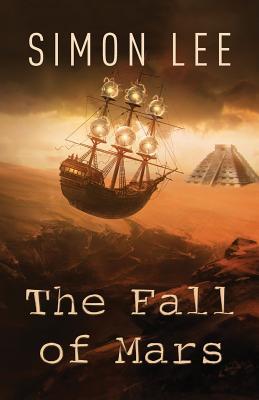 Can you tell us a bit about the cover and how that came about?
I’m glad you asked about that. I feel the cover of a book is very important. I have bought novels because the cover attracted me to them, and I know I am not unusual in that regard. I decided early on the cover art needed to be special and relevant to the story, not just a generic piece.
But I also had a budget.
So I searched the deviantART website for SF artists that produced work in the style I wanted. I ended up selecting a young French artist, Ulric Leprovost. We exchanged 56 emails in the process of developing and refining the cover. The result is a magnificent piece of art, exactly what I wanted. We were half a world apart, I had virtually no French so we relied on his English (which wasn’t bad) yet the collaboration worked 🙂
What in your experience has been the best way of marketing your books?
I have had little interest in business in the past, that had to change when I decided to publish independently. Fortunately my wife (Dana) does have experience and enthusiasm for marketing. So I increased my willingness to sully my hands with the commercial side of things and Dana pitched in to help.
She downloaded ebooks on the subject. She’s even reading one to me when I’m trapped in the car with her. As a result we’re both getting more savvy on this new age of independent publishing.
It’s early days yet but, to answer the original question, the best way to market so far has been to build my online presence through social networks such as Facebook and use the promotional tools Amazon provides as well.
Doing this resulted in quite a surge of downloads.
It seemed a herculean task to write the book and prepare it for public consumption. Then the obvious fact dawned on me, that was just the beginning. Making oneself known takes just as much if not more work.
For your own reading, do you prefer ebooks or traditional paper/hard back books?
I have never read an ebook. I love holding a physical book in my hands. But my wife reads ebooks all the time, even on her iphone! I can see myself trying that out sometime, in the future 🙂
What kind of books do you read, any favourite authors?
I mainly read science fiction or fantasy. Modern writers I have enjoyed are Peter Hamilton, Raymond Feist (particularly his first three books), and Dan Abnett’s works in the Warhammer 40K universe.
E.E. Doc Smith’s brilliant Lensman series is a classic I re-read often. Jack Vance and H.P. Lovecraft are other favourites. I could fill a page with a list of the authors on my bookshelves.
What’s next?
I am in the middle (actually more like a quarter through) another science fiction book. This one is not steampunk, it’s set in the near future. It is galactic in scope and has some similar themes to The Fall of Mars. In fact I call it a paraquel. A made up term for a book that is not a sequel or prequel but has parallel themes and story arcs. Possibly in a parallel universe.
However, it definitely stands alone and can be read independently from The Fall of Mars. This one is called ‘The Galaxy Burns’.
* * * * * * *
Interview by Dag Rambraut – SFFWorld.com © 2014




Great interview and very interesting answers from the author.
Very much enjoyed reading and learning more about the author. I loved reading The Fall of Mars. Highly recommended.
Awesome interview! Was so happy when I found Simons work, been looking for a good sci fi read for a while and this was something different enough for me to really sink my teeth into 🙂 Thanks for the great questions and answers 🙂