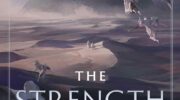
Back in 2013 I reviewed Drakenfeld, a locked-room crime novel with a Fantasy setting. I liked it a lot, and so was very happy to pick this one up.
Retribution is the sequel and continues the tale of Sun Chamber Officer (rather like an Inquisitor or a Police Constable) Lucan Drakenfeld and his bodyguard-friend Leana. After the events of Drakenfeld in Detrata, Lucan is sent to the city of Kuvash, where a priest has disappeared.
Once arrived in Kuvash, Lucan finds that the inquiry has become a murder investigation, when parts of Bishop Tahn Valin’s body are found.
I guess this is one to be subtitled, ‘The Travels of Lucan’, as much of the tension is created by Lucan trying to understand how things are done in a very different city. Here, further away from the Empire’s direct influence, things are rather fuzzier than would normally be expected, and Lucan seems to be frustrated many times while trying to do his duty.
When more corpses are found, Lucan realises that he seems to be looking at a multiple murderer/s, one who seems to enjoy torture and dismemberment as part of his/her Modus Operandi.
I thoroughly enjoyed this step into a world that seems to be a combination of Jack the Ripper meeting Osten Ard, the secondary fantasy world of Tad Williams’s Memory, Sorrow and Thorn trilogy. The plot is done well enough, although as this is the second book the novel is more about character development than a mere revenge plot. Having set the main characters up in Drakenfeld, Mark has more room here to develop the motivations and inclinations of our lead characters. I am growing to like Lucan Drakenfeld, who, despite his health issues, seems like a decent sort of chap, even when things are stacked against him. Here he takes on the role of Inspector Abberline in trying to discover both the motive and the perpetrators of the murders.
Some of the new characters are well done, too. The Cleopatra-like Queen Dokuz Sorghatan manages to convey both leadership and compassion in a world dominated by male leaders. Sulma Tan, the Queen’s advisor is a character who I suspect Lucan will meet again. And the Queen’s daughter, Nambu, has a rite of passage that many teenagers would long for, as a pupil to Leana. They are introduced relatively smoothly and become part of the plot in a way that seems unforced and logical.
Another aspect that is done well is that Mark’s characters build on the ever-present feeling overall that ‘things are changing’. One of the key aspects of this tale is that Drakenfeld is a long way from the centre of the Republic and so has to deal with things without the support of his seniors back in Detrata.
Though the book is firmly placed in the city of Koton, the wider context suggests that there are rumblings of conflict on Kuvash’s borders, a situation that both creates a motivation for the killings and a possible reason. I suspect that such skirmishes will continue through this series, whilst I kept being reminded of present-day real world troubles being similar.
The need for a Republic to meet the needs of the people who are feeling rather ignored out on the edge creates a motivation and a reason for Lucan’s difficulties. He is very much alone here, having to deal with a rather different culture to his usual, and this creates a further complication. Combining a Roman Empire with an Egyptian-style queendom is an intriguing mix, which Mark does well.
For those looking for a Fantasy-type element in the novel, there is relatively little. There are no dragons, no elves, no demons, though the central MacGuffin has aspects that could be construed as such should you wish for it.
Indeed, as fantasy novels go, Retribution is relatively trope-light. If Drakenfeld was a locked-room mystery, Retribution is a much more straight-forward revenge novel. The novel’s central theme is the crime/murder aspect of its telling. (This may explain the novel’s title.) I’m pleased to say that I did not work out the villain/s, nor the reason for their actions until it was revealed towards the end, as is appropriate for a crime novel. It does seem to end rather abruptly with a lot of loose ends tied up very quickly, but that may be due to the immersive nature of the novel up to that point.
The novel can be read without reading Drakenfeld, though there are links that a reader will appreciate. Thoroughly enjoyable, Mark’s deceptively smooth text eases the reader into a world that, once entered, becomes difficult to leave. This series is developing nicely, and I look forward to more in this series. Recommended.
Published by Pan Macmillan, October 2014.
ISBN: 978 0 230 766846
430 pages
Mark Yon, November 2014.