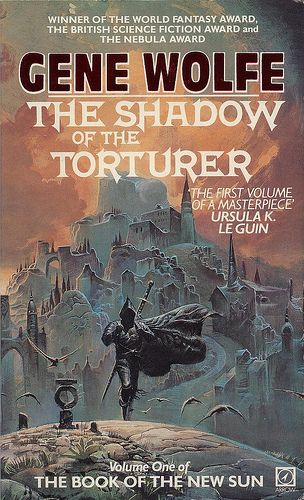
From the publisher: “Severian is a torturer, born to the guild and with an exceptionally promising career ahead of him . . . until… he is exiled from the guild and his home city to the distant metropolis of Thrax with little more than Terminus Est, a fabled sword, to his name.
Along the way he has to learn to survive in a wider world without the guild – a world in which he has already made both allies and enemies. And a strange gem is about to fall into his possession, which will only make his enemies pursue him with ever-more determination . . .”
About 25 years ago Gene Wolfe’s The Book of the New Sun series was voted by Fantasy fans as the second greatest fantasy of all time, after Lord of the Rings. It’s won awards since – many more, including the World Fantasy Award for best novel in 1981 and the BSFA Award for best novel in 1982. The second book in the series of five, The Claw of the Conciliator, won a Nebula Award for Best Novel.
But things have changed a lot in the Fantasy genre since then – after all, Shadow of the Torturer was published 15 years before George RR Martin’s A Game of Thrones, first book in the Song of Ice and Fire series. Today it seems to be generally forgotten. Although there is an ecopy available, it was fairly hard to track down a new physical copy. (Here in the UK I had my original paperback copy from 1982 and a Kindle ecopy. There is also an omnibus edition of Shadow and the Claw of the Conciliator that is the first in the Gollancz Fantasy Masterworks series.) Please note: I will only be reviewing Shadow here. I hope to review Claw and even the other books in the series later.
I must admit I have tried reading this more than once since it was first published in 1981. Like The Wheel of Time, it has always defeated me (story for another time!), usually with having read a hundred or so pages I’ve just lost interest.
And whilst I could admire its brilliance, I’d just considered that it was just not for me.
The Shadow of the Torturer is the tale of Severian, a young apprentice in the Guild of Torturers in the capital city of Nessus, on the world called Urth, exiled for committing the ultimate sin of his profession–showing mercy towards his victim. He is exiled as a consequence of his aberration.
When the story begins Severian’s journey as an exile from the Guild of Torturers, the narrative really gains momentum. We then begin a look at the world outside Severian’s so-far sheltered existence, at the towns and cities beyond, and in particular the city of Thrax. Here the story becomes almost Jack Vance-like in its descriptions of people and places that reminded me a little of Vance’s The Dying Earth series – ancient buildings slowing eroding through time, with a faded baroque surface and connected by ancient rituals.
The level of depth and detail in its florid yet exquisite language hints at a world of ancient history and a complex yet well-established world that I suspect will gain even more from a reread. There are moments of beauty and brutality, yet often depicted in brief sentences – Severian’s matter-of-fact descriptions of some of the torture methods and executions he undertakes are quite shocking, yet to him are perfectly normal. Details that seem minor become important and not all that we read is entirely true.
So why is it that Shadow of the Torturer is not mentioned in the same breath as, say, A Game of Thrones/Song of Ice and Fire? It’s certainly an influence on GRRM, who has mentioned the inspiration writers such as Wolfe and jack Vance have had upon him. (There’s even an enormous wall here, albeit around the city wall of Nessus rather than in The Kingdom of the North.)
Some of the elements are unusual, and a little jarring. A duel with killer flowers is certainly original, and I think meant to create a slightly lighter mood, although it just felt rather odd to me. This may deter some readers.
Could it be the characterisation? Severian is an enigmatic lead character – not entirely trustworthy, nor as valorous and romantic as some of the more positive fantasy leads of the time. In fact, it could be argued that he is one of the more notable main characters whose narrative is unreliable. Although this is fairly common now, like Thomas Covenant it was more unusual character trait in the 1970’s/’80’s.
Perhaps the biggest issue to modern audiences may be Wolfe’s depiction of the female characters, who are often seen as enigmatic, coolly detached, strange or just nasty. This may be partly due to that 1980’s view of the Fantasy genre, where the dominant characters are often men, with women taking a secondary role. (It is also nearly a decade away from Robert Jordan’s Wheel of Time series.)
Of course, this may also be deliberate, because we are reading Severian’s version of events. It could be said that such characterisation tells us more about how Severian sees women, viewed through a skewed lens. But is not the view of women many readers prefer in 2025.
It may also be because Shadow is the first part of a much longer series. Really, in terms of action in this first book all Severian does is serve his apprenticeship, and move to the city walls of Nessus on his way to the city of Thrax. The finale itself is a humdinger of what we now call a cliffhanger ending. It feels like an incomplete book, with things unresolved. For readers who like things tied up by the end of a book (even to a slight degree) Shadow may frustrate.
Personally, I think that it is mainly that complex language, which makes the book a richer experience but also a slower one. I regularly had to stop to check up words. It is therefore not as easily accessible or as immediate as some of the better-known fantasy works out there at the same time, such as Raymond Feist’s Magician or Terry Brooks’ Sword of Shannara series, published around the same time (Feist’s Magician was 1982, Brooks’s Sword was 1977.) Having said that, you could argue that Stephen Donaldson’s original trilogy of Thomas Covenant work (1977-1979) is just as dense and just as slow – paced. And Tolkien’s language can hardly be regarded as always accessible.
And yet, I must admit that I keep coming back to Shadow, thinking about what happens in the book, what is said and what it might mean – the usual sign of a good book for me. It would, like Lord of the Rings, repay repeated reading, I suspect.
So: to sum up, it’s not perfect – but I now can admit that Shadow of the Torturer, once it gets going, is a memorable read, even 44 years after its first publication. It must be said that whilst Shadow of the Torturer is a challenge, it is a challenge worth taking. It is a book to take your time with, to luxuriate in the language, and enjoy the journey. (I can also recommend the use of the Kindle version to look up words in the dictionary, too.) The book demands your focus, does not give up its details easily or lightly.
Sometimes a challenge makes a book worth reading. This was one of them. I wish to continue with the series very soon – and you never know, it might be time to try those Wheel of Time books (again!)
© 2025 Mark Yon
Paperback | Sidgwick and Jackson
SHADOW OF THE TORTURER by Gene Wolfe
First published 1980 (UK:1981) by Sidgwick and Jackson
303 pages
Cover by Bruce Pennington
There is a physical copy available as an omnibus edition, combined with the second book. First published 2000.
Published by Gollancz | 606 pages
ISBN: (1981 UK version) 978 0 283 98738 0
2000 Omnibus Edition (Gollancz): 978 1857 989 779
There is an ecopy available of each book separately.