 Film is an alchemical process, process of change.
And my brother and I were alchemists, magicians. …
- Paloma, in The Shoemaker’s Magician
The Shoemaker’s Magician, second of her Chicago novels after The Children of Chicago (reviewed here), taps into one of my favorite tropes: cursed films. An excellent occult horror-fantasy, the core premise concerns a lost film, The House of the Devil directed by George Méliès – early French innovator of special effects best known for his short film, Le Voyage dans la lune (A Trip to the Moon) – with its connection to the history of film in Chicago.
Each chapter offers a character’s point of view, though most chapters follow Paloma, a podcaster concentrating on horror films, also a wife and a mother, who is more attuned to the unnatural and paranormal than most. Her young son, Bela, may be even more attuned. Each experience odd, disturbing events as a serial killer with his own passion for the lost Méliès film begins a murder spree that threatens Paloma, her son, her detective husband, Sebastian, and Paloma’s role model, Grand, a movie presenter on local TV in the tradition of Maila Nurmi (better known as Vampira, and name checked in the novel), who has secrets of his own.
Merging film history and fable and magick (per the novel), Pelayo spreads throughout information about Chicago’s role in early filmmaking, a role far more extensive than I realized, as the site of production for many silent films including Charlie Chaplin’s The Tramp for Essanay Studios. For the record, The House of the Devil is a real film by Méliès, lost for decades until rediscovered in 1985 (according to Wikipedia; Pelayo cites 1986), and Essanay Studios was a real studio, and Chaplin did, indeed, work there for a time.
Besides Paloma and her family, the city of Chicago becomes a major character in the novel, especially those poorer quarters where Paloma grew up with her brother, Noel, living over a small neighborhood movie theater. Paloma’s husband, Sebastian, says of Chicago, “If you’ve lived in Chicago, you’ll crave it. There’s no escaping the taste of her. Chicago is that relationship you knew was bad for you but you needed more of, even though you knew it’d ruin you forever.” And Grand offers the reflection, “The architecture of houses morphs and changes as I cross different communities with varying historical and cultural influences. The names of streets tell a story of people who once made way. We are permanent fixtures, but still, our story, whether we want it to or not, will unfold. That is the wonder of a geographic energy center like this city. The stories we make here will ripple throughout time. A song. An echo. A story. A fable.”
An easy read, The Shoemaker’s Magician is still layered and nuanced. Pelayo’s prose is smooth and filled with details that make her Chicago feel lived in, from the rustle of trees to the popcorn scattered across the floor of an aging theater, and her people seem plausible human beings. And as she conveys the passion and excitement of her film buffs, even as horrific events pile one atop the other, Pelayo also conveys the feel of Chicago and her love of it.
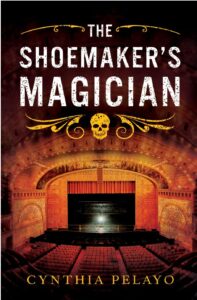
Just to note, you may not want to do what I did and read this one first. Events from The Children of Chicago are mentioned and some of them are spoilers. Also, I came across a handful of typos that led to odd phrasings. Lastly, I want to point out the cover of this paperback has one of the most striking designs I’ve seen in some time and accurately reflects the feel of Pelayo’s story and setting.
© 2026 Randy Money
Hardback | Agora Books
THE SHOEMAKER’S MAGICIAN by Cynthia Pelayo
May 2023| 336 pages
ISBN: 978-1957957104