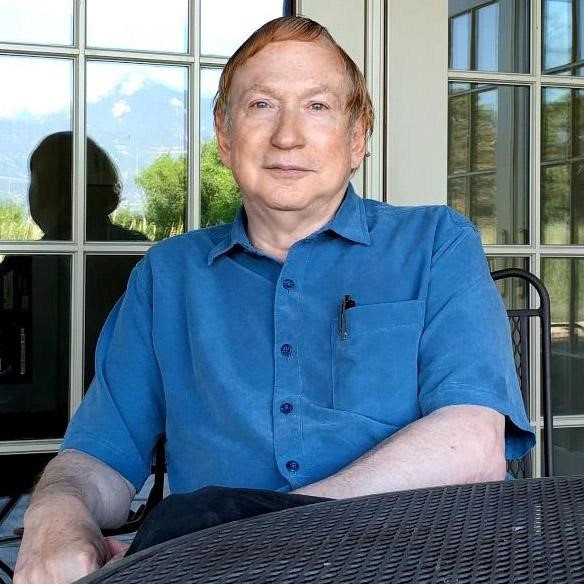
Available in paperback again, some for the first time in over 10 years, ReAnimus Press is re-releasing nine science fiction titles from internationally recognized author John E. Stith in 2016 and 2017.
How comfortable are you generally with seeing the re-appearance of older work? Is it something you’re happy to do, reaching a potentially new, wider audience?
I’m pretty comfortable, and I do look forward to building out a new readership. While I think my skills have increased over time, I think readers take into account one’s publishing history. For instance, I think SCAPESCOPE is my weakest novel since it was my first. I’ve generally not been writing near-future work, so there’s not very much that feels dated.
 Redshift Rendezvous and Manhattan Transfer are probably your most known novels, but are those also your personal favorites among the nine books now being re-rereleased?
Other than RR and MT I’m partial to REUNION ON NEVEREND as it was inspired by a high school reunion of my own, and DEEP QUARRY marks the inclusion of a stronger sense of humor in my work. I’ve loved works by writers as diverse as Robert Sheckley and Robert B. Parker. Not every work benefits from touches of humor, but many do.
You also have to tell us a bit about the new covers that are quite different from the old ones? How involved have you been in the process?
I’ve been quite involved. I have the right to use the covers from the original Tor Books and Ace Books editions (and others) as advertising when they’re kept intact, but I don’t have the right to use the underlying artwork in a new cover. When my work reverted to me from the traditional publishers, it was re-released by newer publishers such as Peanut Press and Wildside Books, but the covers were sometimes fairly generic or rushed, even though I had a hand in a few of them.
A couple of years ago, a friend, Kavin King, and I decided that those covers were not as strong as they could be. Kavin has since worked as my art director, actively searching for new talent, people producing professional-quality work but who were new enough in the business that they would be willing to provide artwork at a price that made sense for re-issues. We found talented people like Sina Pakzad Kasra, Julian Faylona, Takumer Homma, and Charlie Pharis. In addition, we found Jorge Abalo Budczinski, who is one of many new artists making amazing use of Mandelbulb software to produce 3D fractal art.
Kavin took that original artwork and provided the cover layout design and title lettering. He also added DAZ Studio models in some cases. For the new SCAPECOPE cover we used Mandelbulb ourselves.
Can you tell us a bit about what led up to the re-release by ReAnimus Press?
My backlist had been under contract with Wildside Press, run by John Betancourt. I like John a lot and found him very easy to deal with, but as it happened, his team got overloaded by other issues, like the Google Play store suddenly changing the rules in ways that cost them a lot of time. Some of my books that had been under contract never actually made it into print, and they didn’t have time to do the work involved in updating cover art. Around this same time, I ran into a colleague I’ve known for years, Andrew Burt, who’s running ReAnimus Press and bringing out the backlist for writers like Ben Bova and Norman Spinrad. (Andrew recently acquired the backlist from Advent Publishers, including titles like James Blish’s literary criticism works.)
Andrew expressed strong interest in bringing out my work in trade paperback and DRM-free ebook formats. My contract with Wildside had entered the optional-extension phase, so I moved my list of titles to ReAnimus. Andrew has also been great to work with, and he’s not quite so swamped right now. He also has a novel way of selling ebooks via conventional bookstores in a painless way that uses a dvd case as a display box and giving the store a 30% commission on each sale.
 Thinking back, how did you start writing? Was there a particular book or moment in your life that spurred you on?
I came to writing later than some. It was only during my college years that I understood the growing desire to write. And even then, I mostly thought about being a writer rather than engaging in being a writer. I was nearly 30 before I finally made writing a small part of my daily routine, and that time grew quickly.
I don’t think there was a particular book that was pivotal, but rather a stream of books. Whenever I finished reading a really great book, the last few pages would give me a small adrenaline rush, and kept magnifying the feeling of, “I wish I could do that.”
What is it with the Science Fiction genre you find fascinating?
I love technology and thinking about where we’re headed. I love fiction that makes me think and feel and consider the possible consequences some of the potential paths ahead.
Undoubtedly, the science fiction field is a genre that has grown in style, maturity and complexity over the years. Do you find yourself still reading for entertainment much? Or do you tend to read away from the genre?
For a several years, my leisure reading dropped, but it has climbed back up now. I’ve actually read mostly mystery-suspense for pleasure for the last twenty or more years. That doesn’t reflect any deficiency in SF, but more a change in me. I enjoyed mysteries early on, including the Hardy Boys and Ken Holt, but now I enjoy Harlan Coben, Linwood Barclay, Lee Child, and others.
 And what of newer authors? Are there any personal favourites?
In the mystery field, Barbara Nickless’s first published novel, BLOOD ON THE TRACKS, is a terrific start to a new series. In SF, I’ve enjoyed THE PINES by Blake Crouch (WAYWARD PINES book 1) and Patrick Lee’s THE BREACH trilogy,
You also write shorter fiction. How different do you find writing short stories and shorter fiction rather than novels? Do you have a preference?
I really like novella length fiction, as it’s easier to finish than a full-length novel, but the novel market is where the more reliable income is.
Would you agree that short stories seem to give authors a way to experiment more compared to novels?
Absolutely. You can take a really off-the-wall concept if you like, and run with it. If the experiment is less than a complete success, you haven’t lost a year or two or three on it.
How are you finding the e-book revolution? Personally, are you happy with an e-reader these days, or do you still prefer ‘tree-books’?
I love both. I love the feel and look of paper books. But I love the contrast ratio, the easily magnified text, portability, and indestructibility of ebooks.
And, in 2016? What are your aspirations today?
A new mystery suspense novel needs at least one more significant draft. I’ve finished a science-fiction novella that I will likely turn into a graphic novel partly as a learning experiment. I’m getting some of my work recorded in audiobook form, starting with two short stories that are on the Audible and Amazon sites now. I’m marketing a couple of feature film screenplays. I’m writing a pilot for MANHATTAN TRANSFER for a producer who wants to make the pilot as a way to either sell the series to a bigger fish or to crowd-fund as a series. And it sounds like the producer working to get NAUGHT FOR HIRE made into a series is likely to make some steps forward soon.
* * * * * * *
Interview by Dag Rambraut – SFFWorld.com © 2016