Even overgrown battle stations need something that goes BOOM.
In the pursuit of a new super weapon to bring lasting peace through fear, the Republic rapes worlds to build what could be an impossibility.
Disclaimer: As a fan of the movies, I’ve not yet found a love for the novels. So perhaps my review is as appealing to the rabid fan as a Wookie personal ad on Match.com. A past attempt at reading Thrawn’s appearance in Heir to the Empire (which I hear is a fan favorite) left me unable to finish the novel. So, for the devoted Star Wars fan, you may not find any interest in finishing this review. You have been warned.
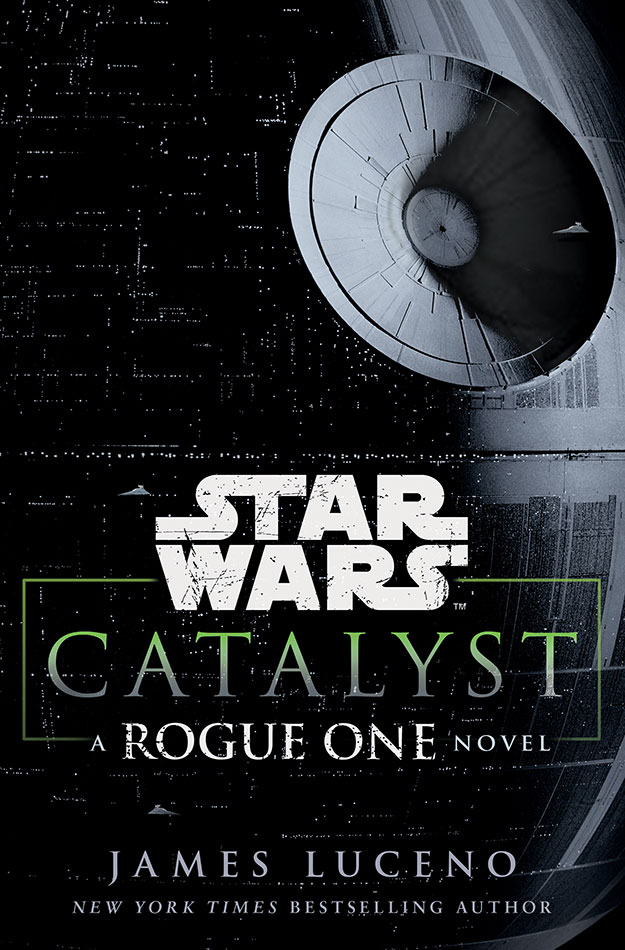
Where does Catalyst go wrong? We have a conniving power-hungry manipulator that works behind the scenes, a scientific genius with high morals, his strong-willed wife, a smuggler of some acclaim, and Governor Tarkin that is suitably patient to undermine his fellow Imperial when the timing is advantageous. It’s a varied cast that could have, should have, worked.
Nearing the end of the conflict with the Separatists, the Republic uncovers plans for an ultimate weapon. Opportunistic Engineer Krennic takes to the monumental task of managing the project to build their own, but it is quickly realized that the moon-sized battle station (even with the stolen schematics) offers nothing revolutionary, other than size. (Insert bad pun here.) The energy weapon that would one day make it a force to fear across the galaxy — and the constantly used rationale of fear-induced peace as the reason to build the dang thing — is not provided by schematic or even hinted at; Krennic, however, places his sights on scientific genius, Galen Erso. Certainly an intelligent fellow, and they have history, so he is aware of Erso’s research, but how Krennic can bet everything he has to lose and gain that Erso will unlock the secrets of the kyber crystals and unleash a new power is beyond me. For Krennic, who views everyone around him as but tools to further himself, who managed to uncover the varied and hidden exploits of an experienced smuggler, who manipulates Imperials that outrank him, it is a massive character inconsistency that grates throughout the book, for simply the one fact that he takes on Erso to create the weapon on a (wait for it): Leap of Faith.
And antagonistical masterminds with everything on the line always resort to that, right?
(And yes, yes, quick aside: The emperor is implied to have somehow manipulated/provided the schematics for construction of the Death Star, somehow washing his hands of the mess and putting it on other shoulders. But the kind of manipulation over years that this takes to accomplish leaves me still grasping for something more sensible. He’s the self-appointed emperor, with hushed atrocities happening all over the galaxy. If he wanted to build the weapon, why not just say: build it; then hand power-seeking Krennic the edict to convince his friend Galen to make the research happen. Maybe I should be emperor?)
And if that weren’t enough, the amount of resources utilized to build the battle station — literally scouring worlds for their minerals — was beyond ridiculous for a weapon, that has no…weapon. (Let’s go ahead and counter what the Separatists don’t have with something we don’t even know if we can build.) One would assume that once the schematics were revealed to have no real threat, other than size, it should have been more likely that the plans would join other data on the enemy in a giant doomium-clad filing cabinet.
This being the fundamental plot driving the rest of the story forward, it is sadly not the only error of logic. Granted, governments and law are full of inconsistency, but for me to want to read a good story, I want it well vetted. That, and these flimsy scenes didn’t have to exist; leave out the reveal of the schematics, leave the machinations of the empire and their massive construct up to our imagination.
But even if that were the case, the book suffers from contrived dialogue, uninspired prose, and as Krennic grows as the focal antagonist in the book, his manipulations stumble like a rusty droid. How a man just a few steps down from the emperor himself can flub up a conversation with the Ersos so dramatically when he knows everything they’re doing; and how they can bluntly call him out on issues that should normally put them on the other end of a discharging blaster…? Leaves me flummoxed. The reader has already been privy to the test-fire of Galen’s research, validating the power generation of the Kyber crystal. What more does Krennic need Galen for? Am I spouting into the air here? The book specifically said his research was utilized successfully; further need for Galen became unnecessary, and yet Krennic starts to act like he still is, and then Galen’s further need is restated— Despite all that we have read before.
Baffling. And not to mention the times where the Ersos realize they may be under surveillance by a ruling entity that spans hundreds (thousands?) of worlds and somehow think that using their personal com will avoid a tap of the communication. That’s not even likely in our day and age, yet alone in theirs.
I can only wonder what kind of timeframe the author had to write the novel. And what kind of editing allotment they had.
I’ve read that Catalyst shows some of the events leading up to Rogue One, and for the Rogue One fan that wants to know more, certainly you have that here, but I fail to see how the information in and of itself is sufficient reason to slog through a full length book. While certainly not poorly written, Catalyst lacks the story, the conflict, the dramatical tension that makes for good story telling.
(And there aren’t even any Jedi.)
When asked what I did over the weekend, I could take the time to break down each dish that was washed, the car that was vacuumed, the flavor of the latté that was drunk and the papers that were sorted; wasting hours in the telling if I really wanted to, or I could simply say it was uneventful with some work around the house, but relaxing. Perhaps the uber fan wants to know each and every detail, but for me, the allusion to details that are probably in Rogue One already are likely sufficient. If I happen to watch the movie and find that Catalyst adds so much more, I will let you know; but as a standalone novel, Catalyst fails to ignite.
An impotent 2 out of 5 Death Stars.
If you have read a few of my book reviews, you should know that I stick to books I like. The stinkers usually sink into oblivion. This stems from the fact that, as an author myself, it is painful to think of impacting another novelist in any sort of a negative way. There is the argument that any publicity is good publicity, and that every critical review (if well thought through) serves as constructive feedback to the publisher, to help improve books for all of us. So while other books I could not finish or failed to pique my interest might not have found me with time to review, this one I will. Star Wars is a BIG Intellectual Property with lots of money floating around and it is offensive to me when the conveyor belts of some large organization just crank out material, regardless of quality — stealing shelf space and mind space from other worthier products. You may disagree with me regarding the rating of this book, and you have that right, but it is certainly not strong in plot, character, or prose. It had potential, but I have to assume the timeline for production was so tight as to steal the light it could have held, leaving it simply mediocre.
May the Force be with you.
© 2017 Clifton Hill – Author of the Fantastical and sometimes reviewer.
www.CliftonH.com
November 2016 | Del Rey