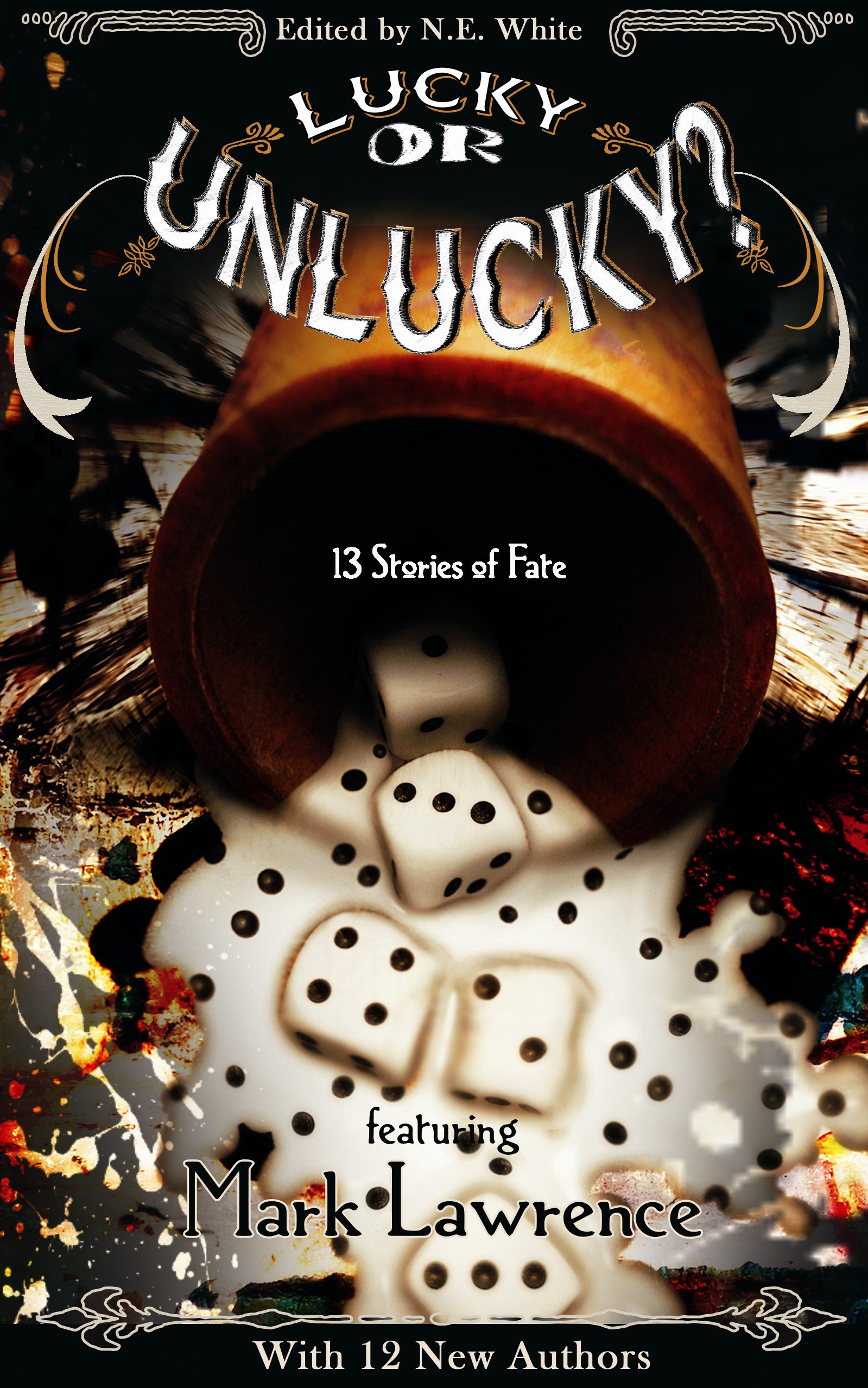
SFFWorld.com has a discussion forum where readers gather to talk about their favorite stories and writers come to swap advice. For the past two years, we’ve wrangled interesting tales from our forum writers to compile two collections. Our latest anthology, Lucky or Unlucky? 13 Stories of Fate, feature the number 13 in some capacity. In some cultures, the number 13 is considered a good omen. In others, it is a number to be shunned. But in the story we’d like to share today, the number 13 takes on a whole new meaning…
Fold
by Charlotte Ashley
There are only two settlements on Allie: the Snag, and Beauform. We had always known that if anyone escaped the Snag, they would make for Beauform. They had to. There was nowhere else to go.
Sure, there were the guards, and the escapee would have to cross miles of barren, snow-covered terrain to get to us, but these guys could do that, they could handle that. They were resourceful, and they had unexpected skills and abilities. If they escaped, they would come here.
At the end of the day, it was my job to make sure they couldn’t escape. In college, I folded 1,000 paper cranes and hung them in the Bahen Centre’s Lobby. Now I fold aluminum boxes for people. Now, I fold prisons.
* * *
In a lot of ways, Allie (or Al/13, if you live in the Snag) was a paradise for a guy like me. The planet was hospitable enough—by which I mean the water wasn’t toxic and your head didn’t explode when you went outside—and building materials were virtually limitless. I could make anything here. Anything that could be folded out of aluminum, anyway, but that really was almost anything. Space for building also felt limitless. If I wanted to build a 22-room mansion adjacent to my own private amusement park, I could do that here. People did do that here.
Beauform was a great, tight-knit, vibrant little place filled with interesting people. We were all designers or maintenance-people, farmers and cooks and architects. We were people who made stuff, who built things. There wasn’t a man or woman that didn’t have what your grandfather might have called “get up and go.” Everybody here had three projects at any given time. We built, we experimented, we shared and we created. I love Beauform. But we wouldn’t exist without the Snag.
* * *
It was Lundsday morning and I was on the tram to the Snag with pretty much everyone else. Unlike everyone else, I could usually work from home, but I had a meeting with the Warden about a particularly problematic inmate and he wanted me to see what he had done to my last trap. I had seen; they’d sent me hirez stills as well as footage. But the Warden felt I should see. I think he wanted to scare me, to drive home that if I wasn’t up to this task, we were all in a lot of trouble.
As if I didn’t know that. But up the labyrinthine chain of command, the Warden was my boss, and so I went, trying not to grumble too much as I stomped my feet and tucked my fingers into my armpits alongside my stoic neighbours. They looked past me, out the windows at Allie’s landscape, wisps of snow blowing across the glaciers that covered the rusty land bridges between the lakes of liquid aluminum that gave the planet its name. The sun was a few thumbs over the horizon, small and red, and over the hiss of the tram’s rails you could hear the ice groaning and snapping. I found myself holding my breath, as if sitting perfectly still was going to lessen the likelihood of a “transportation incident,” which was what they called the devastating explosions that resulted if the rail arced and a glacier off-gassed at the same time. Transportation incidents were common enough that on any other planet, we’d have redesigned the transportation system by now: but on Allie, we built with aluminum or nothing. Lucky number 13. Regular commuters travelled with the spooky calm of dyed-in-the-wool Nihilists. It was all I could do not to shit my pants every single time I rode.
I drew my tablet out of my pack and flicked on my stylus, trusting work to keep my mind off the odds I would be randomly killed this morning. I had my next design ready to show the Warden, if he turned out to be interested in solutions rather than just obsessing over the problem. The inmate—referred to in the parameters as SAM46629, but whose mother had named him Agustin—had escaped two of my traps now, and both times had been due to “manifestations of unforeseen variables.” That was what they called it when the time bombs they had locked up in the Snag suddenly developed new superpowers. It happened pretty regularly. Most of the inmates knew they were dangerous and chose to submit themselves to the system so that when their genemods activated there was a trained team there to help them. They weren’t psychopaths, just stressed-out old Marines with a seriously shitty medical condition. They were, mostly, pretty happy for the care they got in the Snag.
Not Agustin. Agustin wanted out. He wanted to go back home—for reasons which might be really good, for all I know—and he was prepared to do anything he could to get there. I felt bad for the guy, but the harder he pushed, the harder we had to push back. The last two traps I’d built for him were pretty cushy. Comfortable, portable, and frankly, pretty stylish. I wasn’t going to be able to do that this time. The Warden was going to need assurances that SAM46629 was going to stay in the box I put him in, no matter what “new variables” might crop up.
I doodled a while, rendering a tricked-out, 30-module kusodama, then I pulled out a sheaf of aluminum foil squares and started folding. Fully assembled, the kusodama would not only be super-reinforced, but the living space at its centre could be latticed, allowing the free flow of air while maintaining the cage-within-cage structure. I finished folding 12 modules before the tram rolled past the Snag’s outer perimeter, and I locked them together into a mock-up that would at least give the Warden something to touch and feel, to punch and test.
I stashed the model before we disembarked at the sally port, standing and lumbering towards the doors with the rest of the workers. The air was crisp and light in the outer courtyard, but I couldn’t stay for coffee and breakfast. I made for the gatehouse, steeling myself for the security procedures that would clear me to enter the heart of humanity’s most remote military supermax prison.
* * *
Agustin’s trap had been peeled open like a banana. Strips of aluminum curled back in all directions like a starburst; like an octopus beached and dumped on its head. Like a heap of scrap.
“Where’s Agustin?” I asked, noting a muddy, black stain along the torn edges of the aluminum peel, a detail which I hadn’t taken note of in the stills.
“SAM46629 had to be tranquilized. He took more Ketamine than a herd of elephants. The doc thinks he should be in the hole for a couple of days, but.” The Warden gave me a meaningful look. But Agustin always exceeded our expectations. I nodded. The Warden was a good guy, respectful of competence and hard work. He was a career bureaucrat despite his military rank, a manager of the first degree. But like so many good managers, he got frustrated when things stepped beyond his control. This Agustin thing was an insult to his own competence, and he was going to buckle down hard to fix it. No more Mister Nice Guy.
“Is he okay?” I had to ask.
“Maybe you should see yourself. He ripped himself up pretty good tearing through the sheets,” Warden Khan lectured me as we passed through the corridors towards the infirmary. “He wasn’t careful. He started just before dawn yesterday—probably thought he’d be out before they came to bring him breakfast. It’s a forty-minute window. But one of the other inmates heard the screech of metal. They were worried about sparks, about getting blown up. He was almost out when the subdual team arrived. It was a close thing. Damn close.”
I exhaled, stressed. Agustin was a model Marine—polite and respectful in the face of authority, but absolutely an ends-justifies-the-means kind of man. I could imagine him getting his huge, modified biceps up through the star-shaped skylights and ripping up the metal, calm and detached from the devastating damage to his flesh. If he was willing to tear through himself to get out, he would tear through any of us.
“Here.” the Warden held open the door for me. Agustin wasn’t the only prone body in the wide room, but he was the biggest. That had been his first mutation: a 40% increase in body mass almost overnight. He’d gone from a lean, hardened soldier to a bulked-out monster over six painful hours and hit the ground running. He’d torn the door off his cage and used it to restrain the first four guards that had tried to lock him down.
The straps on the medslat were obviously just there to make the doctors feel better. Even I could tell they wouldn’t hold the man down if he had control of his faculties. He’d been stripped to the waist and the meaty flesh of his forearms, biceps, deltoids and pectorals were scored with deep incisions, now cleaned and stapled. There was something wrong with the angle of his collarbone. His thick neck looked too long, or his shoulders too low. His ribcage seemed to have folded over his stomach and the muscles of his six-pack were skewed and disordered like a heap of toy cars.
The Warden took me by the elbow and pushed me another step towards the medslat. “His last mutation gave him some kind of ability to collapse his skeletal structure. Like a fucking raccoon. He got his shoulders through the air vents and tore—”
A strangled hiccuping sound interrupted us. Four alarmed medical staff skipped towards the exit, swapping places with twice as many heavily armoured guards bearing dart rifles. But the mangled body of Agustin didn’t move, and the hiccups bled into an animal moan. After a few tense moments, the medics crept back, nervously looking at readouts.
“What? What?” The Warden had pulled out his own tranq pistol, and glared at the doctor.
“I’m awake, Warden,” Agustin’s voice was muddied and imprecise, “dooooown at the bottom of the hoooooole.” His deep, clucking laugh sent shivers up my neck.
“He can’t move, sir,” the doctor sounded relieved. “The Ketamine is still working.”
“I need two days for the new trap,” I couldn’t help saying. “Can you keep him like this another two days?”
“Is that you, Trevor?” Agustin asked after a pause. “I can’t turn my head.”
“Yah, man.” I stepped closer, but the guards wouldn’t let me get within arm’s reach. “You alright?”
More laughter. “Your traps are sharp, I’ll give you that. But still weak. They will always be weak, Trevor. You can’t keep me in with aluminum.”
I felt blood flood my face. “I can, and will,” I said, “if you insist on pushing me.”
“Oh, I’ll push.” Even with the frozen-mouth drawl of a dental patient, Agustin’s voice was thick with threat. I stepped back. “I’m sleepy, Trev, but we’ll talk. When it’s time for me to go, I’m coming for you to get off this ice-block. You’re so clever… with these… whachacallum… origami… friggin’… triksssssshhhhhh….”
“I can have the new trap built today,” I muttered at the Warden as the doctor checked Agustin’s vitals. “The team can assemble it tomorrow morning. Tell me that’s quick enough.”
“This flower-thing.” Warden Khan sounded skeptical.
“It’s called a kusodama. It’s a modular sphere containing 30 pieces which reinforce—”
“I know, Jesus, Trevor, I read the brief. But honest to God. Your design is all air. Look at him. Look at what he did.”
“I know, I know. But that trap was a single layer, designed to withstand blunt force trauma. Each module of the kusodama is double-folded and reinforced by the neighbouring modules. Force exerted in any direction is redistributed along a minimum of eight lines, each of which is reinforced by eight lines again—” I was babbling, to convince myself as much as anyone. “And we don’t have to make it latticed if you think he’s going to slither between the bars somehow. It could be solid, with a non-contiguous ventilation system.”
“What’s the highest gauge you can do on this?” the Warden demanded, and I licked my teeth and looked away from him.
“12-gauge at the most.”
“He will tear that up like pap—”
“I can’t fold anything thicker, Neil!” I spoke over his objection. Guards inched away from us as our voices became raised. “We have to rely on finesse this time, not strength. I’m sorry, but this isn’t Earth! We can’t weld together 6-gauge steel sheets here! But this is better! We have physics on our side. Trust me.”
This last statement hung in the air between us. His heavy black eyebrows dipped deep over his eyes and he pressed his lips together until they disappeared beneath his goatee.
“Tomorrow morning?” he confirmed. I nodded. “Fine. We’ll install him in a giant flower. But Trevor,” the Warden glared at me, “if he gets out again, we’re going to have to put him down.”
Assuming he didn’t get away, of course. Assuming he didn’t come for me in Beauform.
* * *
I threw myself into construction back home. This was where magic happened, here in my workshop. Beauform was kitted out with the most cutting-edge printing system known to man, and with it, we had built a society.
The first colonization team to arrive on Allie had brought my printer with them. We’ve built more since then, but mine was the original: a 40,000 gallon tank the size of a swimming pool framed with precision seed coders. It was a simple beast built on 19th-century technology: fill the tank with the super-saturated aluminum solution that lapped in vast quantities all over the planet, then catalyze a solid condensation with a seed of pure aluminum. The printer’s coders guided the formation of the solid, causing the metal to harden in vast sheets, as aluminum is wont to do anyway. Then, with no melting, welding, or cutting required, the specially designed sheets could be folded into—well, anything. That was industrial origami; that was my job. I was a master.
We ran all five of Beauform’s printers all day, extracting 30 sheets perforated exactly to my specs. I sent my apprentices along with a team of labourers on the evening tram with the sheets, bidding them a reassuring adieu as they trundled off to the Snag where they would begin folding the modules of Agustin’s new home. All in a day’s work.
I already had other designs forming in my mind before I’d returned to my workshop. I was in the zone now, thinking about shapes and folds. Agustin’s new trap, not yet assembled, was bustled off to the dimly acknowledged “completed” box at the back of my brain, though the problem of Agustin—or future Agustins—was not.
My feet clanked on the patterned floor of the covered walkway from the tram station to the waste processing station where I hoped to find my friend Ruby. The plant’s pumps were roaring away, relegating the byproducts of my day’s work to enormous tanks that rarely got to see this much action. I clambered down the spiral staircase onto the plant floor and made for the light in the control room, not bothering to try to announce myself over the cacophony. Ruby looked bored until she spotted me, at which point she leapt out of her chair to throw herself at me with an overenthusiastic greeting.
“Trevor!” she exclaimed, hugging me around the chest, her raven-haired head coming no higher than my chest. “Oh, thank God! This is going to take hours! Nooreen is staying with Pinky while he’s sick, and I didn’t bring a book—d’you wanna play cards? Sort the recycling? Did you bring a project with you? Can I help?”
“Yah, sorry,” I extracted myself and sat on a wobbly chair nearby, stashing my satchel under the desk, “we had a big assembly to print out today.”
“No kidding! I have over a million gallons of cryolite here thanks to you. Like I said—it’s gonna take forever to process. I assume you’re here to play with me to make up for it.” Ruby crossed her arms and narrowed her black eyes at me, mustering all the threat of a sleepy housecat. I put my hands up in mock defence, though I had to smile.
“I actually wanted to talk to you about the cryolite. Can you spare a few of your busy moments to talk shop? Okay—cool. Uh, Roobs, if I pump out the cavity under the hydrofarms, can you find something else to do with the waste? I mean, can you leave it empty, rather than pumping the cryolite back in?”
Ruby balked at me, then pushed her glasses back up between her eyes and adjusted her seating.
“Trevor. What do you think I am going to do with 200,000 gallons of cryolite? Make an acid bath? Dispose of bodies? This stuff is technically a controlled substance.” She laughed nervously, “Is this for Warden Khan?” I shook my head, and she scowled. “I know oversight is light out here, but I’d have to report that. Or better still, say no. What could you possibly need a 30,000 cubic foot hole in the ground for?”
“I was thinking—I was thinking we need to start building down. Underground. You know.”
“It’s hot underground,” Ruby pointed out. “And you’d be running a pretty constant risk of hitting an aluminum chloride vein.”
“It wouldn’t be for permanent residences.” I flushed.
“Is this for a new trap?” I shook my head. “You want to build a hidey-hole.” Ruby sat up, surprised. She glanced at the monitors, then back at me. “In case someone escapes the Snag. But I thought nobody could escape the Snag. We’ve been here twelve years. Nobody has ever—”
“I just think it would be smart,” I interrupted, standing abruptly. Ruby looked alarmed, and I realized I was more bothered than I’d thought. Sure, the Snag has stood for twelve solid years. But things were changing. I had been there, I had seen. The first inmates were in the early stages of mutation. Their genemods gave them incredible strength, great reflexes, eagle-eye sight—stuff that was invaluable to a soldier’s life. Their rogue mutations were unstable, freakish changes that often hurt or crippled the soldier. They needed to be contained, to keep everyone safe, but the violent outbursts were brief, manageable.
But Agustin was something else. His mutations were all beneficial. They didn’t seem to hurt him. He just kept getting better. I don’t know if the genemod technology was changing or what, but I was starting to feel like the Snag was becoming less of a rehab centre and more of a remote dumping ground. Somewhere up there was a military brass tinkering with experimental gene sequencing technology, and leaving us holding the bag. I couldn’t help but think they’d decided an escape scenario wasn’t their problem. I couldn’t help but think we were on our own out here, and we’d only been lucky so far.
“Trevor,” Ruby said quietly, “are you telling me you can’t keep them in anymore?”
“Of course I can,” I sighed. “But part of keeping them in might mean being able to step out of the line of fire once in awhile, you know?” I smiled, trying to look confident. “It just might mean we need a hidey-hole.”
Ruby looked at her monitors again, considering.
“I could pipe the cryolite into Lake Daxiong,” she conceded. “But it would take ages for it to become homogenous with the rest of the lake. You wouldn’t be able to use it for construction anymore. Not for a good long while. Years. Decades, maybe.”
“There are other lakes.”
Ruby nodded. “30,000 cubic feet…that’s not very big. I assume you’d want the whole town in there. It would be snug.”
“It wouldn’t be for long—”
Ruby waved her hand at me to be quiet, annoyed. “You could get a permit, you know. Clearance.”
“I’d like to start immediate—”
“Trevor!” Ruby silenced me. “Is something coming? Why the hurry? Should I be worried?”
“I don’t know,” I admitted, taking my satchel in hand. “I just want to be ready. I want to build a new trap.”
“The hole is for hiding, right? Trevor?”
I nodded. Ruby’s eyes went wide anyway. We started making plans right then.
* * *
The ice groaned a lot lately. Maybe I was getting paranoid in my old age, or maybe the weight of the town was putting a lot of pressure on the glaciers, it was hard to know. It was Ruby’s job to know, and she didn’t seem worried. “Let them off-gas,” she’d say, “as long as nothing combusts, the gas can’t ignite.”
Everything on Allie was built to work without combustion, though sparks were sometimes inevitable. We just did what we could to mitigate that risk. Transportation was the riskiest thing we engaged in. If you could walk somewhere, you did, all bundled against the subzero winds in your thermals. The trams were…well, the trams. Offworld flights all departed from close orbit, from a thinly-manned flight dock reachable by elevator. The elevator could only carry a few people at a time. It was hardly feasible mass transportation.
I had been working on a glider design for some time now, and this seemed like a good time to start construction. We’d injected the pumps into my underground cavern and started to drain it, and the aluminum had to be used for something. We had hundreds of thousands of gallons of the stuff. This went beyond our usual scale of construction, beyond furniture, art projects, foil textiles, or flatware. I’d have to build something big. So during the two weeks it took to prep our hole, I built the glider.
Every kid in the galaxy can fold a paper airplane. I’d won competitions with mine when I was growing up back on Earth. This was no different. Aluminum was fantastic for aircraft—slick and light at an atomic level, 13 protons, 13 electrons and a fluffy, fat-free centre. What it wasn’t was very strong. Aluminum has what they call an “unpredictable fatigue limit,” which meant that it might hold for a long time, or it might crumple without a moment’s notice for no good reason except that 13 isn’t a good number for a solid, symmetrical molecular structure. But origami had that problem long before industry did. Paper isn’t strong enough to contain a good-sized kitten, and yet if you fold it just right, you can build a structure strong enough to stand on. Folded aluminum creations could be almost indestructible. It was all about the physics.
Once we’d folded it, the glider looked good. The body was 40 feet long and thin, with a big dorsal fin. The cockpit was latticed to redirect air while maintaining decent visibility. The wings were long and wide, running the length of the body, and angled ever so slightly upward, with an acute upward fold at the tips. A wedge under the nose could be controlled with a pedal to adjust altitude, and nubs on the wings controlled steering. I was having trouble with landing gear. I couldn’t work out a way to extend wheels without risking arcing. As much as I wanted to fly, I wasn’t willing to be blown up over it. So I tinkered.
“That’s poetic, Trev,” Ruby quipped, coming up behind me as I sketched plans. “Out of the earth and into the air! Could this thing reach the flight deck?” She paced the length of the craft where it lay in triage in my workshop.
“Maybe,” I said evasively. Admittedly, the glider looked more like a rocket. That was the twelve-year-old in me. I’d always wanted to fly a spaceship. “It’s designed for lower altitude travel…”
“How are you going to get it off the ground? These things need to start high, don’t they?”
“It uses a winch-launch,” I explained. “Or maybe I’ll get some of the inmates to carry it up Mt. Joshua for me. I’m sure the Warden would be willing to reward a few of his hulks with a day in Beauform.”
“Ha ha.” Ruby looked queasy. “So speaking of which. Your hole’s empty.”
“What?” I spun around on my stool, dropping my tablet. “Already? I thought you were going to need weeks for the entrance?”
“Yah, me too. But I was able to break up the metal at our entry site with some superheated boring injections. Crumble ’n’ scoop, easy-peasy. It’s pretty in there, too. I left a coating of cryolite to cool. It’s all crystal-y!”
“Crystalline.”
“Shut up, Trevor, you’re not a geologist. It’s crystal-y. More important, so gorgeous! When do we move in?”
I laughed. “Let’s, you know, keep the place quiet, okay? Hidey-hole. We can’t exactly hold a launch party down there. Give me a few days to install some furnishing, some life support systems… We’ll have a camp-out, you and I. It’ll be fun.”
“It’ll be toasty. The geothermal in there is nuts. But yah, we’ll have a blast. You’ve seemed tense lately, Trev. I think this’ll be good for you.” Ruby had moved back to my side, and she put a sympathetic hand on the back of my neck.
“Mmm, that feels good.” I closed my eyes. It did. I’d been hunched over my tablet all day every day for two weeks. I felt like I’d become a hunchback. Ruby tucked her little fingers into a fist and started rubbing her knuckles over my knotted muscles and I couldn’t help but go slack, turning myself over to her expert care. It was nice, and more than that, reassuring.
“Trevor!” The boy’s voice startled the shit out of me and I almost fell off my seat trying to get into a flight position. I started to laugh at my own absurdity until I saw the look on his face: the whites of his eyes, the tug of his lip as if he was struggling not to cry. He’d been my apprentice for two years now, but he was only fifteen.
“What? What happened?” I started walking towards him, instinctively taking Ruby by the hand.
“They just radioed in…the Warden…the guy, the SAM4—uh, 3…Agustin, Trevor! He’s out.”
I looked at Ruby, who just stared in disbelief. I wished I could apologize for this. “How long?” I asked, finding my mouth dry.
“Twenty minutes ago. They managed to hit the disassembly on the tram, but he has the Warden’s gear and his—he took everything from the Warden.” The boy stumbled over that part, and I closed my eyes. I’m sorry, Neil Khan. “He’ll just walk, won’t he? He’ll be here.”
“It’s a long walk. Even at a jog it’s three hours. At least. But it’s okay.” I looked at Ruby again and squeezed her hand. “We have a plan.”
We’d always known someone would come for us in Beauform eventually. It was time for Agustin’s last trap.
* * *
Evacuating everyone to the hidey-hole—hastily nicknamed Ruby’s Retreat—took slightly less than an hour. We’d wanted to build a tunnel from town to the Retreat, but we’d run out of time, so all 237 residents of Beauform were marched across the frozen waste nervously clutching packs full of flashlights, dried fruit and playing cards, driven by Ruby’s grim efficiency and the horror that followed in the wake of the rumours that took approximately five minutes to reach every ear in town.
One of the prisoners has escaped. He killed the Warden and half a battalion of armed guards—tore them limb from limb. He’s as big as a bear. He’s immune to tranqs. He’s half-man, half-snake. He can’t be killed. He doesn’t want us, just what we have. Just leave it. Leave it and go.
In fact, we didn’t know what his new mutation might be. My boy had taken the message, and he’d been too scared to ask for specifics. I could only imagine how Agustin could have got out of my trap. Maybe he’d shrunk, small enough to stroll out the ventilation system. If only.
I was the last to leave town. It had been easy to justify, given my leadership role in our evacuation, but Ruby hadn’t been happy about it. She’d gone first, to lead the way. She wanted me with her. To be honest, I was surprised by how powerfully I wanted to be with her. But I had one last thing to deal with.
I rolled up the curtain wall of my workshop, admitting a harsh blast of frozen air. My workshop faced the east, towards a thin tongue of Lake Xiaoxiong and the glacier bridge that led to the tram line. Dressed in my thermals, I jogged out towards the lake, anchored my winch, and hauled the long rope back to my glider, tying it to the nose of the trailer. Then I raced back to the winch and hit the big yellow button.
This sucked as a one-man job, but I had no choice. The winch shook and wobbled as it drew my plane out of the shed, narrowly avoiding clipping the frame with the starboard wing by half a foot. Once the glider had trundled clear of the shed, I shut off the winch, wheeled the trailer around by hand, and turned to move the winch again, extending it to its full 1000 foot length, then turned to jog back down the glacier strip.
“Trevor.”
I winced at the voice, and turned slowly. Agustin seemed posed out there on the snow, an imposing statue of cut muscles and throbbing veins carved from russet sandstone. He’d stripped almost naked, clothed instead with straps and belts holding weapons, tools, harnesses and supplies. His flesh was a dark rust-red, and even at this distance, I could see a squall of steam rising from his skin.
I held up my hands. “Agustin,” I greeted him. “What can I get for you?”
“Good answer.” He crossed the distance between us with a shark-white grin plastered to his face. I didn’t dare move a muscle. “I knew you’d have a solution for me. You have a solution for everything.”
“That’s what I do.” I tried to look relaxed and jovial, knowing it was absurd under the circumstances. At closer range, I could see Agustin was deeply uncomfortable. He was sweating buckets despite being fully exposed to the deadly-cold air, and his breathing was laboured. He ran one hand over his bald head, gathering a mitt-full of sweat. It was ice by the time it hit the ground. He looked over my shoulder at the glider.
“Going somewhere?” he asked.
“Not if you don’t want me to,” I chose my words carefully, eying his foot-long hands. They seemed studded with metal, accented with char. I realized belatedly how he must have gotten out of the trap. He’d melted the aluminum.
Somehow, he’d become a human heat inductor. I swallowed, brain humming at the implications. Just keep him stable. Don’t get killed before you’ve had a chance to think. “I’m the last one here. If you need my help, I’ll give it. Just don’t—you don’t need to—” I stuttered, the words needed to beg for my life not coming easily.
“They’ve all gone, hey? Evacuated, I guess? This is it, then? The last train outta Dodge?” He stepped towards me, and it was all I could do not to step back. I wanted to keep his attention on the glider, away from the footprints Ruby had left behind on the exodus to the Retreat. “I don’t suppose it seats two?”
It didn’t. I glanced over my shoulder at the glider, then back at Agustin, affecting a pained look on my face.
“Please,” I begged. “Everyone I know—all my friends, all my neighbours…”
“Your friends?” Agustin spit, suddenly angry. He wiped another fistful of sweat off his face in frustration. “Your neighbours? You haven’t been locked in a box for two years. You weren’t put on a one-way ship to an iceball limbo for the crime of doing your job.”
“I understand, Agustin. I just—”
“If you understand, than shut your mouth now and stop asking for consideration you don’t deserve! I should light you up for those traps. I should turn you into a candle wick, like I did the Warden.” Agustin reached his big, red hand towards me, steaming. My thermals were foil, but my flesh wasn’t. The way the ice had been shifting lately, I knew he could not only burn me to a crisp, but set off half the town. He must have understood the look on my face, because he burst out laughing. “But I’m not going to risk blowing up your pretty ride, Trevor. You’re lucky today. I just want a ticket home. I am going to get on that evacuation ship,” he pointed at the sky, “and it is going to go where I want it to go.” He stepped closer to me, and the heat coming off his body was blistering. I looked away, cowering. “I think I might just go up there and slaughter your whole damn town!” He turned and paced a few steps away, tripping over his own feet and laughing. “I should! That would serve them right. If they think I’m an enemy, I’ll show them what an enemy I can be! They have no idea! No idea!”
He was shouting now, and his body seemed even redder than before. I needed to say something, for him to see me scared. I just wanted to go hide with the others, but he would find us all if I didn’t do something.
So, I bolted. I ran past him, ducking under his big arm as it came around to clock me, racing for the winch. He seemed to take a minute to react, shaking his head as if he was dizzy, then making a staggered start after me. I jumped, diving into the ice and smacking the power button hard as I hit the ground next to the winch. The rope started winding, and I hammered it two more times, setting it to full speed before rolling onto my back and bringing my arms over my face, in case Agustin was there to crush my skull.
He wasn’t. Sometime during the last thirty seconds he had turned and made for the glider instead—hauling himself onto the trailer and starting to pry open the cockpit.
“Wait!” I screamed, attracting his attention again. I started moving my hand over the button, but Agustin reached into a holster, drew out what I can only assume was a weapon, and fired it at me. The whole motion played out in less time than it took me to draw a breath. Pain exploded under my ribs, cold like lake water. I looked down to see a long-nosed dart protruding from where I imagined my spleen might be under my thermals, and the next thing I knew all I could see was sky, endless sky. The woody grind of the winch churned in my ears like trapped water and the red-hued clouds far above me seemed to blow by at the same rate. The glow of the sky was almost unbearable, like someone had ignited all the neon in the atmosphere.
Something hit my legs, a solid nudge just before the winch ran out of rope to reel in. The glider passed over my head so close I could have touched it, if I could move my arms. I willed myself to roll over, to move. The red sky eventually rolled for me, and I knew only from the snow in my nose that I’d managed to move. I pressed into the ground and looked up after the glider.
He had launched. He was getting good altitude, too. The glider banked pretty steeply, reaching 1000, 2000 feet before turning. The craft came around then, swooping in a wide arc back towards the elevator to the flight dock some ten miles from town. I could see the slice across the sky on a clear day. He banked harder as he circled upward, soon little more than a twinkling red bird over my head. Come on.
Then came the fold.
I didn’t see it, but I heard it. The bang of two aluminum sheets snapping together at high pressure. My shining red ship continued sailing across the sky, but it was losing altitude. As the shape grew bigger and bigger, I could see it was now more of a square than a triangle. I breathed a sigh of relief. I struggled to sit up and squirm past my trailer just in time to see what was left of my glider plummet into Lake Xiaoxiong. The structure had entirely collapsed, now little more than four thick layers of metal folded flat along straight lines. Just like it had been designed to be.
It was a long time before I could stand up and walk around, but it took my glider a long time to sink into the lake, too. There was nothing left alive inside; no monster climbed out. The higher pressure air in the cockpit had evacuated at high altitude, blowing out lode-bearing angles. Agustin might have been crushed, or he might have been sucked out the tiny evacuation holes, but he was certainly dead. Put down. Like the Warden had promised.
I went to get Ruby and my neighbours, to tell them we were safe. That it had worked.
I’d caught Agustin in my last trap.
* * *
Charlotte Ashley is a writer, editor and bookseller living in Toronto, Canada. She reads slush at Lakeside Circus, review short stories at Apex Magazine and has had her short fiction appear in several anthologies, including Crossed Genres‘ Fierce Family ed. Bart Leib. Her story ‘The Posthuman Condition’ will appear in Kaleidotrope in 2015. You can follow her bookish wanderings at http://www.once-and-future.com.
If you liked this story, please consider purchasing the entire anthology for a whole buck on Amazon, Barnes and Noble, Kobo, or Smahswords . First year’s proceeds will be donated to the Children’s Hospice in the U.K. Thanks for reading.