It’s been a while since I read, never mind reviewed, any of Dr. Bova’s novels. In fact, the last one I reviewed was the Ben Gunn anthology, The Sam Gunn Omnibus (2007) back in, erm… 2007.
So what do we have here, eight years on? For those who don’t know, for over two decades Ben has been creating his own series of novels (The Grand Tour series) which explore different planets (and in this case, satellites) of the Solar System.
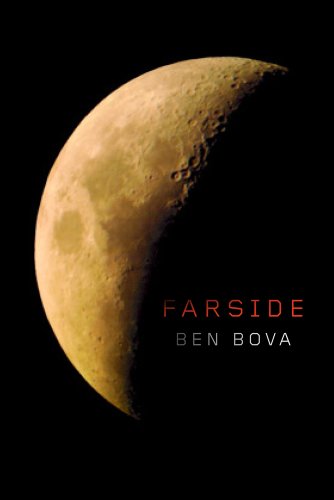
Here, in Farside, the spotlight is on the development of a huge radio-telescope array being built on the far side of the Moon, shielded away from any of that annoying radio-wave chatter from the Earth. As this is a solar system built on private enterprise and profit, then part of the novel’s tension is created by the race to completion between the Moon-based Cyclops array at Farside and the IAA creating a just-as-big interferometer out in space. Whichever finishes first and gets data on the recently discovered ‘New Earth’, Sirius C, will get the media attention and glory, not to mention the associated research contracts.
The cast list of this cinematic escapade is appropriately multinational, and as befitting a space opera, each bringing their own personal issues to the plot. We begin the book by meeting Canadian Trudy Yost, the new young assistant-astronomer being sent to the Moon to help with the construction of an optical interferometer on the Farside. On her journey there Trudy meets her object of lust, American Carter McLintock. Carter is the administrative manager for the project leader at Farside, there to help, but also to determine whether his wealthy family should invest into the observatory project.
Trudy and Carter’s arrival at Farside leads us to meet others in our list of characters there. Austrian Dr. Jason Uhlrich is the driven project leader, determined for a last chance at achieving a Nobel Prize for his work at Farside. We also meet Grant Simpson, a South African construction manager on Farside, another character who finds Trudy attractive. Anita Marie Halleck is a character that has been in earlier books in this series, and is the Australian Director of the competing IAA project. Dr. Kristine Cardenas, the world’s leading nano-technologist is a character brought in to assist with solving a mirror problem.
Life on the frontier is tough. The moonbase at Farside, we are repeatedly told, is cramped, oppressively small and uniformly grey, both in colour and design – functional, rather than luxurious. The whole project is developed with the idea of keeping costs to a minimum, with no frills – as was the American frontier towns of the Wild West, something which Ben is keen to point out:
“Space is where the action is, boy,…. ‘It’s the frontier now and the frontier is where new fortunes are made.”
This idea of ‘expanding the frontier’ fits the template I first encountered back in books before The Grand Tour series, with Colony in the 1980’s. What we have here in Farside is the continuation of a number of themes from earlier books and throughout the other Grand Tour books, which creates a consistent background to the series. Climate change has flooded much of Earth, (see The Precipice, 2001) which has led to increased exploration out into the Solar System, often pushed forward through private industrial funding (see The Asteroid Wars series, 2002-2007). However, expenditure is constantly monitored, for the risk of flagrant overspending means the closure of the projects. Science is rather regarded by many with some suspicion as we have the abolition of stem-cell techniques and nanotechnology research on Earth (see Moonwar, (1996) and Moonrise, 1997). The effects of constantly living in this rather dangerous environment are also raised again, with many of these explorers of the new frontier are dependent upon drugs/narcotics/alcohol for their survival (see also The Trikon Deception, 1992)
With such a broad background set-up, in Farside the plot here is all fairly straight-forward. There are no major surprises here. Ben sets an Analog-style mystery (scientists put in jeopardy and have to solve puzzle though investigation and research) and then gets his characters to solve it. Much of the book sets up what will presumably be the next book, for we are constantly reminded that this book is just one element of many and has a background and a foreshadowing of things to come.
Have things changed much in these books in the last eight years? Not really. Farside is a comfort read, rather than something that pushes the genre. The reader knows what they are getting and the story provides it. But then I suspect that that is part of their charm, as Ben interweaves the different characters and plots into his own Solar System series. The chapters are all fairly short – two or three pages – and this allows Ben and the reader to follow the plot without too much effort.
Farside is a book that you can read quite happily without reading the earlier books, and I suspect that if readers have managed so far in this series, then I think they will want to continue, to see where it is going. This creates both a comfort and a limitation. Whilst the sense of credulity is rather stretched at times to fit the convoluted plot, the dialogue at times can be a little creaky and the characterisation is rather slim, it must be said that I found it entertaining. It is stridently solid, and determinedly un-flashy or over-written.
In the end, although I enjoyed Farside a lot, I can see why many more recent converts to SF wouldn’t be impressed with its old-school tone and style.
Farside by Ben Bova
Published by Tor, February 2013
368 pages
ISBN: 978-0765323873
Mark Yon, January 2015.