

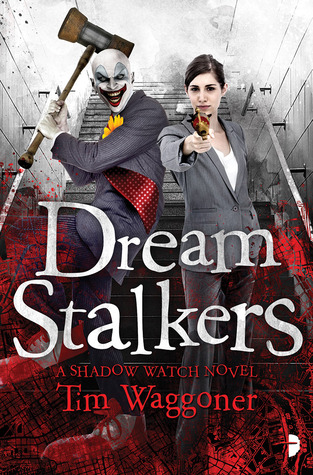
“A new drug – Shut-Eye – has been developed in the dreamland, and smuggled into our world. It’s addictive, and dangerous, and Shadow Watch agents Audra and Mr Jinx are on the case, preparing new recruits to deal with the problem.” We have talked to Tim Waggoner about his Shadow Watch series and the second book Dream Stalkers.
First of all can you tell us a bit about your Shadow Watch series?
There are certain powerful dreamers called Ideators who can literally bring their nightmares to solid, three-dimensional life. To make sure these nightmares-made-flesh behave, the officers of the Shadow Watch patrol both Earth and Nod, the city of nightmares, and do their best to keep the chaos to a minimum. The series focuses on two officers, Audra Hawthorne and her nightmare clown partner Mr. Jinx, who more often than not function like two especially clumsy bulls in a very expensive china shop.
Dream Stalkers, your second book in the series is being released soon. What can we expect?
As Audra and Jinx begin to work on a case involving Audra’s mentor in the Shadow Watch, bits and pieces of reality begin to disappear around them. They need to find out what’s affecting reality and reverse the process – if they can — before all existence is gone.
There’s even more wild action in this book than in the first one, Night Terrors, and the relationship between Audra and Jinx deepens – especially when they find themselves switching bodies now and again. The world and mythology of Nod are developed more as well.
A supernatural agency dedicated to hunting down rogue nightmares. How did you come up with the idea for the Shadow Watch series?
For years I’ve wanted to write an urban fantasy series using dreams as the basis for the setting’s supernatural elements, but I wasn’t able to make it work. I kept thinking of the waking world and the dream world as separate. But when it occurred to me to embody a person’s nightmare a physical being – one that’s bound to him or her for life – the concept finally took off.
Audra Hawthorne and Mr. Jinx, the psychotic clown. Can you give us some insight into your main characters?
Audra is a woman in her twenties who’s hard a difficult time adjusting to being an Ideator. Her biggest adjustment is learning to live and work with her worst nightmare brought to life, but since Jinx is an Incubus (a Latin term for nightmare), during the day he becomes an ordinary human with a very different personality. He’s like a combination of Jekyll and Hyde and Felix and Oscar from The Odd Couple. Audra finds herself having to ride herd on Night Jinx to keep him from destroying everything in sight, and she has to put up with Day Jinx acting like a disapproving paternal figure toward her the rest of the time. She’s has to do a lot of mental and emotional gymnastics when dealing with Jinx.
Jinx is half id and half super-ego, and both sides are determined to be as little like each other as possible. They have very different relationships with Audra, but deep down both care for her deeply – not that either of them is comfortable showing it. Day Jinx wants to take care of Audra and make sure she does her job right and stays healthy. As Night Jinx would put it: “I may be a monster, but I’m her monster.” He loves mayhem for its own sake – the more violent and insane, the better — but if anyone or anything tries to hurt Audra, he’ll come down upon them like the wrath of a clown-faced god.
How do you feel your characters have evolved since the first book?
In Night Terrors, Audra and Jinx have been working at partners in the Shadow Watch for several years, but they still aren’t completely comfortable with one another. Audra is still afraid of Night Jinx on some level, and she resents having to hold onto his reins and keep him in check. When he’s Day Jinx, she resents how he nags her to eat right, rest, and follow all the rules and regulations when doing her job. Night Jinx wants to be allowed to do as he pleases, going through life as a one-clown wrecking crew, and he resents Audra trying to crush his groove all the time. Day Jinx is frustrated that Audra won’t take care of herself and cuts corners when it comes to her work. By the end of the novel, they’ve reached a better understanding of one another, and they truly become partners, although they still drive each other crazy at times. They both come of age as “family,” for lack of a better term, as well as Shadow Watch officers.
In Dream Stalkers, Audra and Jinx must deal with a case from their past that resulted in one of their mentors being driven insane, and they also are facing deeper issues about the nature of existence and what it means to be alive as a human and an Incubus. And they gain deeper insight into one another’s lives when they find themselves becoming too close, to the point where they being to Blend, a process where an Ideator and his or her Incubus begin to switch bodies. So even though there’s still plenty of humor in their relationship, in the second book, they both have to begin dealing with more serious issues than they did in the first.
How did you start writing? Was there a particular book or moment in your life that spurned you on?
I’ve made up stories as long as I can remember. Sometimes I would draw characters I created, sometimes I would make up elaborate scenarios and continuing sagas when playing with toys and action figures. When I was twelve or so, I began writing and drawing my own comic, featuring myself and my friends as a group of cyborg superheroes called The Bionic Team. I continued writing and drawing the comic until I was eighteen. When I was sixteen or seventeen, I read an issue of a black-and-white Marvel comics magazine called Dracula Lives. There was in interview with Stephen King in the issue, and this was soon after The Shining was first published. After reading the interview, in which King spoke about his writing, I realized for the first time that writing was a career that someone could choose to do, and that it was a career I could choose too. That experience, more than any other, helped my consciously decide to devote my life to writing.
Have you ever struggled between what you would like to happen to a character and what you considered more sensible to occur? Can you tell us when and what did you do at last?
This does happen to me in a way. Sometimes I’ll create a character that I plan to kill off relatively early in a book, but as I write more, I realize that the character will open up more possibilities for the story if I keep him or her around and make them more integral to the plot. I’m not sure this is a more sensible choice, but it is one that creates more story possibilities which, I hope, strengthens the novel.
What is the hardest thing about writing?
Writing is a sheer act of will, and the only way to produce it is to believe, perhaps beyond all sense and reason, that what you’re writing is worth someone’s time and money to read. Writers are often their worst critics – at least I am! – and sometimes it’s hard to make myself believe that what I’m creating is good enough to see the light of day. Finding the self-confidence to keep going, day after day, year after year, to keep writing, make what I write better, and then try to push myself to continue growing as a writer, isn’t always easier. Sometimes I think it’s not so much that I find that self-confidence but that I love writing so much that, despite the ups and down and the occasional hardships, I simply can’t give it up.
How do you feel you have evolved as a writer throughout your career?
I was eighteen when I first started writing seriously, and I soon realized I was terrible at description. I also realized that my prose was very plain and basic. So I made a conscious decision to start working on those areas. After a while, I settled into writing category fantasy adventure because I’d read a lot of it and I thought it would be more marketable. But over the years I eventually learned to let my imagination run free, and now I write cross-genre novels and stories that ultimately are probably unclassifiable even if they are sometimes published as urban fantasy or horror. I think of them simply as Tim Waggoner novels, and I think learning to be yourself if one of the most important things an artist of any kind can do.
What are your thoughts on good/bad reviews?
It’s always nice to get a positive review, of course – especially when you get a number of them! Bad reviews aren’t as much fun, of course, but sometimes you can learn something from them that you can use to improve your writing or inspire you. I got a major plot point for my novel Dark War from a somewhat negative review of Nekropolis, the first book in that series. I also added a small bit where the main character is being filmed for a reality shop to poke fun at a negative review the first book received. In general, I don’t care about “good” or “bad” when it comes to reviews. I’d rather read a thoughtful review of my work, one where the reader took the time to engage with my story on a deeper level and really think about what I wrote. That’s the greatest compliment a reader can pay an author, I think, and there’s a much greater chance I can learn something useful from reviews like that.
For your own reading, do you prefer ebooks or traditional paper/hard back books?
I read both. I find that I remember a story better if I read a print book. My retention seems to go down when I read ebooks, and I’ve read some articles that suggest it’s a common effect of reading e-text, although no one knows why yet. I started reading ebooks to get a feel for how different the experience was from reading text and to see if it changed anything about how I wrote. So far, I haven’t seen any changes in my writing because of reading ebooks – none I’m aware of, anyway. I often don’t have a lot of time to read anything other than student work or books from authors who’d like me to blurb their novels. Because of this, I Iisten to audiobooks in my car, and I find this a great way to find “reading” time during my day.
What kind of books do you read, any favourite authors?
As I said above, I don’t have a great deal of time to read for pleasure. I tend to read anthologies and short story collections for this reason. The shorter the work, the greater the chance I’ll actually get to finish it! I’ve been exploring the New Weird for the last couple years, and I love Laird Barron’s work, as well as Simon Strantzas’. Shirley Jackson remains a favorite, as does Caitlyn R. Kiernan. Simon Green’s books are great. I’ve loved his stuff since the Hawk and Fisher books first came out. John D. MacDonald is a genius, and I wish I could write like him. Lawrence Block was a huge influence on me, and I’ll read anything he writes. Allison Littlewood’s The Cold Season was one of the best books I’ve read in years, and she’s one of my new favorite authors. I’ve read almost all of Terry Brook’s fantasy novels, and I especially like to listen to them on audio.
What do you do when you’re not writing, any hobbies?
Almost everything I do is writing-related. If I’m not writing, I’m teaching writing. I do enjoy watching movies, but even that plugs back into my writing, since I’m always analyzing character, story, and narrative approach. I love everything about writing fiction, and I don’t see why I should spend my time doing anything else. Who needs hobbies when your life already revolves around your greatest passion?
What’s next, what are you working on now?
I’m currently working on a horror novel called The Mouth of the Dark. I’m also working with the good folks at Angry Robot to decide what they’d like me to do next for them. And I’ll start working on a new Supernatural tie-in novel soon, once the CW gives me the green light.
* * * * * * *
Interview by Dag Rambraut – SFFWorld.com © 2015




Fantastic interview! i love it. 🙂