 You may know Richard for writing SF (Altered Carbon, Thin Air) or perhaps his A Land Fit For Heroes series involving Ringil the elf (The Steel Remains, etc).
In his new book, his first fiction novel for eight years – Thin Air was published in 2016 – he takes up that idea of ‘A Land Fit for Heroes’ that was mentioned by Prime Minister Lloyd George in 1918 by setting the book in the post-war setting of 1920’s England, but adds to it Grimdark folk-magic.
This is a book about war and the consequences of war, both physical and magical. It is about change, the need for change and the need to cope with such change. It is anti-war, in the sense that men’s violence against other men is seen as wrong and that honourable men can be forced to do dishonourable deeds for the sake of their country.* There is a general disillusionment with society and the governments who run it.
We also have the return of Nature, with a Forest reappearing to the English countryside almost overnight. Home of the Fae, it is encroaching upon civilisation, upon the urban towns and cities that have expanded in the 19th and 20th centuries. A sign of the Fae regaining strength once more, and with it a return by humans to mysticism, folklore and witchcraft – Conan Doyle’s belief in fairies is given as one example. People are looking for answers, and as technology and science are not giving them, they are returning to older ways.
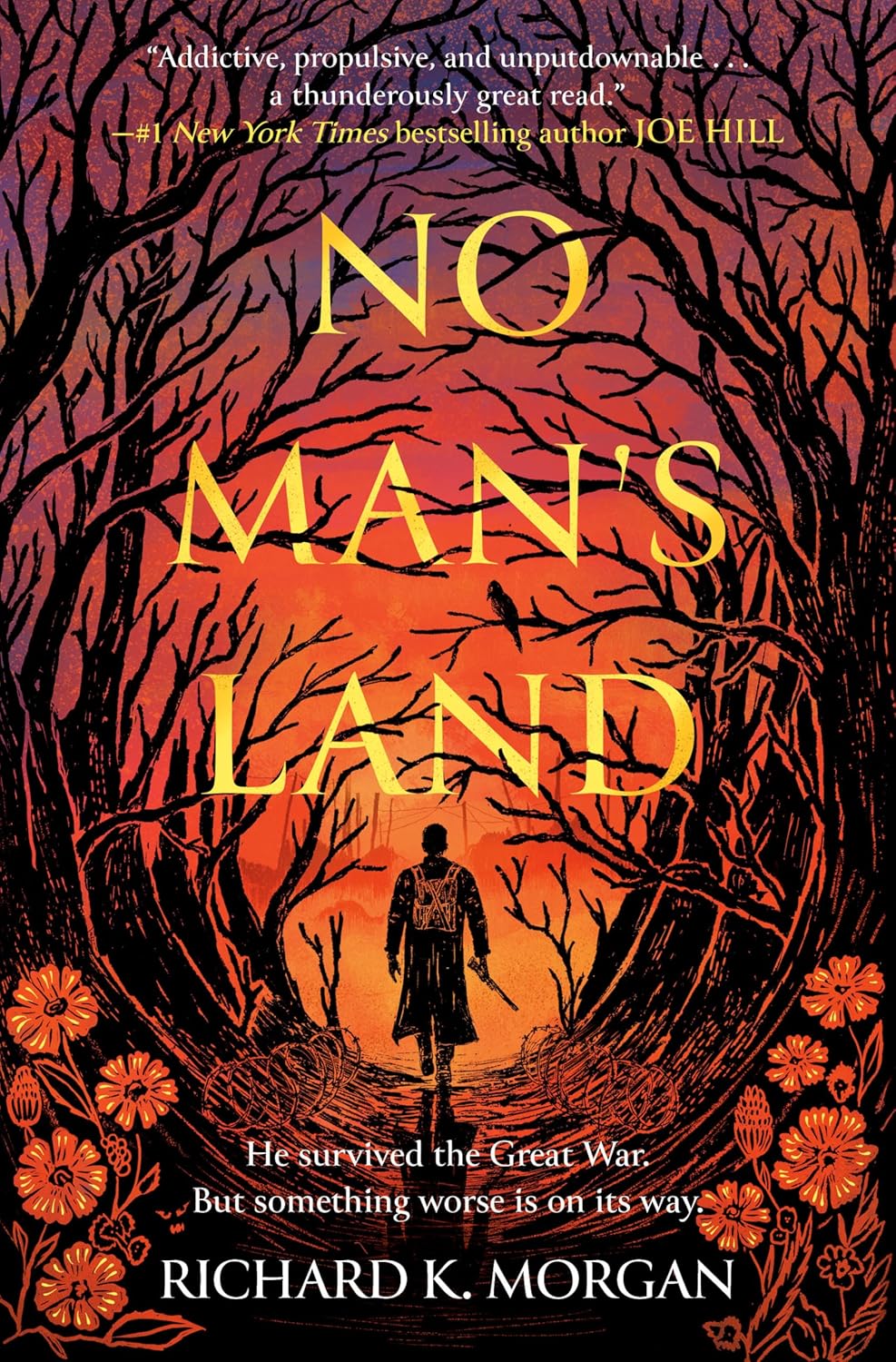
Which is where we come in. Duncan Silver is a gun for hire, someone who can retrieve children taken from humans by the Fae and return them to their parents. The plot begins with what seems to be a simple job – four-year-old Miriam has been taken by the Huldu and Duncan has said that he will get her back, even though this means he has to travel into the Forest, the domain of the Fae.
Of course, this is not as simple as it first appears. The situation is much more complex and wide-ranging than first appearances would suggest.
Richard does say in his Acknowledgements that this was not the book he was expecting to write and that it is different to his other books.
To some extent, I agree with that – dealing with fairies and other mythical creatures in a post-WW1 Britain is not like Thin Air or Altered Carbon. And yet there are elements that to me are similar, recognisable in his other work.
This being a Richard Morgan book, this is all told with energy, graphic violence and deliberately colourful language.
What also seems prevalent is the rage that fuels Duncan’s actions. Duncan is an angry man, and this is repeatedly shown throughout the book. Prone to fits of rage at the unfairness of everything, I did feel that he is clearly suffering with what we would now refer to as PTSD. He takes his anger out on others in impressively violent ways – especially those from the magic world of the Fae, who would steal children from their families and leave a changeling in their place, and any form of official authority.
Duncan comes across as a “man’s man”, as perhaps reflective of the 1920’s the story is set in. Although society is changing, No Man’s Land still feels like a human world with men holding onto power. Silver at times seems to be trying to deal with this change, and failing. There were times when this seemed to boil down to this being a place where men do manly things, whose actions speak louder than words, whilst women are there mainly to either be a support or to be used by men. This may not sit well with some readers.
Duncan himself is a man of those times of change – angry, snarling, taciturn, often struggling to convey his thoughts and feelings to others and yet still wanting to save children, people, the world – because he thinks that he can and morally feels that he should. He felt a little like a Clint Eastwood/Dirty Harry-type character to me, even down to the “are you feeling lucky, punk?” snap-liners. Regular mention of Duncan’s weaponry, and in particular his cut-down McCulloch shotgun – his equivalent of Dirty Harry’s Magnum .45, surely – reinforces that image. It is a book definitely written with a male gaze prevalent.
And as already said, it is also not for minors. There are sex scenes throughout, often fairly graphic, to illustrate how Duncan and the Fae interact – nothing is for free.
With all of this in mind, it is quite difficult for me to decide whether I like this book or if others will. I do not consider myself anti-violent or prudish and yet there were parts that actually made me wince whilst reading, both for their visceral imagery and explicit content. Some of the set action pieces are excellent, and Morgan’s descriptions of life in the trenches of WW1 are appropriately horrific, lest we forget. But at the same time there were moments when the dialogue felt a little more 2000 than 1920’s, which was a little jarring.
What surprised me most of all was that the characters in the end seemed rather impersonal – whilst I got what Silver was doing and why, I didn’t feel any empathy towards him, which surprised me. He is, even at the conclusion, still a rather unsympathetic character, a machine doling out violence. This may be deliberate – it is clear that he is a dangerous man –but it also meant that these were characters I could admire but not love, despite all of the horrible things that have happened. He is not the sort of hero that I would want to sit and have a pint with, but I guess that is the point. It could also be said that difficult deeds need such a character to get things done.
In summary, No Man’s Land is a book that didn’t entirely work for me. All of the author’s usual keynote elements are there, and fans of Richard’s earlier work will get what they expect, in a new setting, and possibly like it. Personally, I did not enjoy (if that is the word to use) the book as much as, say, Altered Carbon, but I did appreciate that the author is writing something very different.
Being a standalone means that new readers may therefore try this one to see if they like Richard’s work.
*(Reading and writing about this as I am in March 2026, with global events being what they are, made me feel that we don’t learn from history. Something I’m sure Richard is aware of.)
© 2026 Mark Yon
Hardback | Gollancz
NO MAN’S LAND by Richard Morgan
March 2026 | 480 pages
ISBN: 978 0345 493 156
© 2026 Mark Yon
Hardback | Gollancz
NO MAN’S LAND by Richard Morgan
March 2026 | 480 pages
ISBN: 978 0345 493 156