
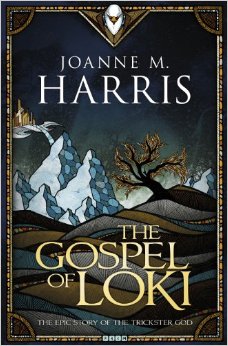
The Gospel of Loki by Joanne M. Harris
Published by Gollancz, February 2014
ISBN: 978 4732 0235
256 pages
Review by Mark Yon
It’s not difficult to point out the recent revival of Norse gods in genre literature and culture. From MD Lachlan’s Fenrir to James Lovegrove’s The Age of Odin to the Marvel Thor movies and Kevin Hearne’s Iron Druid novels, Thor, Odin, Loki and the gang are perhaps generally more noticeable at the moment than they have been for a long while.
Suffice it to say then that at this moment, the publishing of The Gospel of Loki is a most precipitous one.
From the start, we are pretty much told what to expect. This is the story of the Norse gods, as told in the first person by Loki. It is, as the title suggests, his ‘gospel’ – the truth, although it should perhaps be subtitled ‘The truth, according to Loki’. As Loki freely admits himself, this is his version of his own rise and fall, but he is ‘The Trickster’, after all, and you take his word at your peril.
For those who have followed the story in the Marvel comics and films, if nowhere else, this is the story of how Odin found Loki, brought him up at Asgard, tried to fit in with the other gods but ultimately, erm – didn’t, ultimately leading to Ragnarok. Much of that would be known to myths and legends fans, but if all of that is new to you, the book is written in such a way that you can pretty much pick it up as it goes along. There’s even The Prophecy of the Oracle in poem form at the end.
Except that this is Loki’s own version, of course, and one which is a little different from the traditional. What works best here is the persona of Loki, used to tell the tale. It’s pretty clear that Loki is clever, witty, humorous, self-depreciating at times and outrageously laddish at others, the sort of person you’d be happy to spend time with at a bar. Loki is a likeable lad, a ‘go-to guy’, at least according to this account, whereas Thor is ‘likes to hammer things’ and is not a fan of Loki, Balder is described as ‘Handsome, sporty, popular’ and sounding a little smug and Odin ‘Knows how to sell himself (and others).’ But then you probably wouldn’t expect Loki to tell this story any differently, and therein lies the danger. At one point Loki is described as ‘clever, ruthless, self-obsessed, narcissistic, (and) disloyal’, to which Loki’s response is ‘She had me there, I thought.’
Joanne writes this story with panache and skill, infusing it with humour and a wry smile throughout. As I’ve said before in these reviews, humour’s very difficult to pitch right, but this one worked for me. It’s clever and literate, yet surprisingly still accessible. Through Joanne’s writing Loki becomes something tangible, at times liked, at others strangely melancholic.
This is not easy. The difficulty in telling the traditional tale (for me, anyway) is that there are aspects of the Norse pantheon that are usually a bit hard to swallow, never mind the fact that some of the names have always been a bit of a personal difficulty, frankly. Just trying to get your reading head around terms such as Yggdrasil has always seemed to be more effort than its worth. Here Joanne/Loki cleverly sidesteps this difficulty for me by mentioning some of the more imaginative (some would say outlandish) parts of the traditional tale, but then explains them away as mere exaggerations, the sort of tall tale often bragged about over beer.
To be fair, if you can get around such issues there’s a lot of plot here to enjoy – like the last Thor movie, the book deals with some quite epic ideas, albeit from Loki’s own rather self-centred perspective. The Twilight of the Gods in particular is very well done, telling of epic events in crisp, sparse prose. Loyalty, deception, World Serpents, carnage, delirium – all in little more than a couple of pages.
So: if you can cope with the names and the sheer oddness at times, The Gospel of Loki is a great journey and a fun read. And that’s not something I can normally say about Norse mythology.
You know, based on this I guess we might just read more about these gods and goddesses in the future…
Mark Yon, February 2014





I get the feeling the book is broken up into individual tales. Is that so?
Hi Nila. A good question, thank you. And to answer it: no, not really. It is one narrative, although there are four parts/books to it, and within each book there are chapters, here called ‘lessons’, which do give the book an episodic quality.