The Star Beast by Robert A Heinlein
Originally serialised in The Magazine of Fantasy & Science Fiction (May, June, July 1954) as “Star Lummox” and then published in hardcover by Scribner (1954).
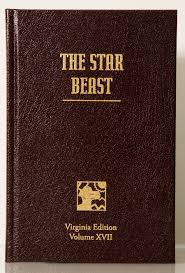
Virginia Edition published December 2008. Text with minor corrections based on the Scribner’s edition.
ISBN: 978 1 897350 218
200 pages
Review by Mark Yon
Here’s the latest reread of Heinlein’s works, as Mark goes through the Virginia Edition series.
And by 1954, we’re now well into the Heinlein juveniles. Some would say here’s where Heinlein was settling into a purple patch, with many of his best-loved and long-lived novels appearing.

Following on from Starman Jones, The Star Beast (title reduced to Star Beast here in the UK) is pretty much what we expect from Heinlein at this stage of his writing career. Whilst clearly writing to the template for Boy Scouts (as mentioned in previous reviews), it is a superior piece of work, managing to juggle a coming-of-age tale with humour and pathos and also shows an author not content with producing ‘more-of-the-same’. This is clearly a writer confident in what he is doing and showing it through his repertoire.
To the plot: John Thomas Stuart XI has a family pet, inherited from his uncle who returned home with it from a space voyage. The long-lived and amusingly named ‘Lummox’ is sentient – kind, caring, childlike, supremely loyal – and has grown to the size of a small bus.
This leads him and the latest John Thomas into all sorts of run-ins, with his neighbours, relations and eventually the law. The book begins with a chapter telling of how the childlike Lummox escapes the family property, initially out of curiosity but eventually frightened into a situation involving a trail across the city of Westville and the police. Not too surprisingly, for John’s mother this is the last straw and she wants John to get rid of it.
In the aftermath of the wander around Westville, Godzilla style, things become more complicated. The governmental Department of Space, or DepSpace, is informed and becomes involved. The local court orders Lummox to be killed. The court actually tries to have Lummox destroyed in an ‘accident’, but is unable to do so, much to Lummox’s amusement. Desperate to save his pet, John Thomas sells Lummox to a zoo before the creature is killed. However he rapidly changes his mind and feeling that there is no alternative, instead runs away from home, riding off to hide in the nearby forest wilderness on Lummox’s back.
His girlfriend Betty Sorenson joins him and suggests bringing the beast back into town and hiding it in a neighbour’s greenhouse. However, it isn’t easy to conceal such a large creature.
Readers of Heinlein’s previous books, not to mention my reviews, may feel that The Star Beast is another version of a tale we have read before. It is fairly easy to see that Lummox is the literary progeny and logical extension of Martian Willis, Venusian Sir Isaac Newton, the Martian flat cats and Mr Chips the spider-puppy met in previous Heinlein books. Like them, Lummox is cute, likeable – some would say loveable, even when in the first chapter he/she eats a local canine that has previously terrorised the local neighbourhood. The incident, which could be seen as quite serious is given instead as rather humorous. The reader accepts this, as it is explained by Heinlein in such a logical way that the reader seeing events from Lummox’s perspective becomes totally accepting of his point of view.
Anyone who has ever owned a pet will recognise aspects of Lummox as a large, fairly intelligent, clumsy-yet-well-meaning animal. Lummox is an absolute winner here, with Heinlein getting the tricky balance between humour and sternness about right.
And the crux of the tale is that, like most of the other aliens Heinlein has written about by this point, Lummox is misunderstood by the majority of humans he/she encounters. By comparison, the way that the humans often behave here is often the joke.
Cleverly, the book examines what sort of role humans and aliens could have together in a future society. It reminds us that we may not be alone, nor are we necessarily the best ambassadors of extra-terrestrial relations. Think of it as dealing with some of the same issues as District-9 but written sixty years or so previous. Its ending shows that humans have a lot to learn but ends on a positive note in that we are willing to do so. This is rather different from the more arrogant, ‘blast them all while you can’ attitude that was in much of the SF pulp and Hollywood movies of the time (and even today.) Here, in The Star Beast, diplomacy wins the day: ‘I do not like weapons… they are the last resort of faulty diplomacy’, a character states at one point.
It is this diplomacy that becomes increasingly important towards the conclusion of the novel. When representatives of The Hroshii, an advanced, powerful and previously unknown alien race appear and demand the return of their lost child…or else, humans are shocked to realise that this is Lummox. The situation is compounded further when Lummox, now discovered as a ‘she’, refuses to leave, instead wishing to her only hobby and principal interest: the raising of John Thomases. She makes it clear that she intends to continue doing so.
In such a brief summary the story may perhaps seem rather straightforward by today’s more cynical standards. However from a viewpoint of the 1950’s I was surprised at how keen Heinlein was to push things within his now rather standard template. The Star Beast shows that there is a Heinlein still pushing the boundaries here. There are lots of little touches that are cleverly not what was typical of SF in the 1950’s. It is good to see that we have a female character (Betty) in a major role, even though her character is a little two-dimensional. Interestingly, though, it is with this character there was controversy: Alice Dalgliesh, the librarian-editor of whom I have written about through these reviews – did hear of and get a poor review because of the point made in the novel Betty has divorced herself from her parents – something which was not seen as a positive thing to do in nineteen-fifties society. Despite this, the point was kept, and seemed to unaffect sales.
Of the other characters I was also surprised but pleased to see a more worldly view than I expected. For example, we have Mr. Henry Kiku, the Under Secretary for Earth who is African in origin and defiantly pointed out as ‘black’. There’s another generally likeable character with the first name of Sergei – rather provocative in a communist-aware nation as was the USA in the 1950’s. Heinlein was clearly against racism and breaking down boundaries before the civil rights movements of the 1960’s here.
It is perhaps worth mentioning here about another usage of names, seemingly deliberate. There’s also the name of our key character, ‘John Thomas’ – whilst fairly innocent in the US, here in the UK it is a slang term for – well, let’s say a male anatomical part. This is probably deliberate, and something mentioned by Robert James and William H. Patterson in their introduction in this Virginia Edition as part of Heinlein’s continual battle with his editor. (Evidently she was unaware of its other meaning and was not happy, years after the book was published, when she was told!) This certainly gave the phrase ‘raising John Thomases’ a different meaning with that understanding!
And seeing as how we’ve mentioned humour a couple of times already… I have complained about Heinlein’s attempts at humour before, particularly in Space Family Stone/The Rolling Stones. Here in The Star Beast Heinlein seems to have reined in the previous excesses to the point where his humour, in the main, holds up fairly well even though it is long after it was written.* Unusually, in The Star Beast much of this is at the expense of the hapless bungling humans, trying to deal with the often seemingly clumsy Lummox.
If handled badly, the plot throughout The Star Beast could be written in a way that is trite, or at worst slapstick. However I was pleased that Star Beast makes its points through humour without hammering them home sledgehammer-style, and this means that I found myself remembering the novel more as a result. Though we do have some of that famous Heinlein dialogue here, especially between the diplomats, this is not a book that labours the points, nor does it hector the reader into submission – something which later Heinlein novels have often been accused of. It is rather – at least by 1950’s turns – subtle and deceptively complex.
Star Beast consolidates the enviable position Heinlein is now finding himself in by 1954. He is clearly the King of SF juveniles by this stage, both popular and best-selling. Although it is strangely often forgotten today, The Star Beast is one that epitomises the solidly-good Heinlein juvenile. There’s an occasional lapse, and the odd part that hasn’t dated well, but generally this is one of the juveniles I’d recommend, although it is often not one regarded as a favourite. For me it was a surprisingly satisfying read.
Next up: Tunnel in the Sky, originally my first encounter with Heinlein.
Mark Yon, April 2014
*I find generally that humour often dated remarkably quickly in novels – faster than some of the gadgets we were expecting/promised!
.