SFFWorld End of the Year 2025 Part 3
Welcome to our now-traditional look over what we at SFFWorld have enjoyed this year. We have tried to limit our choices to five in each category, although as you will see, this can vary. Most are in alphabetical order, or no order of preference.
Part 1: Fantasy Books
Part 2: Horror Books
Part 3: Science Fiction Books
Part 4: Film and TV.
The staff involved this year at various stages in the four parts are Rob Bedford, Randy Money and Mark Yon.
—————————————-
Without further adieu, lets get started!
Part 3: Science Fiction Books
Rob Bedford:
Full admission here… since the majority of novels I read in 2025 fall into horror, there are some that skirt the line between Science Fiction and Horror. Conversely, my reading trends the last few years have shown a downward slope for straight-up Science Fiction novels, so some of the books I list in “Science Fiction” could easily be considered Horror.
 Overgrowth by Mira Grant
Overgrowth is a novel that forced me to wrestle with some big thoughts. Because Stasia is the protagonist of the novel, I as the reader naturally built up a great deal of empathy for her. She is largely a likeable character and cares about her friends. Good start for a person. But she’s also, very much admittedly, part of an alien invasion so that makes her difficult to “like” in many ways and as a member of the human race, I both empathized with the difficult situation she was in, but also didn’t want her and her “people” to succeed. … I think a more apt comparison, or a comparison my mind kept making was to Octavia Butler’s masterwork Xenogenesis/Lilith’s Brood which begins with the novel Dawn. While humanity is in a slightly different situation (Butler’s saga imagines a humanity largely destroyed by nuclear war), there’s a resonant assimilation of humanity in both Butler’s work (which does have some horrific passages and scenes) and Grant’s novel here.
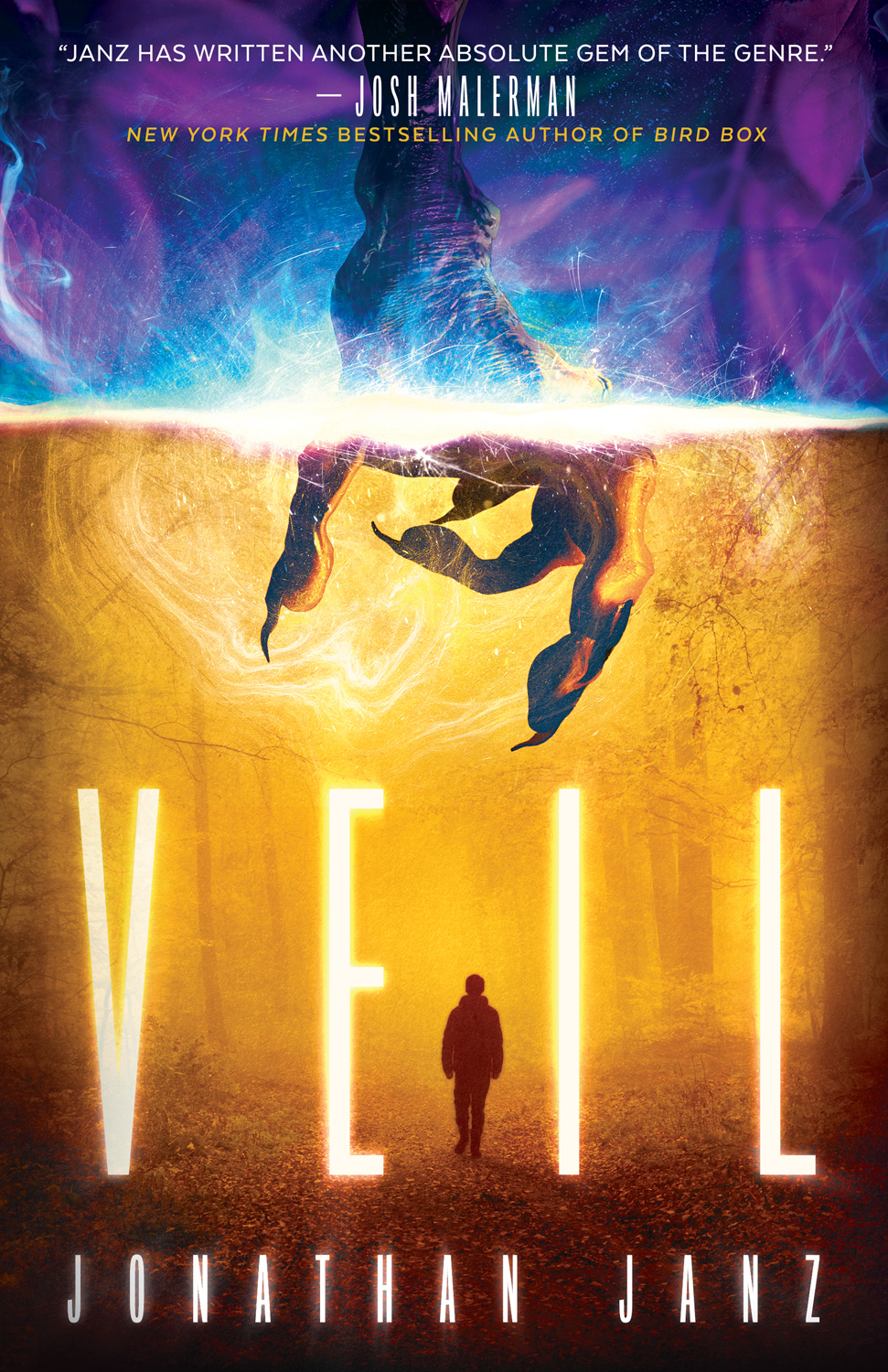 Veil by Jonathan Janz
Here in Veil, however, Janz has seemed to level up in his storytelling on multiple fronts and he is an even more assured writer at this point. He’s always been able to turn a fanciful literary phrase or theme into his fiction, his prose is even stronger here in Veil. I also appreciated how these aliens were portrayed…or the nature of what they are and where they originate. There aren’t giant spaceships, but something quite different and perhaps even more frightening and intimately terrifying for the characters. Ultimately Janz may have crafted an even more effective alien invasion apocalypse than readers (and film viewers) are accustomed to experiencing.
 The Martian Conspiracy by Mary Robinette Kowal
What keeps these novels going; however, are the characters and Kowal has crafted extremely charming characters in Elma, Nathaniel, Leonard, Nicole, Parker (it was unexpectedly nice to see him return) as well as all the others. There was a scene towards the end the end of the novel that I found very believable: Elma is a problem solver, she’s always trying to make things right. Her role is somewhat reversed and somebody else is leading an initiative and had to put Elma in her place. It was a genuine moment and the kind of interaction I’d expect to see between trusted colleagues and friends.

The Two Lies of Faven Sythe by Megan E. O’Keefe
But this is also a science fiction novel, and what would a space-based, futuristic science fiction novel be without some form of non-human, post-human, or alien characters. Case in point, the race Faven is part of – the Crystborn. They look human and interact very much like human beings, but they are not quite the flesh and blood that humans are. They have a different life-span, different birth process, and have different afflictions that can strike them down. There’s also an intriguing mystery about how the Crystborn came to be in the universe.
 The Shattering Peace by John Scalzi
I didn’t review this one, but I was very happy to return to the world of John Scalzi’s Old Man’s War.
Mark Yon:
I haven’t counted properly, but I think I’ve read mostly SF this year. This shows us that the state of the genre is pleasingly healthy, but also makes the task of choosing five favourites harder! Anyway, in alphabetical order:
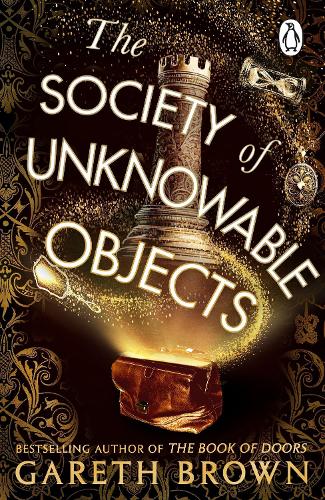 The Society of Unknowable Objects by Gareth Brown
I really liked Gareth’s debut book The Book of Doors last year, so looked forward to this one. It’s really a refinement and an extension of what worked in the first book, a story imagining that there’s a secret society in London whose task is to collect and keep ‘unknowable objects’ – things with magic powers – and keep them safely locked away to stop their misuse.
As you therefore might expect, this therefore involves books, bookshops and secret objects as well as magic and a bit of global travelling. It is fast-paced and accessible and whilst not entirely unpredictable, is a great read that uses these ideas well. I did enjoy his first book, but this is better.
 Whalesong by Miles Cameron
You may have noticed that I’m a big fan of Miles’s space opera books – the two previous books were in my ‘Best Of’ lists in each year they were published. So: guess what? I l actually liked this third book more than the second, although most of the main characters and the major plot elements set up in the previous books are slightly sidelined. Nevertheless, Miles’s meticulous plotting here leads to an exciting and rather taut plot. In my review, I said that “Whalesong continues to show the author’s strengths in characterisation, pace and plotting. It is a tight, fast-paced and shorter story that effectively builds on what has gone before, before leaving with a humdinger of a cliffhanger ending.”
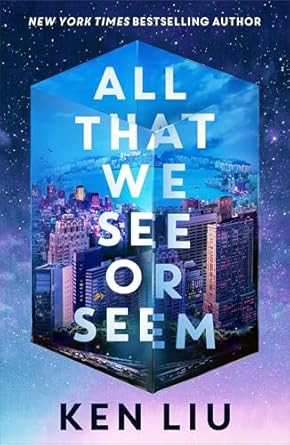 All That We See or Seem by Ken Liu
This one was a surprise in that it is very different from Ken’s epic Dandelion Dynasty books. A literate intelligent cyberthriller that brings in some interesting ideas of AI, social media and an intensely oppressive government. In my review for concatenation I wrote that “In summary, All That We See or Seem was a surprisingly different book from Ken. Although it may at first glance seem little different from the multitude of cyber-thrillers out there, there’s a pleasing degree of thought and ’what if’ that elevates it above the mass and enough technical know-how to make the book appear less contrived and perhaps more carefully considered than many. Its focus and directness make it quite dissimilar to his previous books, but also make All That We See or Seem feel like a refreshing reboot.“
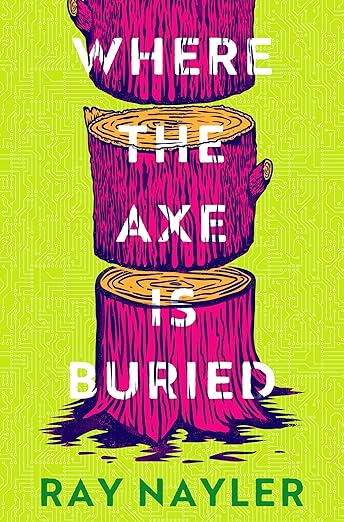 Where the Axe is Buried by Ray Nayler
Perhaps my favourite SF of the year. Although only his second novel (his first was Mountain in the Sea), Ray has shown that he can write complex stories that engage that go into some ideas that really make you think.
This was a novel where AI is part of an Eastern Europe despotic government and the need to endure, looking at not only the attractiveness of enduring power but also the endurance of the people and of freedom under such a regime. Although SF, it clearly has a lot to say about the world we live in now.
In my review I wrote that “Where the Axe is Buried is a different kind of book in many ways to Mountain in the Sea, but continues to show shows that Ray is definitely an author to watch. It is a book that warns and makes you think, that makes you observe and relate to the situations uncovered. It is quite an intense read – there’s not a lot of humour here to lighten the mood – but it has things to say and does so extremely well. Another memorable read that I can see doing very well; I’m definitely thinking that this is one of my best reads of 2025.”
I’m going to be very interested to see what Ray comes up with next – a rising star to watch, I think.
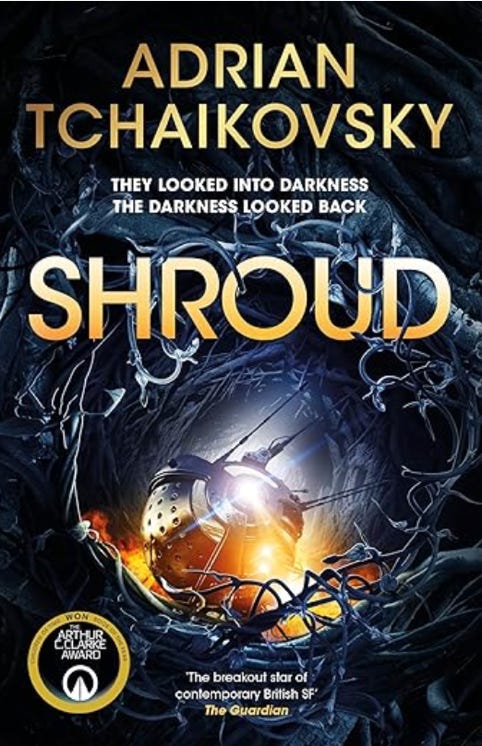 Shroud by Adrian Tchaikovsky
If nothing else, I think 2025 has been the year of Adrian Tchaikovsky. I have read his work for years, but this year I have reviewed five – yes, five – of his books in the last 12 months or so (although admittedly some were novellas and reprints.) Fantasy, SF: he seems to write well in all of our genres.
And so, Shroud appeared out of this. A big, strong SF novel that allowed Adrian to write about alien species – really alien creatures that communicate on a dwarf moon planet by using sound. It’s also about two humans stuck in the middle of this intimidatingly dangerous environment, trying to make it back home. In my review I said “Adrian has done it again. He’s taken some traditional science-fictional ideas and given them his own unique spin to create an arresting story that raises questions, introduces some unusual exobiology and holds your attention until the end. Another success, that I can see being on the Awards lists of 2025. How does he keep doing it?”
Honorary mention to Halcyon Years by Alastair Reynolds, an interesting mixture of film noir and generational spaceship science fiction, The Shattering Peace which showed Scalzi on-form, and Gareth L Powell’s comprehensive story collection Who Will You Save?, which was a nicely compiled collation of his science fiction short stories.
Randy Money:
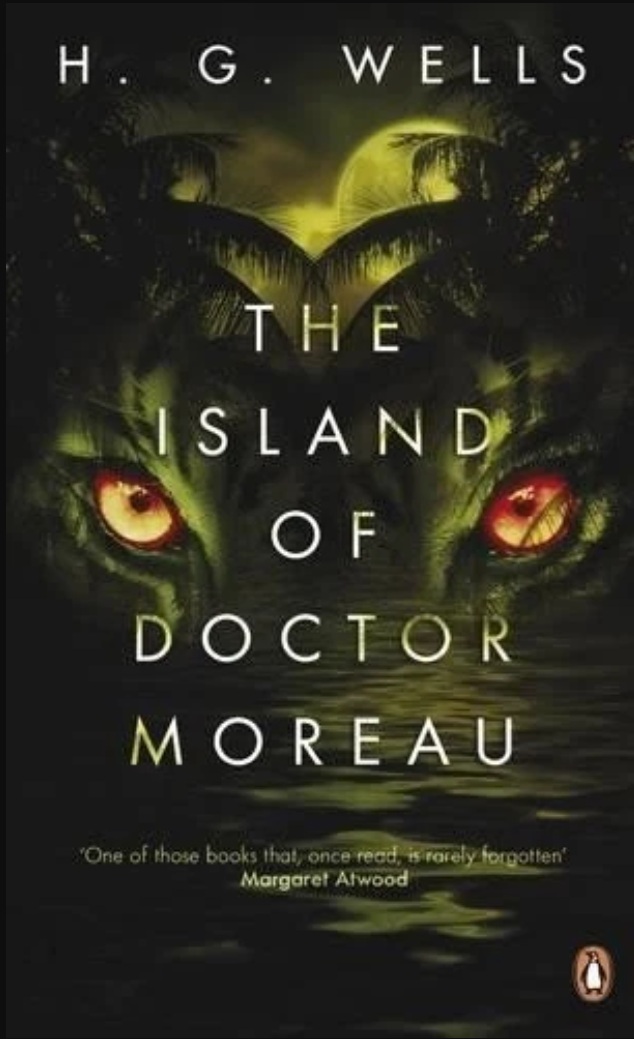
The Island of Dr. Moreau by H. G. Wells – Probably my fifth or sixth reading of this. After Frankenstein and The Strange Case of Dr. Jekyll and Mr. Hyde, arguably the most famous mad scientist novel, and still relevant in the age of gene-splicing.