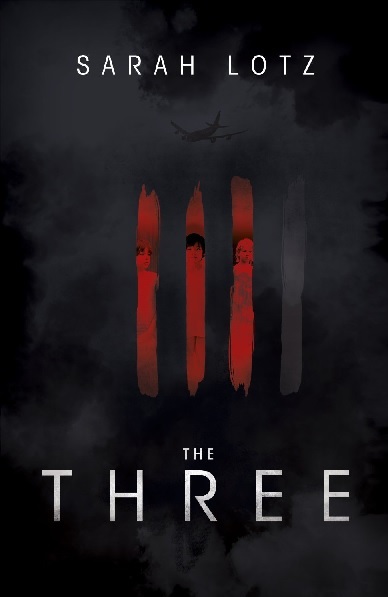
 The Three by Sarah Lotz
Published by Hodder and Stoughton, May 2014
ISBN: 978 144 4770 377
480 pages
Review by Mark Yon
As I type this, it is approaching summer holiday season (again) at Hobbit Towers. And as is normal, I notice the appearance of the usual holiday reads, all ready to take away with you on that long holiday journey.
The Three is one of those catastrophe novels that is *that good* it should come with a big warning sticker on its cover: do not read whilst on a plane.
This may be partly to do with its plot: simultaneously on one day, Black Thursday, four aeroplanes in different parts of the world crash without any warning. There are few survivors. One passenger in the Japan crash, an American named Pamela May Donald, records a brief and cryptic message on her mobile phone as she lays, dying. Three other people, all young children, are found at each of the crash sites in the Aokigahara Forest, Japan, Cape Town, South Africa, the Florida Everglades, USA and over water en-route to London, UK from Tenerife, Spain.
The book tries to uncover the enigma of ‘The Three’ – who they are, and where they have come from.
As their origins seem mysterious, as things settle down after the crashes the usual conspiracy theories proliferate. Some think that the children are the cause of the crashes, some that they are aliens. From Pamela’s recorded phone message religious zealots in the USA see an opportunity to develop a cult group – the Pamelists, from which the next apocalypse is foretold. For our young survivors things settle into some degree of normalcy, albeit in very different cultures. Bobby Small, the only survivor of the Everglades crash, has to go to live with his grandparents in Brooklyn. In Japan the survivor Hiro Yanagida only talks to people through an automaton created by his uncle, a world expert in Robotics. In the UK survivor Jess is left to be brought up by ‘Uncle Paul’ Craddock, a gay Londoner and brother to the child’s dead father. Lastly, in South Africa a frenzy occurs as people search for the enigmatic ‘Kenneth Oduah’, a survivor reputably seen at the crash site but now missing.
The main conceit of the novel is that it is actually a non-fictional collection of material about ‘The Three’, compiled by fictional author Elspeth Martins. Using transcripts from eyewitnesses, rescue workers, news reports and Skype and the Internet to tell the tale, the plot unfolds in short transcripts as they are reputably described, told or relayed to Elspeth. Elspeth’s job is to present all views of the event without too much personal comment, and so all of this is told in an engagingly objective manner, even when some of the transcripts are remarkably frank and emotional. This has the effect of both distancing the reader and engaging the reader at the same time. This worked really well for me.
The Three has a certain intelligence behind it that may belie its rather mundane origins. It does read in places rather like the first draft of a film or television script, not a surprise seeing as how the genuine author is a scriptwriter amongst other occupations. The book has energy from the start, although it is the way the suspense builds that is clever, with plot twists I just didn’t see coming.
It also helps that we get very different styles for each of the voices telling their tale. As we flitter from character to character it can be difficult to follow a variety of people, but Sarah manages that difficult trick of creating characters who are immediately recognisable and yet do sound different from each other. The worldwide nature of the different reactions creates the feeling that what has happened is a global event.
Most importantly, it is genuinely creepy. Because the main characters are so immediately identifiable, because their situations are presented so realistically, the events that happen have that impression that they *might* just happen. As we, the reader, find out more about the consequences of the crashes and we invest more into the characters, we begin to care about what happens. There’s more than a touch of Stephen King here, not to mention The Grudge and Ring/Ringu. It does take a little while to piece the fragments together and a little while to build, but when it does, it’s great.
There aren’t many books I find frightening these days – I can usually detach the fiction from the reality fairly easily – but I must say that this novel is one of the better ones in that it creates a chill, simply because it seems so plausible. Even the ending, which is usually where these tales fall down, holds up pretty well – although not too much in the cold light of day.
This was a read I picked up rather unenthusiastically and yet in the end could not put it down. It will make a great beach read this summer, even with some of the sad recent global events that seem to echo it. Recommended.
Mark Yon, June 2014