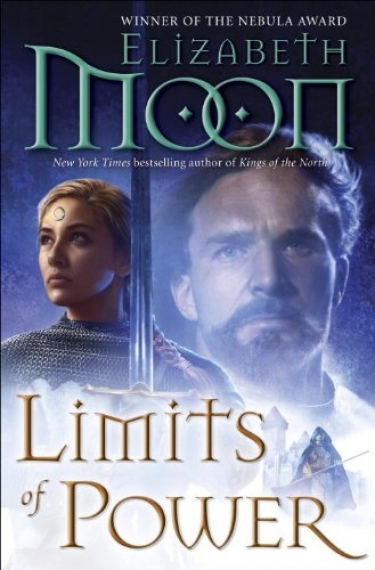
Limits of Power is the fourth installment of Elizabeth Moon’s Paladin’s Legacy series, itself a sequel to her landmark debut trilogy The Deed of Paksenarrion. While the Paladin’s Legacy can be read with no knowledge of Deed (which is indeed how I read the first book, Oath of Fealty), reading this fourth volume without having read the earlier three in the Legacy series would be a mistake. Not only because this is the fourth “episode” of a larger story, but primarily because Limits of Power is such a “reactive” novel. Specifically, Limits of Power deals with the ramifications and fallout of the events of the third book, Echoes of Betrayal.
So what exactly happens? Kieri Phelan, the king of Lyonya, is in a bind. He’s recently married, an attempt was made on the life of his wife resulting in the death of his unborn child and his grandmother, the Lady, was killed at the end of Echoes of Betrayal. He is suspected of the deed early on in the novel and must assuage those who accuse him. It doesn’t help Kieri’s case that he is only half-elven, but assuage those accusers he eventually does, even if they still distrust and dislike him. Meanwhile, magic is reemerging in the world and people close to the royalty are being affected; dragons have reawakened, and dark elves (Iynisin) plot to take down the Lyonyans.
As the series has progressed, Moon has introduced more viewpoint characters and much of the narrative here in Limits of Power, bounces around these character’s heads. Duke Dorrin has to deal with leading a group of soldiers who don’t like or respect her. She has named an heir whom she brings when she visits with Kieri. Dorrin also provides a magnificent gift to King Mikeli, who is presented with a major problem: people are showing Mage talent in greater numbers. Historically, this was a death sentence, but far too many people – and children of importance – are exhibiting such talents.
The previous volume focused quite a bit on Arvid Semminson and his moral and philosophical character growth. Here, the story doesn’t focus on him quite as much, but his character arc – specifically with his role with Gird, the primary deity of the series. Moon also focuses narrative on Arcolin, leader of the Fox Company. Arvid and his gnome companion Dattur join up with Fox Company as their storylines intertwine. This spreading out of the plot lines allows Moon to devote great character growth, because in a sense, they each are very much heroes and central figures of their own narratives.
One of Moon’s greatest strengths is her ability to build up tension and conflict between characters, often allies, who are at ideological odds; only to have them deal with those differences and come to a better understanding with each other. I wouldn’t say always she makes each character look admirable, but there’s always a sense of empathy and believability to the characters.
Where I had a more challenging time getting through the novel was when certain details were covered in the narrative, in what often felt to me in the smallest of details. This distracted me, though only minimally, from the larger story being told and the character arcs unfolding. All that said, four books into the series and I am both pleased with how Moon is driving the characters and plot and look forward to seeing how it is all resolved. Readers who are checking the review to see how the series is progressing: it is moving along nicely, so go back to the beginning and get caught up with the series.
Recommendation with the provision that you must read the earlier books in the series; Moon leaves little room (or recaps prior to each novel) for readers new to the series.
© 2014 Rob H. Bedford
Published by Del Rey / Hardcover ISBN 978-0-3455-3306-7
June 2013 / 512 Pages
http://www.paksworld.com
Review copy purchased