There is a good reason that bees feature prominently on the cover of Clade by James Bradley, the Australian author’s latest impressive foray into literary science fiction.
Firstly, it is easy to explain the structure of the book as a honeycomb, each chapter a self-contained cell forming part of the whole mosaic. The book follows the lives of several characters that share a familial connection – members of the same clade – from approximately present day to many decades into the future. The book does not feature a traditional linear narrative, but is told by multiple voices, a new point of view character introduced in almost every chapter; each chapter shifting the timeframe forward by several years, to tell a story that occurs over a lifetime, both epic and fleeting.
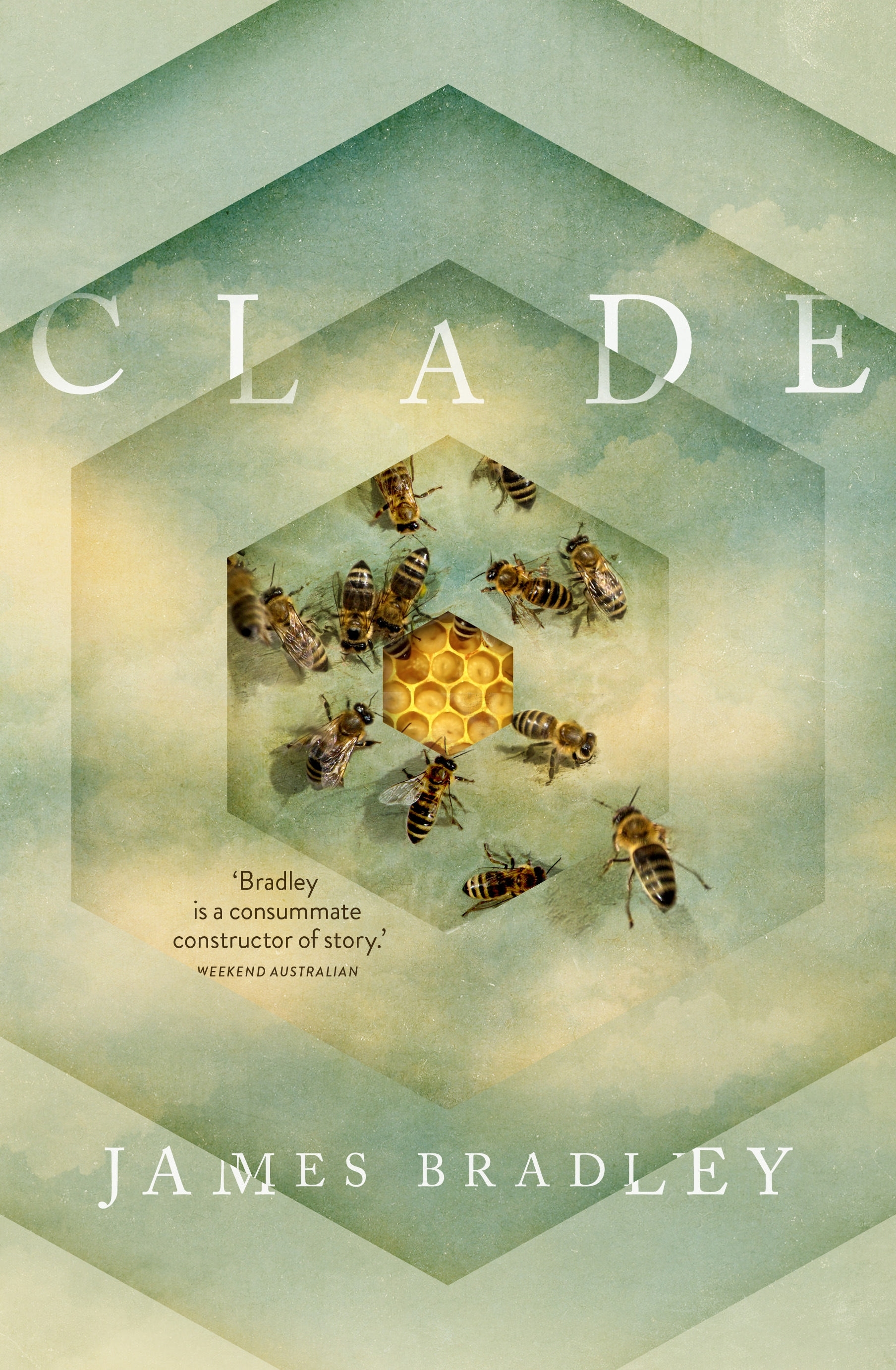
Secondly, bees are used in the book as a recurring motif, symbolic of the key themes of the book:
“She has seen fossils of bees, bodies in stone dating back 140 million years, evidence that they existed alongside the dinosaurs, that they were moving between ancient flowers in the forests of the Cretaceous. It is a dizzying thought, the idea that they have existed for so long, their colonies shifting and changing and evolving as the world altered around them, and one she finds herself returning to. Do individual bees have a conception of time, or is their existence simpler than that, their brief lives lived in the busy rush of the moment? And if they do, what do they do make of the collapse, of passing away and out of time?” (p.138)
Clade is a book about the “great depth of time” and how we can give meaning to the evanescence of human life trapped within this depth.
The novel opens with Adam, an Australian scientist working in Antarctica during the solstice. Adam and his wife Ellie are having a difficult time lately. Following the death of Ellie’s close friend, the couple have been trying unsuccessfully to have a child, and they have been going through a long process of failed fertility treatments. Across this great distance Adam is waiting to hear from Ellie living at home in Sydney about whether the last round of treatment has been successful, while the Antarctic ice sheets slowly crack and shift under his feet due to worldwide global warming. Adam wonders whether bringing a child into this crumbling world is the right thing to do.
The next chapter shifts us forward several years. Adam has returned to Sydney from Antarctica, and he and Ellie have had their child, a daughter they have named Summer (linking back to the solstice which is a motif in the book). However, as climate change is beginning to wreak havoc across the globe, Adam and Ellie’s marriage is unravelling, just like the world around them. Ellie has been working on an art project about Alzheimer’s, attracted to the project by the idea of “the loss of self, the annihilation of memory, … desire to escape the present” (p.31).
This is not so much a genre science fiction book, but instead a book that uses science fiction as an organic and necessary tool to tell its story. As Bradley moves his timeframe forward throughout the book, he fills the lives of his characters with cataclysmic events: natural disasters wrought by climate change, devastating influenza pandemics, messages beamed from outside our galaxy.
The depiction of the possible (though not unlikely) future impact of climate change, and other similar events, in this novel is perhaps one of the most realistically and skilfully rendered in fiction that I have encountered. As indicated earlier, it begins with the melting of the Antarctic ice sheets and increasing unpredictability of South Asian monsoons. Soon, there are throwaway references to the prohibitive price of luxury items, such as coffee, and descriptions of degrading coastlines (with “something beautiful in this ruination of the beach, a sense in which its destruction answers a need” (p.37)). Moving further forward in time, at one point in the novel scenes set in England depict that country with a climate transformed to something more akin to the tropics, with a landscape overrun by genetically modified trees and other organisms. One particularly harrowing scene depicts a powerful and destructive flood with imagery clearly intended to recall scenes from the 2004 Boxing Day tsunami:
“At first all that is visible is the rising water, the refuse floating by. But then he hears a rushing noise, accompanied by creaking and grinding like wind. And then, at the street’s end, he sees it. It seems so improbable it’s difficult to be afraid, for it is as if the water is pouring towards them in a sloping wall, a liquid hill that moves faster than any could run, a wave that does not end but comes and comes and comes.” (pp.98-9)
Similarly, later in the novel a virus called Acute Viral Respiratory Syndrome (AVRS) is described in a way that is sure to evoke in the minds of readers real life pandemics such as the SARs or the recent Ebola outbreak. By alluding to real-life, lived experiences Bradley’s future extrapolations are made scarily relatable and terrifyingly plausible.
More devastating to the characters’ lives are not the natural disasters that afflict them, but the dissolving relationships. What is really important in this novel is not these brilliantly rendered future disaster scenarios, but the way epic events are juxtaposed with very human stories. Clade is a book full of people struggling to find connections, not only with each other, but the wider world around them. Again, bees provide an apt symbol for this struggle:
“The first time they landed on me, enveloped me, it was as if I was no longer simply me but part of them, as if they connected me to something that went beyond myself.” (p.129)
One of the novel’s few technological science fiction conceits is the idea of lenses, which allow character to instantly interface with the Internet. Eventually, as the book’s timeframe moves forward, these lenses create the possibility for characters to interact with virches, or altered and virtual reality environments. Extinct birds can be restored to bushland scenery or the ghosts of lost family members can be resurrected and conversed with.
Reading back over this review, I realise I may be giving the impression that Clade is a depressing novel. That would be a distinct failure on my part as a reviewer. Clade is a novel full of tragedy on both the cultural level and the personal level. However, there is a beauty in the way Bradley depicts sadness with such truthfulness and honesty. And in very important ways Clade is, in fact, a hopeful novel. It is a book that depicts human life and love as a shining star in the great dark abyss of time. Perhaps this is best demonstrated by the reflections of one of the novel’s key characters, Noah, a scientist on the autism spectrum, unable to effectively relate to the immediate events that surround him. Noah is manning an observatory in remote and deserted Western Australia, scanning the skies, attempting to connect with something larger than himself, something beyond humanity:
“Those gardens, those houses, the land that surrounded them are gone now, vanished beneath the sea, yet they still exist somewhere, in the possible world. As a scientist he knows the experience of time is an illusion, that all times exist equally, all possible worlds are present in every moment. That in another universe those gardens are still there, he is still there, that the past never ended.” (p.223)
Clade is not a novel about what is lost, but what we can never lose.
Clade by James Bradley
Published by Penguin Aus., January 2015
256 pages
ISBN: 9781926428659
Review by Luke Brown, February 2015