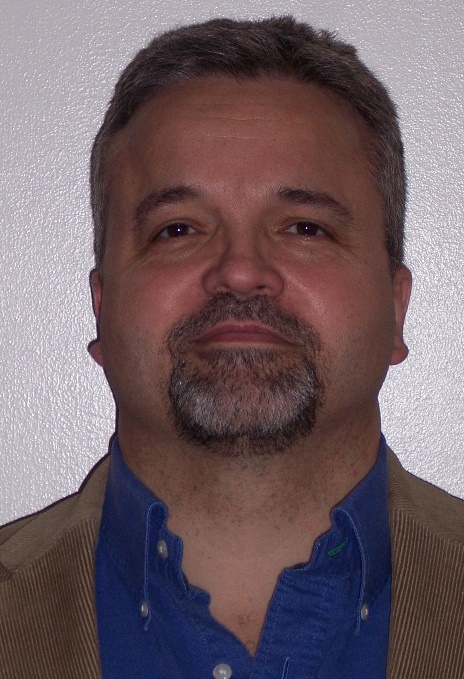
 Jeff Horton is an author of Christian Fiction, writing within several different genres, including science-fiction, fantasy, and apocalyptic thrillers.
Can you tell us a bit about your latest series, Cybersp@ce?
First of all, I’d like to thank SFFWorld for the opportunity to introduce myself, my work, and most importantly, the Cybersp@ce Series.
The Cybersp@ce Series follows the Reynolds family as humanity struggles to take its first steps out into the cosmos. It begins with Cybersp@ce, a story of cyber-warfare, espionage, and alien technology. The second novel in the series, Frontiers is about the peoples of Earth coming together peacefully as a species, developing new and long-lasting sources of energy, and the beginnings of discovery for our species as humanity launches its first interstellar flight to another star-system, and those who will give their lives to stop it. New Beginnings, the third novel in the series, presents a scenario where, following the near-destruction of Earth, humanity sets off to find and colonize another world.
In many of your books the theme is apocalyptical in some way, what is this theme you find fascinating to write about?
I suppose I like them because they are big topics, and because they are subjects which have, in one way or another, occupied my thoughts at one time or another. The Great Collapse is a warning about our dependence on modern technology, and a statement on how frail we really are as a species. The Last Prophet is based on the Book of Revelation in the Bible. I wrote it because it’s a book filled with imagery and is extremely important to many people all over the planet; it’s something I’d wanted to do for a long time.
You also say you write with a Christian Worldview, can you explain a bit?
That’s correct. So much of what we read and what we see on film is either openly hostile to Christianity or at the best is agnostic. I feel like we need more books and screenplays written with either a pro-Christian worldview or at least from a viewpoint that is more tolerant of it, and one that is more family-friendly. In addition, so much of what we see and read is chocked full of sex, violence, and depravity these days. I’ve been a big science-fiction fan for some time, but I’m also a Christian. I see no reason why science-fiction can’t be great and entertaining, without having to make it R-rated, or worse. I want families to be comfortable reading or watching one of my stories in their living room, without constantly having to police it for inappropriate material.
Do you do a lot of research into the topics you write about?
I do. It’s not as much as I’d like sometimes, unfortunately. For example, when I was writing The Great Collapse, I read the EMP Commission’s report on the risk of an EMP attack to the infrastructure of the United States. I also watched videos about the Air Force’s Operation Starfish Prime test in 1969, where the Air Force detonated a high-altitude nuclear bomb; the resultant EMP knocked out electrical transformers in Hawaii, over 900 miles away. I also researched how to dig a well, purify water, and even how to build a log cabin.
How did you start writing? Was there a particular book or moment in your life that spurned you on?
There was, actually. I‘ve been in the information technology field for almost 30 years now. Several years back, I sat down one day and asked myself what I thought I’d really enjoy doing in the 2nd half of my life, if I had a choice. Obviously, I decided I’d like to take a stab at writing, something I’d considered doing for decades. Seven novels and a few screenplays later, I hope I’m on track to eventually transition to writing as a fulltime career before eventually retiring.
What sort of challenges, as a writer, might you have faced over the years? Any insights you would be able to share for those aspiring writers seeking advice?
I suppose the biggest challenge has been in getting my work noticed. It seems like everyone and his brother is writing these days. Now don’t get me wrong, I think that’s a good thing; it’s just that with so many writing, it’s tough to get my work noticed, to get it to stand out above the rest. I know for certain that there are a lot of great stories out there today that will never capture a wide audience despite being high-quality work, for the same reason. It’s unfortunate, really, considering that so much of what we see on television today has been recycled, sometimes many times over, when so much fresh and vibrant material is out there.
As to what advice to offer aspiring writers, I wish I knew something truly insightful that would help speed them on their way. It’s just as hard these days, if not harder, to find a good agent as it is to find a publisher. It always helps when you know someone, of course, like a literary agent. For those of you who, like me, don’t personally know any publishers or agents, I’d recommend looking for small publishers who are just getting started. They’re much more open to taking on new and inexperienced writers. I happened across a young publishing company called World Castle Publishing and I’ve been with them sense. There’s always the option of self-publishing as well, something that’s gained respectability the last few years.
Have you ever struggled between what you would like to happen to a character and what you considered more sensible to occur? Can you tell us when and what did you do at last?
This strikes right at the heart of what I believe is important to great writing, believability. As an author, you have the freedom to create whatever world and characters as you see fit. What’s critical, however, is that once you’ve defined them, you must play by your own rules; your characters must behave in a manner consistent with that character. I suppose my biggest challenge here has been with my antagonists. I sometimes go overboard initially, making them about as mean, ugly, and as nasty as they can be. Reality is, however, that bad guys aren’t always completely bad just like good guys aren’t always completely good. I’ve had to temper the evil of my antagonists with traits or qualities that reveal that despite their evil, they are still, in some ways at least, human beings.
How do you feel you have evolved as a writer throughout your career?
One of the most important ways in which I feel I’ve evolved is my writing process. In the beginning I was almost entirely an organic writer, meaning that the story would take off in its own direction and I would just write down what I envisioned transpiring. While extremely creative, that style proved to lack the basic overall structure I felt my writing needed. I began outlining more and more of my stories from the beginning as my writing skills developed, which enabled me to inject more plot reversals, more depth in the characters, and increase the level of excitement in my stories.
How do you publish your books?
My publisher is a traditional publishing company called World Castle Publishing. They publish a wide-range of novels including science-fiction, paranormal, and children’s books.
What are your thoughts on good/bad reviews?
I very much respect the reader’s right to call it like they see it, and I’m very glad to say that all of my novels enjoy an average of 4-stars or more. To be frank, my biggest objection has been how a few people will trash my work not because it deserves it from a literary perspective, but because they object to the religious undertone evident in some of my novels. Oftentimes reviewers will even state that it was well-written, but then go on to rant about the religious viewpoint. That’s okay, however, as it goes with the territory.
For your own reading, do you prefer ebooks or traditional paper/hard back books?
I confess to being a bit of a dinosaur, because I still prefer paperbacks. I don’t own a Kindle or Nook yet, though I will probably buy one sooner than later.
What kind of books do you read, any favourite authors?
Aside from my obvious affection for reading the Bible, my reading has encompassed a wide range of genres and authors. I confess a particular weakness for science-fiction. Among my many favorites are works by Dickens, H.G. Wells, Tom Clancy, Michael Crichton, Edgar Rice Burroughs, Jules Verne, and Sir Arthur Conan Doyle.
What do you do when you’re not writing, any hobbies?
I’m very much a family man so I enjoy spending a lot of time with my children. I also enjoy reading, exercise, spending time at the beach, and watching movies.
What’s next, what are you working on now?
Well, I’ve been in discussions with some producers about making Cybersp@ce into a motion picture. It seems it would have to be a big-budget film, however, so finding producers with the financial backing to pull it off has been a challenge. I’ve written a screenplay for Cybersp@ce, an episode for a new science-fiction series for television entitled Intergalactic Space Rangers, and I’ve been contacted by a producer interested in having me write a screenplay for a military-type/revenge action-thriller. I’m also working on my eighth novel, tentatively entitled “Garden of God,” about a man’s search for the Garden of Eden following the death of his archaeologist wife.
I can’t thank you enough for the opportunity to share a little about myself and my work. Please consider this an open invitation to contact me via email or social networking. Anyone interested in taking a more in-depth look at any of my works can view book trailers, excerpts, and more by visiting my website at www.hortonlibrary.com.
* * * * * * *
Interview by Dag Rambraut – SFFWorld.com © 2015