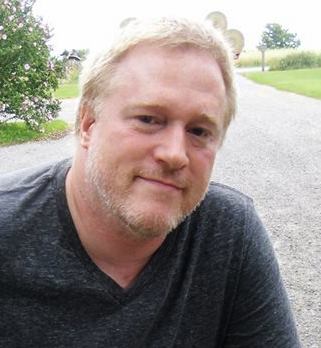
 Gregory Lamberson, dubbed “the hardest-working man in horror” by Fangoria magazine has just released his sixth and final book in The Jake Helman Files series.
First of all can you tell us a bit about your new novel, Human Monsters?
Human Monsters is the sixth volume in my occult detective series The Jake Helman Files. I originally wrote the first entry, Personal Demons, as a screenplay 30 years ago, envisioning a trilogy with Human Monsters as the third film. When I redeveloped the series as a literary property, the initial three-book storyline grew into six. The series blends horror, crime drama and noir; I’ve seen it described as urban fantasy by some reviewers. My goal all along was to explore different genres: mystery, mercenary, supernatural, fantasy, SF.
Can you give us some insight into your main character, Jake Helman?
Jake begins as a flawed character, a homicide detective with a drug problem. In the first novel, he lost everything that mattered to him, and had to rebuild himself to try to reclaim those things, so it’s a redemption tale. He’s a wiseass who sometimes exhibits more fear than the average occult detective, but in the end he’s more fearless and unstoppable than any others I know. I put him through pretty severe emotional, psychological and physical punishment in each novel. He’s a badass with a strong moral code. He lives in a world where scientific extremism and religious extremism often butt heads, and the result is he gets his ass kicked a lot. I’ve created a mythology that cherry picks from different religions and legends and stirs the pot.
How do you feel your main character Jake Helman has evolved throughout the series?
I view these six books as the origin of Jake Helman, his evolution into a true hero. By the sixth book, he’s aware of who and what he’s become, a avenger of sorts. His numerous encounters with the supernatural have made him a target, so he knows he can’t escape these confrontations. I’ve always been more interested in beating him down and watching him claw his way back up than in watching him battle monsters, though I derive a great deal of excitement from the big set pieces I’ve created. I’ve put him through greater torment than most heroes undergo.
This is the sixth book in The Jake Helman Files and it also marks the end of the series. If you had the chance, is there anything you’d want to go back and change?
No. My writing definitely improved over the course of the series, and I’m pleased with that. Jake had to grow into a hero, and I had to grow into a novelist; I’m happy where we both ended up. Jake’s origin cycle is over, but I’ll continue writing his adventures whether they’re published or not; creatively, this is the most fun I’ve ever had. Perhaps there will be a second series in the future, or maybe novellas or short stories. We’ll see.
What is it with horror you find fascinating?
Horror enables an author to deal with the most extreme permutations of emotions possible. It’s such a broad genre that generalizations do it injustice. In each of my novels, I’ve blended it with another genre. I can point to Desperate Souls and say, “That’s a crime drama in which the drug dealers just happen to be pushing a voodoo narcotic,” or to Cosmic Forces and say, “That’s a conspiracy story,” or to Tortured Spirits and say, “That’s an action yarn about island revolution,” or to Storm Demon and say, “That’s a disaster story.” It’s a very flexible genre, and it’s allowed me to stretch my muscles.
Can you tell us a bit about your other series also, The Frenzy Wolves?
The Frenzy Cycle is a trilogy, ostensibly about a secret war in New York City between elite police detectives, peaceful and violent factions of werewolves, and European werewolf hunters. The three novels – The Frenzy Way, The Frenzy War, and The Frenzy Wolves – are really about the reactions to terrorism in the 21st century. My werewolves are unique creatures: they’re shape shifting wolves with the ability to mimic human beings. They’re living among us to escape the history of what happened to wolves in this country, and to a degree Native Americans. I had a lot of fun writing those novels, and I might like to write another one some day, but I didn’t want to be ‘the werewolf guy.’ These books allowed me to concentrate on specific themes, characters and conflicts, but The Jake Helman Files has a more epic canvas. Both series are driven by action.
How did you start writing? Was there a particular book or moment in your life that spurned you on?
I was enamored of cartoons, comic books and movies from a very early age, and so I started writing. I wanted to become a filmmaker, and I am: I’ve directed six low budget feature films and produced a few others. I fell into writing novels when I realized I could never make a living making those films, so I novelized three unproduced screenplays of mine: Johnny Gruesome, Personal Demons and The Frenzy Way. I’ve had 13 books published since 2004, and have made or worked on seven feature films and one short during that same period. In high school, I was inspired by Stephen King and Peter Straub.
Have you ever struggled between what you would like to happen to a character and what you considered more sensible to occur? Can you tell us when and what did you do at last?
A more accurate scenario, which occurred in an early draft of Personal Demons, was that I forced characters to react to situations in pre-conceived manners dictated by my planned story; I had to learn to let them run rampant and surprise me, which is why I dislike working from an outline. I never worry about being sensible, the crazier the developments the better. My books are the wrong ones to read if you’re looking for sensible.
What sort of challenges, as a writer, might you have faced over the years? Any insights you would be able to share for those aspiring writers seeking advice?
I learned early on to write straight through to the end, never polishing or addressing sudden changes until the first draft. These days, I find myself procrastinating over starting a book more than I used to. After a story has percolated in my mind long enough, I write pretty quickly once I pull the trigger, but even taking that writing gun out of its holster seems to take me longer now. Fortunately, I work with great people at Medallion Press, which has published all of my novels so far, so getting an extension has never been a problem. I tend to write fairly long novels, 92,000 – 105,000 words, and I think my goal in the future will be to keep them down to 60,000 words. My style will remain the same, but my plotting will be less dense. Few characters get into as much trouble as Jake Helman anyway.
What is the hardest thing about writing?
I think each novel presents a different challenge. For my current book, it was choosing a starting point. I agonized over that decision, and I just couldn’t begin until I made up my mind. It set me behind several months. And then the snow came, and the family colds… Life gets in the way a lot. And weather.
How do you feel you have evolved as a writer throughout your career?
I’ve become aware of, and comfortable with, my process. I understand I’ll discover who my characters are over the first few chapters, and then my story will take over. I’ve learned to trust those characters. I also think I’ve become a strong action writer, and a writer of strong female characters. I used to think, as I wrote my first drafts, “This is going to need a lot of work on the next pass.” But when I do my second drafts, I’m pleasantly surprised at how the first drafts turned out. So I don’t worry about that anymore.
What kind of books do you read, any favourite authors?
I read very little, I have no free time. I’m a stay at home father and the family chauffeur, and when I’m not writing I’m working on films, or running the Buffalo Dreams Fantastic Film Festival. I’m currently reading A Confederacy of Dunces, which I’ve wanted to read for a long time. I’m halfway done, and I’m sure it will take months to finish. When I’m in the zone, I try to stay at the keyboard until I can’t keep my eyes open anymore. Some of my favorite authors are John Irving, David Morrell and Richard Russo. When I do read, I don’t read horror; I don’t want to be influenced, or deterred by something that might e similar to what I’m working on. I read horror for a good 20 years, I get it.
What do you do when you’re not writing, any hobbies?
I used to enjoy playing Connect4 with my daughter, but she started beating me! I like to watch TV – Survivor, Justified, The Americans. Empire is crazy! But this winter is my third one without a snow blower, and I seem to shovel my long driveway three times a day. Snow is brutal on hobbies.
What’s next, what are you working on now?
My new novel is entitled Black Creek. It’s a stand alone novel, an ecological horror story. I live in Buffalo, and we’re enduring a snow storm filled winter, and we’re 20 minutes away from Love Canal, so all of these elements will play a part in the book. I’m behind as usual, but brimming along. I’m sure there will still be snow on the ground when I’ve finished. I’m also in post production on a new film, a horror comedy called Killer Rack which I believe is going to be successful, and I’m developing two of my books – one novel and one novella – as films with bigger budgets. I keep telling myself I’m going to take a year off, but that doesn’t seem possible. Like Jake Helman, I’m comfortable with my fate.
My website is www.gregorylamberson.com.
* * * * * * *
Interview by Dag Rambraut – SFFWorld.com © 2015