In 2013, Paul McAuley completed The Quiet War sequence, one of the major hard science fiction series of the last decade. Something Coming Through, set in the same milieu as a recent slew of short stories, marks not only a new series of novels, but also a clear change in tone and direction. Whereas The Quiet War books were brooding space operas about massive conflicts across time and space set in the mid- to long-term future, Something Coming Through is a lighter, near-future thriller set just after first contact with aliens, which blends SF and police procedural elements with lashings of satire and pastiche.
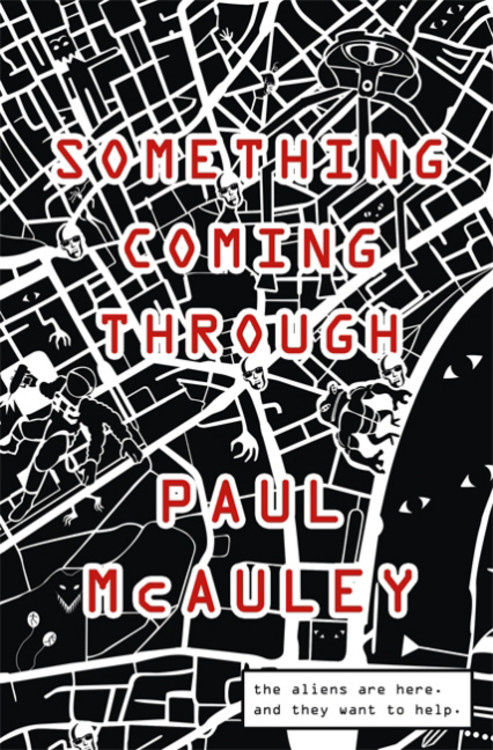
In Something Coming Through alien beings, known as the Jackaroo, have made contact with Earth. Though they have been a continual presence for over a decade, the Jackaroo have remained enigmatic to humanity, never seen and communicating through human-like avatars, and speaking cryptically about their purpose on Earth, offering assurances that they come in peace. Not only have the Jackaroo come in peace, they have also come bearing gifts. Amongst these gifts are wormholes that have been towed by the Jackaroo into orbit between the Earth and the moon. These wormholes lead to fifteen habitable “gift-planets”, which are dotted with the ruins and technological artefacts of several species of mysteriously vanished Elder Cultures. The Jackaroo run shuttles from Earth, through the wormholes, which humanity has utilised to colonise the gift-planets. But the shuttles run both ways, and societies on Earth have been infested with Elder Culture artefacts. Some of this technology has been a gift to humanity, helping, for example, to control the effects of climate change and rising sea levels. But some of these artefacts are dangerous and their mere presence on Earth has lead to dangerous results.
This is where one of the book’s two major characters comes in. Chloe Millar is a young woman who works in London for a company called Disruption Theory. Funded by a French entrepreneur named Ada Morange, Disruption Theory investigates and documents changes wrought by Elder Culture technology on Earth. Millar has a particular gift for sniffing out Elder Culture technology and at the start of the novel she is investigating what is known as a break out – an outburst of strange, cult-like behaviour in people that might be affected by one of the Jackaroo’s gifts. At the same time, Disruption Theory has become the focus of an inquiry by a parliamentary select committee dominated by a political faction that is trying to reduce Jackaroo influence on Earth, if not rid the planet of alien interference entirely. Millar is soon trying negotiate these political intrigues, while at the same time hunt down the son of a Pakistani immigrant, named Fahad Chauhan, who she believes might be under the influence of a powerful Elder Culture artefact. The problem is that Millar is not the only one trying to find Chauhan.
Millar’s chapters alternate with chapters told from the perspective of Vic Gayle. We know from the chapter titles that Gayle’s narrative is told from a timeframe set a few weeks ahead of Millar’s chapters. It is also quickly apparent that Gayle’s story is not set on Earth, but on the Jackeroo gift-world known as Mangala, where Gayle, a middle-aged Brit, works as an investigator on the police force for a city called Petra. During the celebration of the thirteenth anniversary of first landfall on Mangala, Gayle and his partner, a younger Australian investigator named Skip Williams, jag a murder case involving a man recently arrived on the planet who has been found dead outside the shuttle terminal’s freight yard. The man has been shot in the head by a mysterious Elder Culture weapon, with tracks leading away from the crime scene providing evidence that there was at least one witness to the murder. Soon, this murder investigation leads Gayle and Willaims into the middle of a war between rival criminal elements in Petra.
McAuley cleverly weaves these two third person narratives together as the novel progresses, using Gayle’s future timeline to foreshadow events in the Millar chapters in order to create a sense of inevitability and mounting tension. McAuley seems to be having a lot of fun in Something Coming Through. It is strange to say this about a book splattered with bursts of violence, including many important characters meeting gruesome demises, and an atmosphere of dread created by the ubiquitous influence of inscrutable alien beings. Yet, the book exhibits a sly sense of humour in the way it satirises aspects of modern society, such as Westminster political processes and social media, by juxtaposing the everyday mundane against a pervasive alien presence on Earth. McAuley also plays in a lot of genre sandpits with this book. At first, Millar’s chapters read like a political conspiracy thriller, while the early Gayle chapters are obviously heavily influence by the police procedural subgenre of crime fiction. Eventually, as the two plot threads weave together and much of the final action takes place on Mangala, elements of adventure fiction and planetary romance pepper the story. Lots of flavours in the broth, and, though there’s a good chance I’m imagining it, even the physical description of the Jackaroo avatars seemed to homage Max Headroom. But above it all, McAuley remains a hard science fiction writer and while there’s a lot of pure gonzo joy to be gained from reading Something Coming Though, the book’s science fictional extrapolations remain insightful and intriguing, and McAuley creates a nuanced and textured vision of a future social reality influenced by contact with the Jackaroo.
It is unfortunate that while much of Gayle’s early chapters intentionally riff on police procedurals, I felt they did so in a way that treacherously straddled the line between pastiche and cliché. Gayle is an experienced and cynical cop, and Williams is his young and idealistic partner, and the dynamics between the two will be overly familiar to anybody who has ever seen a buddy cop film or read any number of modern faux-noir crime thrillers. Similarly, the dialogue between the police and criminal characters in the book strives to be hardboiled but, to my mind, comes off as derivative and shallow. Readers wearied by an apparent lack of originality in these early chapters, especially in contrast with the more interesting Millar chapters, should rest assured that things do become more interesting as the novel progresses, and some of these tropes are eventually subverted. However, I did feel the plot resolved itself by relying on the interference of deus ex machina and I found the convenient ending, while leaving the door open for future books, somewhat jarring in contrast with much of the violence and grimness of latter half of the book. McAuley also leaves a lot to be resolved in later books, which may leave some readers feeling unsatisfied, though this was not a problem for me as a reader comfortable with ambiguity.
McAuley very well could be an emissary from another planet. Over a long career he has imagined unlikely worlds with the uncanny ease of an alien prophet, to become one of the major hard science fiction writers working in the field today. Even if Something Coming Through feels like a minor work in his oeuvre when compared to landmarks of the genre such as Fairyland or The Quiet War series, it is still a considerable work that I would recommend to anybody interested in the contemporary state of science fiction. I, for one, will gladly seek passage on any intergalactic shuttle McAuley cares to pilot into the future.
Something Coming Through by Paul McAuley
Published by Gollancz, February 2015
384 pages
ISBN: 9781473203945
Review copy received from the publisher
Review by Luke Brown, March 2015