Nila samples The Eternity Quartet’s spring with Seizing the Torch and An Evil Wind.
The Eternity Quartet: Seizing the Torch and An Evil Wind by Ed Greenwood and Robert B. Marks
Review copies provided by author(s)
Published February 15, 2015 and March 15, 2015 (respectively)
Review by N. E. White.
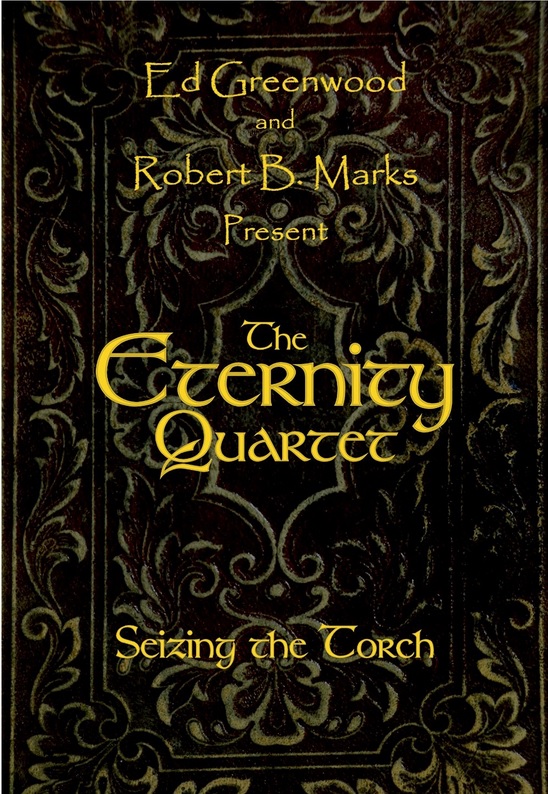 I like to read short stories. So, when I saw there were a couple of short stories available in the reading queue, I thought I would check them out. When I realized the stories were part of a larger work that included 16 separate stories spanning a period of 25,000 years, I was intrigued.
But also hesitant.
It’s not easy to keep a coherent plot through linked short stories, and it is even harder to do so if those stories span thousands of years. Add into that mix two authors, instead of one, and one might expect a hodge-podge of writing styles and characters.
While I have only read two of the quartet’s shorts (currently only three of the sixteen are available), I can’t really conclude whether the authors succeeded in telling a coherent tale over that time period. But I can tell you what I thought of the first two stories of the series: Seizing the Torch and An Evil Wind.
Seizing the Torch
This short story opens The Eternity Quartet and tells the story of Kevvik who, with a select party of his tribe, embarks on a hunting trip that goes bad. They encounter another group of hunters with “pointy ears” (yes, that’s what the authors call these people who are obviously supposed to be elves) who are trespassing on their territory and who are in the process of taking down a mammoth. Once the “pointed ears” do the heavy lifting of killing the mammoth, Kevvik’s group swoops in and kills off the pointy ears.
Afterwards, they find a young pointy ear girl who, presumably, was a daughter of one of the invading hunters. Kevvik takes responsibilty of her and tries to integrate her into his family. However, she remains depressed and Kevvik gets it into his head that he needs to return her to her rightful tribe. With the child acting as a guide, he takes her back to the hunting grounds and beyond. They encounter a big cat that Kevvik fights, find the path back to the pointy eared tribe’s cave-like city where Kevvik discovers a species on the decline. It would seem humanity seized the torch from this pointy eared species.
In my opinion, this wasn’t the strongest story to open the quartet. While the writing is easy to follow, the world building was near non-existent, the dialogue stilted and too modern for my tastes, and the plot didn’t make much sense to me. The dialogue just didn’t suit the stone-age time period the story presumably is trying to convey. Not that I want grunts and growls from the characters, but certainly the cadence of their speech could be altered to help immerse this reading into the appropriate time period. And to top it off, just about everyone had double letters in their name: Klatta, Kevvik, Daggth, Kaggar, etc. The double letter usage seemed amateurism and, frankly, juvenile.
I won’t even get into the plot. At just about every point in the story, I had a WTF? moment. Suffice to say, the story did not work for this reader. While I think the story idea has some potential, the execution was not satisfying.
An Evil Wind
The second story of The Eternity Quartet is set quite a bit more into the future. The only link from this story to Seizing the Torch is that many of the characters from Seizing the Torch are thought to be gods by Lord Emgrar, An Evil Wind’s protagonist, and his people, the Godsblood.
The story begins with Emgrar praying to Kevvyk, Klata, Vakar, Dagguth and Kahgar (notice what they did there with the spelling). He is interrupted by his Swordcaptain Guldark who reports of a mountain of a man, a neighboring lord, who demands the Godsblood people surrender their homes and land. Of course, Lord Emgrar has no intention of doing such a thing.
Along with his two daughters and his Swordcaptain, Lord Emgrar confronts the invading lord. They parley and Lord Emgrar has one day to prepare or surrender. He goes to Harran Ridge to see Harkridu, a wizard who will help – for a price, of course. There’s a bit of a slapdash twist at the end that I won’t spoil for anyone, but that price was a sacrifice that unleashed the gidim, their ghostly ancestors who wreak havoc on the invading army. Then, for no apparent (good) reason, Lord Emgrar gives his surviving daughter to the wizard to marry and take over ruling their people.
I found the world building in An Evil Wind to be the right amount (for a short story) for me. I got a good sense of the place and culture of the Godsblood people and I liked the mix of deity worship along with magic-wielding wizards. The writing style is very different from the first story and had the weight of a religious tome. Told via an omniscient narrator, there’s a bit of head-hopping that had be re-reading passages to clarify who was thinking what.
While I think I liked this story better than the first, I still was unsatisfied. The tenuous link between this story and the last (why would a normal hunting party be elevated to god status?) gave me a sense that the remainder of the stories would be superficially linked. And while I thought the writing was good, neither Kevvik or Lord Emgrar engaged me enough to want to continue this series.
Despite that, it is an interesting project. While I don’t think I’ll be buying the next installments, I may give the final omnibus a try.
N.E. White, March, 2015.
Copyright © sffworld.com. If quoted, please credit “sffworld.com, name of reviewer”.