I consider Michael Moorcock one of the yawning chasms in my genre reading. I have read smatterings of Elric, smidgeons of Hawkmoon, a bit of Jerry Cornelius, and Mother London. It is possible that, were I a devotee to the man recognised to be one of the Grand Masters of Science Fiction, I might have got more out of his latest novel, The Whispering Swarm, a blend of fantasy and autobiography, and the first in a projected trilogy. Though there are certainly tasty moments, I think readers with only a casual interest in the author will find this particularly feast akin to chewing rock.
The book begins in the mode of an autobiography, as Moorcock, born at the beginning of the Second World War, recounts growing up in Brooksgate, London. From an early age, Moorcock showed a keen interest in fiction, particularly stories with a flavour of the fantastic. During his boyhood he displayed a vivid imagination, often finding the distinction between fantasy and reality blurred. His father, shot down during the war, stayed on in France after hostilities had ceased, starting a new life with a French family, rarely making contact with Moorcock or his mother. Moorcock’s mother is described as a person prone to stretching the truth, with a fertile imagination of her own and a keen sense of drama. Moorcock quickly, but evocatively, recounts his childhood memories, including memories of the Blitz. He also talks about his early interest in music, particularly American folk, leading to part-time gigs playing in various rock and roll bands. But Moorcock’s major interest continued to develop in fiction, resulting an involvement in science fiction fandom, including producing his own fanzine focused on the works of Edgar Rice Burroughs.
Moorcock’s participation in fandom led to acquaintances with such luminaries as John Wyndham, Arthur C. Clarke, C.S. Lewis and Mervyn Peake. At the age of sixteen, Moorcock was given the job of editing his first professional magazine. It is at this point in the book that reality and fantasy start to blur, when sixteen year old Moorcock meets a monk named Friar Isidore at a printing press. Moorcock learns that Isidore is a brother in an order of White Friars who maintain a sanctuary in a hidden pocket of London called Alsacia. This magically hidden pocket of London has become unstuck in time, and is inhabited by visitors, both fictitious and real-life, drawn from across various eras of history, including as early as the Sixteenth Century, through to Moorcock himself from the Twentieth Century. Most of these visitors are romantic characters, such as highwaymen or swashbucklers, and all but one is male. The one female is the flamboyant Moll Midnight, with whom young Moorcock falls instantly in love. Moorcock has a brief adventure assisting Midnight in holding up a Universal Transport Company tram, but soon returns to the real world and tries to forget Alsacia.
Years pass and some more autobiographical events are recounted, including, somewhat briefly, Moorcock’s famous stewardship of New Worlds magazine, and his first marriage and the birth of his two daughters. But Moorcock never fully assimilates back into life after his discovery of Alsacia. He is plagued by a type of tinnitus that he comes to know as the Whispering Swarm, which only seems to abate when he is in the vicinity of Alsacia. He also cannot forget his infatuation with Midnight, and she becomes a recurring character in his short fiction. Eventually Moorcock is drawn back into the sanctuary of the White Friars where he becomes embroiled in a plot to travel back in time and rescue Charles I from beheading. It seems that Moorcock is a sage and one of the few people who can navigate the Silver Roads to and from Alsacia, connecting the sanctuary to other points in history.
It is easy to appreciate Moorcock’s intelligence and artistry in this blending of fact and fiction. I did not see this as a metafictional exercise with no point or purpose, which I feared I would going into the book. Autobiography is naturally a very nostalgic mode of writing and Moorcock clearly is of the view that one of the major enjoyments to be drawn from reading fantasy as a genre is also rooted in a sense of nostalgia. There is something charmingly sentimental and romantic about the the pub Moorcock creates within the walls of Alsacia, named The Swan with Two Necks. This is a place where a chap can share a pint with folk heroes, such as Dick Turpin or Buffalo Bill along with fictional heroes such as the Three Musketeers, before shooting out for a merry bit of swashbuckling. Moorcock’s writing, at times, is evocative and involving, particularly in scenes where pistols are cocked and swords are drawn, which do grow in frequency as the novel progresses. The autobiographical writing has brief glimpses of intensely interesting anecdote, especially when describing Moorcock’s career as a ground-breaking editor, his relationship with other writers of the era, such as Barrington J. Bayley or J.G. Ballard (here renamed Jack Allard), or his general recollections about life in post-war London.
However, the book becomes so bogged down in the material that fills the interstices of Moorcock’s autobiographical accounts and the swashbuckling adventures in the Alsacia that it soon turns to sludge. There is a navel-gazing that slowly creeps into the novel about the nature of rationality and the existence of God, and while one of these existential meanderings would have been interesting and appropriate given the events in the fictitious narrative, they soon become repetitive and wearying. Likewise, many densely packed pages are dedicated to Moorcock vacillating between his love for his wife Helena and his mistress Midnight. Many of the elements of Moorcock’s life that should be fascinating, such as his relationship with Peake or his time at New Worlds are disappointingly glossed over in favour of this melodrama. Another thing Moorcock seems at pains to assure readers more than once is that his lovemaking skills are top-notch. He states again and again that there are no complaints from either his wife or Moll in that department. While this would normally smack of vanity, Moorcock certainly does not portray himself in a very fine light for much of this book. Yet, both women continue to inexplicably tolerate and care for Moorcock, despite his selfishness and poor treatment of them. In fact, the book often displays an embarrassingly anachronistic view of gender roles.
I hope that future volumes of The Sanctuary of the White Friars improve on this initial entry. Moorcock’s premise is intriguing, and without a doubt he can still produce some of the most polished and skilful prose of anyone working in the field. While I do not want to appear inappropriately saturnine, Moorcock himself has hinted that this trilogy might be his last major work. To my mind, it would be an incredible shame if his autobiography were to end on this sour note. Let us hope that this strange and infrequently beguiling swan with two necks, one autobiographical and one fantastic, grows from an ugly duckling into a thing of grace and beauty.
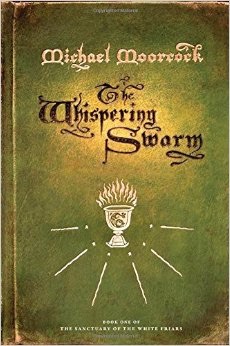
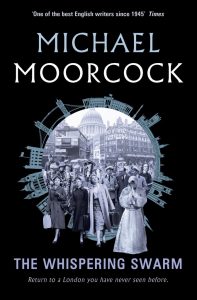
The Whispering Swarm (Book One of The Sanctuary of the White Friars) by Michael Moorcock
Published by Tor, January 2015 (US); Gollancz, July 2015 (UK)
480 pages
ISBN: 9780765324771
Review by Luke Brown, March 2015