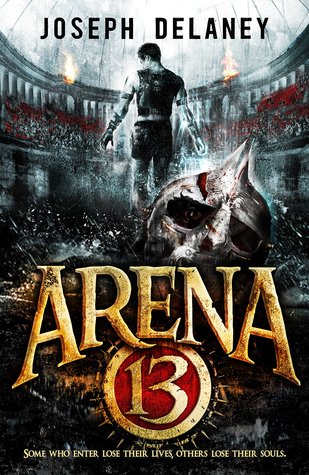
 Joseph Delaney is the author of the Spook’s series (also known as The Wardstone Chronicles) which has been translated into over 30 languages and sold over 3 million books worldwide. The first book in his new series, Arena 13, is published on 4th June.
First of all can you tell us a bit about your new novel, Arena 13?
Imagine a world where anybody can be snatched away at night never to be seen again. Imagine a world where the bodies of those taken are sometimes found drained of blood; a world where those abducted in the night sometimes do return but without their minds.
Imagine a world where everybody knows who has done this and knows where the killer is to be found but nobody dare do anything about it.
This is Midgard the world of Arena 13.
After a cataclysmic war, defeated human survivors have been imprisoned behind a barrier of mist and fear by the myriad shape-shifting djinn who now rule the world. But one of these creatures, Hob, dwells in a citadel above the city and preys upon its inhabitants taking both blood and souls.
Sometimes Hob visits Arena 13 and a human combatant is chosen to fight him. Everyone fears being selected because it means certain death – but one trainee, who is only just beginning to learn the skills necessary to fight in the arena, longs for the chance to confront Hob in combat.
His name is Leif and he seeks revenge for the death of his parents.
Leif has one ambition: to become the best fighter in the notorious Arena 13. Can you give us some insight into your main character, Leif?
Leif’s father came from a tribe called the ‘Genthai’ but his mother was a city dweller. That makes him a ‘half-blood’ and thus an outsider finding it difficult to fit into either culture. But he has incredibly fast reactions and was born for combat both as a ‘stick-fighter’ and then as a combatant fighting with blades in Arena 13 against both humans and ‘lac’ opponents. Leif is brave, determined and prepared to give his own life in order to win.
It’s listed as going to be a trilogy, but that doesn’t necessarily need to be true, does it?
The trilogy will bring the story to a stage which will achieve certain narrative resolutions – a place where the survivors may take a deep breath and wonder what will happen next. But I plan to take things beyond that because I like writing long series and there will be much more to explore in this very complex world. I think there will probably be seven books.
With the Arena 13 series you’re moving from Fantasy to Science Fiction. Has that been something you’ve wanted to do for a while?
Yes! As a reader I have always enjoyed both Science Fiction and Fantasy. I wrote the first version of Arena 13 in 1991 long before I got the Spook’s books published (‘The Spook’s Apprentice’ was published in 2004). It was Science Fiction then and that was my first love. I slowly drifted into writing fantasy. I love both genres. But although the book has certain features which categorize it as SF it also has many elements of Dark Fantasy and Horror.
What is it with SF and Fantasy you find fascinating?
Those two genres stretch what is possible thus opening all sorts of opportunities for a writer to be creative. Both genres (but particularly Science Fiction) enable the writer to as the ‘What if?’ question and then try to tease out the consequences of some change to the world or the way that we live and think. It is like opening a door and stepping through into the unknown. I also like the opportunity provided to build worlds far different than ours with their own cultures, creatures and conflicts.
I guess you get asked this question a lot, but the first book in the Wardstone Chronicles has also been made into a movie called the Seventh Son. It starred both Jeff Bridges and Julian Moore so you definitely had some celebrity drive there, but it also deviated quite a lot from the book. How do you feel about the end result?
I think the end result is a fun-film with lots of action and special effects that children will find entertaining. However it could have been so much better. They threw away too much of what made the books original and discarded too much of the dialogue which was replaced it with one-liners that failed to give that great cast of actors the chance to develop and project their characters. If we include pre-production, the film was made over a period of seven years with three changes of director (Tim Burton was the first to get involved) and several contributing screenwriters. Change was inevitable.
I guess it’s not an understatement to say that your Wardstone Chronicles have been quite a success. Did you ever expect something like this when you started out?
I hoped for success but the reality exceeded my dreams. I never thought that there would be thirteen books in the first series; I never imagined that they would sell in translation to thirty countries and that the first book would be made into a film.
What about the Wardstone Chronicles are you most proud of? And if you had the chance, is there anything you’d want to go back and change?
My favourite book from the first thirteen book series is ‘The Spook’s Battle’ but I am most proud of ‘Grimalkin’. I had been telling the story from the POV of Tom Ward and I was comfortable with that. But I wanted a change so I stepped outside the comfort zone and tried to get inside the head of the witch assassin to let her tell her own story. I tried to make it fast-paced and to let the reader empathise with Grimalkin and want her to survive and win. I really enjoyed writing that book and I am pleased with the result.
I do not plan much in advance so I am also proud of the fact that I managed to generate ideas and ‘discover’ the plot over such a long series. But yes there are some books in the series that I would go back and make changes to. The reason for this is the need for publishing deadlines. On a certain date a book has to be ready for the printer. So it is not the best book you can write; it is the best book that you can write before that approaching deadline!
We’ve also heard rumours that the next Starblade Chronicles book will be called The Dark Army. Any news you can share?
Yes we’ve had several different titles in mind including ‘The Last Winter’ and ‘The Earth Witch’. Finally we decided upon ‘The Dark Army’ so that will be the title of the published book.
What sort of challenges, as a writer, might you have faced before your first book was published? Any insights you would be able to share for those aspiring writers seeking advice?
I was a full-time teacher and found it difficult to find time to write. For many years I’d dreamed of being a writer but had done little about it. I’d write half a book and then give up. Always the demands of my life (family and work) made it difficult. I had to make time to write and did so by getting up very early in a morning and writing before I went to work. So that is the most important advice I can give. Make time to write.
Secondly keep a notebook and jot into it any ideas that come into your head. They are easily forgotten!
Thirdly, read widely. Reading fiction will help you learn to write it!
Have you ever struggled between what you would like to happen to a character and what you considered more sensible to occur? Can you tell us when and what did you do at last?
I think I would have liked to prevent the rift between Tom Ward and Alice. Many readers would have liked them to walk off into the sunset together. But I let the narrative develop in a different way. I’m not saying it was ‘more sensible’ but it seemed the way to go despite my reservations. Not every story has a happy ending! However, the story of Tom and Alice is not over and she will return in The Dark Army.
What is the hardest thing about writing?
I don’t find any one aspect of the writing process particularly hard. I enjoy the whole process from the inspiration that allows me to come up with a new concept or twist in the plot to the editing process where, working with my editor, I make changes and try to polish the text. But yes there are difficult days when the words don’t flow easily from my head. That can be a problem, especially if a deadline is approaching. Then there are days when I walk into town on a sunny afternoon and see people sitting drinking beer outside. The hedonistic part of me wants to join in but after even one pint I won’t be able to work as well afterwards. So I walk on by. It’s the same kind of discipline that made me get up early to write before going to my teaching job. That can be hard but I do it.
How do you feel you have evolved as a writer throughout your career?
I think that I have grown in confidence and self-belief. I discover my plots as I progress; I develop my characters through dialogue as they speak to me and other characters. At first I was nervous about whether that would always work. I worried about meeting deadlines. After over eleven years of being published I am more certain about the outcome of each book.
For your own reading, do you prefer – e-books or traditional paper/hardback books?
I like both forms and read both. The convenience of an e-reader is the number of books it can hold without any increase in weight. So I always read e-books when on tour or on holiday.
What kind of books do you read? Any favourite authors?
I am reading all the time – mostly Science Fiction and Fantasy. At the moment I am working my way through the books of Stephen Baxter. My all-time favourite writers are Tolkien and Frank Herbert.
What do you do when you’re not writing, any hobbies?
I like to travel (some book tours are abroad, which is one of the perks of being a writer. I am off on tour to Brazil in September). I also like to sip red wine or gulp beer in the sun! Walking and exploring new places is also fun and I like to be near the sea. Of course I read a lot too. To be honest writing was my main hobby and it still is. I still don’t think of it as work.
What’s next, what are you working on now?
I am usually working on two books simultaneously. At the moment I am writing the first draft of Arena 13 (Book Two). The latest draft of The Dark Army is with my editor at the moment but it will arrive back soon with her feedback. Then that will become the priority again. I enjoy tours but they make it difficult to write. In June I have a UK Tour but I will take my laptop with me. I have found that even half an hour a day, tapping out words in a hotel room, is better than nothing. It keeps the book alive in your head so that you can quickly get back to full productivity when the tour is over.
* * * * * * *
Interview by Dag Rambraut – SFFWorld.com © 2015