
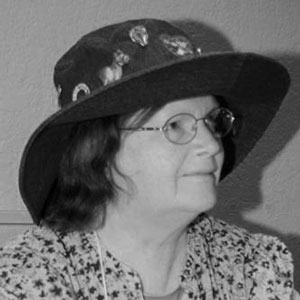
 Hello, Nancy: many thanks for giving us some time here. Welcome to SFFWorld.
I’m writing these questions as Open Road Media are releasing some of your older work in the USA as e-books.
Of the current list currently on sale (Chance, Fair Peril, The Hex Witch of Seldom, Apocalypse, Chains of Gold, Plumage, Wings of Flame). Have you got any particular personal favourites in that list?
I must admit a special fondness for Fair Peril. I was unconsciously preparing for my impending divorce when I wrote it, and it is quite hilariously mad. It encompasses a fat, disillusioned, middle-aged woman, a frog, a teenage girl, a prince, and a shopping mall, among other phenomena. The best line may be “Kiss me, and I’ll turn into a librarian.”
These titles are joining others on sale as ebooks, including your Book of Isle series and Larque on the Wing for which you won the James W. Tiptree Award. Do you have a favourite from that selection?
Metal Angel! A rebellious angel incarnates himself, and OMG he is such a hunk. That book is a throwback to my adolescent wet-dream fantasies about rock stars, with the addition of a great big pair of wings – and they change colors. Mood wings. Sorry; I can’t help myself. But far from being punny, it is a stone-bone serious book about mortality, transience and transcendence.
How comfortable are you generally with seeing the re-appearance of older work? Is it something you’re happy to do, reaching a potentially new, wider audience, or are they something from your past but something you’ve moved on from?
I’m 100% delighted. I’ve always had a sneaky hope that something I wrote might live on after I am gone, and by bringing back most of my lifetime’s work, e-publishing increases the chance that this could happen.
We also have to talk a bit about your Enola Holmes series where you have expanded on Arthur Conan Doyles Sherlock Holmes universe which first appeared in 1887. Why this fascination with Sherlock Holmes?
Why, indeed? And I’m not referring only to my own fascination. Sherlock Holmes may well be the best known fictional character in the world. He’s the only fictional character in my experience to whom people refer as if he actually lived. People have asked me, “Did he really have a younger sister?” To which I can only reply that she’s as real as he is.
My personal acquaintance with the great detective began when I was quite young. My parents had a complete set of the Sherlock Holmes stories, and I read them ragged, even more so than most of the books in the house. I grew up knowing Sherlock Holmes as a personal acquaintance.
I think it’s safe to say that you’ve brought a different perspective on women into this universe. How has it been to expand on something that was written in such a different time and age?
Simply because Conan Doyle was such a misogynist, and the super-intelligent Sherlock Holmes so clueless about women, it was a delight. The more I researched the ridiculous restraints that were imposed on girls and women in the Victorian era, the more I discovered a subculture of clever women inventing ingenious ways to flout the proprieties. And because Sherlock was such a confirmed bachelor, because he so assiduously avoided female contact, Enola could blindside him time after time. I’m surprised nobody else took advantage of this story angle before I did.
The Gypsy Goodbye was the sixth and supposedly final book in the series, but now there is going to be more. Can you share with us what you have planned for Enola in the new series?
I plan for there to be a vexed partnership between Sherlock and Enola; sometimes it will be hard to tell whether she’s working for him or competing with him. The first book involves saving a woman from an insane asylum where her husband, an evil earl, committed her for failure to obey. Also, Tewky makes a cameo appearance, and Lady Cecily and Enola are BFFs, of which more anon.
You have written both for children and adults and your writing also spans many genres, which do you enjoy the most to write?
When I started out, writing mythic fantasy, I was writing YA (Young Adult, literature for teenagers) without realizing it. I had no idea that the readership for my mass market fantasy books was overwhelmingly teen. Heck, the protagonists of those novels were, now that I think about it, just handsome teenagers wearing swords, and “quest” is the metaphor of adolescence.
When I turned to writing contemporary YA, the fit was a natural one; I am and always have been an advocate for the adolescent viewpoint. Even my fiction about middle-aged women usually invokes the rebellious, unfulfilled, striving child in each of us. And doesn’t that last phrase describe Enola Holmes too? I don’t think I have a preferred genre so much as a preferred mindset. But no matter what genre I set out to write in, I always manage to make it difficult for myself.
What is your favorite and least favorite part of the writing process, and why?
Least favorite: plotting, intrigue, red herrings, all the engineered artifice, which is why I leave that part out altogether and write character-driven stories, which may well be why my work is often called quirky and unpredictable.
Most favorite: writing itself, whether first draft, second draft, revisions or whatever. I research as I go along, which makes that aspect of the job much more immediate and interesting.
I must, however, admit to another least favorite part of the process, which is receiving and reading the editor’s revision letter.
What sort of challenges, as a writer, might you have faced over the years? Any insights you would be able to share for those aspiring writers seeking advice?
The biggest challenge is that, when I write, I go to a very lonely place, and I must have faith in myself and find my own way, despite the fact that very often I end up with something nobody else likes whatsoever at all. Few people realize that, in publishing a goodly number of successful novels, I have written nearly as many disastrous novels. I have spent years writing masterpieces that had to be thrown away. Rejection is the price I pay for being such a damn stubborn individualist. Sometimes I get quite thoroughly discouraged. But just the same, my advice to aspiring writers is to cherish the aspect of your self-expression that raises eyebrows. If your entire critique group agrees on something you should not do, that is probably an area you should develop.
Have you ever struggled between what you would like to happen to a character and what you considered more sensible to occur? Can you tell us when and what did you do at last?
This is a good question, but I’m so thoroughly a character-driven writer that it doesn’t pertain to me. I don’t have any opinion regarding what I would like to happen to a character, and as for what might sensibly occur, I demonstrably have no damn sense when it comes to the practicalities of plotting. The course of my stories is determined by three questions I seldom consciously need to ask. The questions are: What sort of interesting trouble is my character, this particular and fallible character, likely to get into? What does my character dreadfully fear that s/he might need to face? What does my character desperately love that s/he might need to save? Beyond those three questions, I follow the naval tradition based on Admiral David Farragut: “Damn the torpedoes, full speed ahead!”
How are you finding the e-book revolution? Are you happy with an e-reader these days, or do you still prefer ‘tree-books’?
My answer to modern technology is always that I can’t afford it, and it’s true, during a lifetime of writing I’ve embraced genteel poverty as part of my art form. But even if I could afford to buy whatever I wanted, I think I would still prefer the tactile experience of physical books. Ever since I first encountered a TV, back in 1954 when I was six years old, I have been solidly in favor of my defending own visceral and physical reality against the seduction of electronic illusions. I prefer to be in control, to have my mind to entertain me from the inside out; I don’t want it to be spoon fed from the outside in. But that’s kind of off base, isn’t it? There’s nothing invasive about an e-reader screen. I guess I’m just a Luddite, and I have always loved just about anything made of paper.
And, in 2015? What are your aspirations today?
Pretty much the same as they’ve been since I started, just to stay alive in the profession and keep going. And of course, very much the way many people hope to win the lottery, I hope some rich producer will buy movie rights to something I’ve written. But I wouldn’t want to go see the movie.
I guess at this point it would be appropriate to ask the age-old question: what is it that keeps you writing, today – or have you now got to the point where you can happily walk away, feeling that ‘the job is done’?
I do sort of feel that the job is done, yet I can’t just walk away. Even though I have slowed down to a crawl compared to my previous gallop, and even though I am not sure whether I’m good for much anymore, I can’t just give up writing. I realize most of my thoughts and feelings through the process of writing, via my fingertips keyboarding the written word. I wouldn’t know how to live without writing.
THANK YOU, Dag and the SFFWorld team, for such enjoyable questions.
Nancy Springer
The pleasure has been ours. Once again, thank you very much for your time.
Dag and the SFFWorld team.
* * * * * * *
SFFWorld.com © 2015





I discovered Nancy Springer via Rowan Hood and Enola (mash-up fan=me), and I will read whatever she writes/wrote. Glad to know that e-versions will help me find the older titles. Thanks for this interview.