
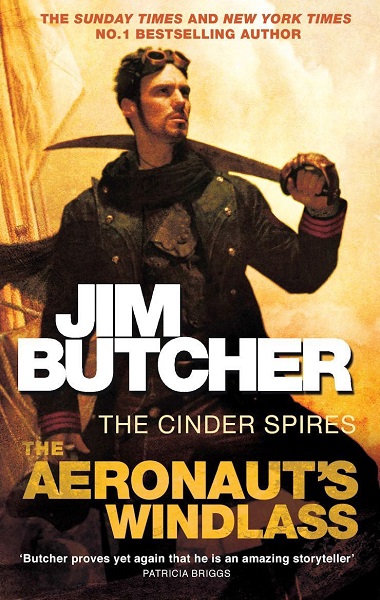
 It’s not very often here at SFFWorld that we find a book that many of us are reading and want to review together. So it is with great pleasure that we discuss, in a review form, what we all thought together of the first in Jim Butcher’s new Fantasy series.
We hope you enjoy it as much as we did.
—————————————

Mark Y: To start with, I’ll put up a copy of the publisher’s summary:
“Since time immemorial, the Spires have sheltered humanity, towering for miles over the mist-shrouded surface of the world. Within their halls, aristocratic houses have ruled for generations, developing scientific marvels, fostering trade alliances, and building fleets of airships to keep the peace.
Captain Grimm commands the merchant ship, Predator. Fiercely loyal to Spire Albion, he has taken their side in the cold war with Spire Aurora, disrupting the enemy’s shipping lines by attacking their cargo vessels. But when the Predator is severely damaged in combat, leaving captain and crew grounded, Grimm is offered a proposition from the Spirearch of Albion-to join a team of agents on a vital mission in exchange for fully restoring Predator to its fighting glory.
And even as Grimm undertakes this dangerous task, he will learn that the conflict between the Spires is merely a premonition of things to come. Humanity’s ancient enemy, silent for more than ten thousand years, has begun to stir once more. And death will follow in its wake.”
So, with the plot out of the way, I’d like us to start with general comments about the book. Did we all like it?

Rob B: I loved this book. Steampunk isn’t my go-to subgenre, when it misses, it really misses. But when it hits like this one (or Beth Cato’s debut The Clockwork Dagger ), I really love it. I think because there’s more of a mix between the Steampunk aesthetic and epic rather than what is more typical of Steampunk in a world that echoes Victorian times. I remarked on twitter that the best storytellers can transfer the joy they had in telling the story to the reader, in that conversation that a book/story is between reader and storyteller. It was very clear that Jim had a great deal of fun writing this one because it was an incredibly fun and engaging story.

Mark C: I loved this book too, and much like Rob, Steampunk is not my go-to genre. It also didn’t feel limited to Steampunk, with some clear indications of Fantasy and Science Fiction within the pages. But I’m getting ahead of myself – The Aeronaut’s Windlass was just a blast from start to finish. I’ve known since reading the Dresden Files that Jim can tell a good story, but I must admit I was a little apprehensive starting a) a new series in a genre I’m not massively fond of, and b) one that tells the story from a third person point of view with plenty of characters. Fortunately, I wasn’t left disappointed in the slightest.
Mark Y: I’ve left saying anything until last, partly because I didn’t want to pre-empt your comments. But I’m going to say that I too really liked it, for many of the reasons you two have said. I do enjoy a bit of Steampunk personally myself, though rather like yourselves I’ve had my fingers burned with a few disappointing ones. I have found as many that I haven’t liked as those I have. For me too, Jim’s book is one of the good ones and it ticks a lot of plusses on my list.
Which leads me to my next question. The Aeronaut’s Windlass is different from Jim’s Harry Dresden, (though I think there are some similarities in style, I’ll mention those later.) With this in mind though, how surprised were you by this book? Was it what you expected, or was it something more, or less?
Rob B: I wasn’t too surprised, to be honest. I’m a huge fan of The Dresden Files so I know that Jim Butcher is a great storyteller. Steampunk is usually hit or miss for me, this one had a more grand and epic feel to it. It was better than I expected, actually.
Mark C: Considering how touch-and-go I can be with anything outside of Science Fiction, and how a recent Steampunk novel by a favourite author of mine didn’t quite hit the mark, I was very pleasantly surprised – here is much more here than gears, steam power, and airships. Add in Jim’s prose and storytelling ability to a world that asks many more questions than it answers, and there really is very little (if anything) that left me wanting.
Mark Y: So, moving on, what were the particular aspects we liked?
Rob B: The world-building, the characters, the monsters, the plotting; pretty much everything. But foremost was Rowl. I think my favorite character was Bridget. A very believable character; a great hero.
Mark C: I agree with Rob – pretty much everything. The whole setup of Spire Albion was so interesting, with such a varied society and many differing sections and masterful world building – plus talking cats! Despite wanting to see where the story goes, I’m particularly looking forward to finding out more about the world and its history, including the oft-mentioned ‘Builders’.
Mark Y: My first impression was how big a book it was – 600+ pages. As the first book in a new series, does it merit being so big?
Rob B: I think the size was just about right though I don’t think a shorter book would have made it worse (although I wouldn’t know *where* to trim it!). The Dresden books, at least the earlier instalments, are shorter, but the scope was different. As the scope of the story being told in The Dresden Files widened and became more epic, the books became larger. Jim was establishing the world in this one so I think the size was warranted.
Mark C: Not only warranted because of the need to establish the world, but also because it has a wider cast of characters through which we follow the story. With the differing points of view, certainly compared to the first-person style of the Dresden Files, the story felt right at this length. I don’t think any chapters or viewpoints were wasted either, and there was little pointless world-building within the pages. Just about right for me.
 Mark Y: I said I’d come back to a similarity in Jim’s writing. For me, characterisation has always been a strength of Jim’s – Harry Dresden and Tavi are all characters that we can both like and identify with, for example. Does Jim improve on these characters here in The Aeronaut’s Windlass?
Rob B: I haven’t (yet) read the Codex Alera series, but I think what Jim did best in this one, in terms of seeing his skills grow, was giving readers female characters who were proactive and quite simply believable human beings. Granted, Karrin Murphy is a well-drawn character in The Dresden Files, but she’s mostly a secondary character in a series of books which are first person narratives so we rarely see the story from her point of view. I go again to Bridget who is in my mind a co-protagonist (at the least) with Captain Grimm. Grimm is a bit larger than life, a character many people know by reputation so that sets up a distance whereas Bridget seems to be a character who truly comes into her own in The Aeronaut’s Windlass, her history prior to the novel is not “set” the same way Grimm’s is.
Mark C: The main difference between The Aeronaut’s Windlass and the Dresden Files (like Rob, I’ve not read the Codex Alera yet either), is the fact that this is a third-person narrative. As such, it opens up a great deal of possibilities for Jim as a writer, and he takes advantage of them all by giving us plenty of interesting characters. Grimm is a fairly typical character, but Bridget, cousins Gwen and Benedict, etherealists Ferus and Folly, and, of course, Rowl, all bring something different to the table. It’s nice that we see each situation from different points of view, and the characterisation is very strong throughout.
Mark Y: As you’ve said already, Rob, Rowl is a wonderfully realised character, and I think my favourite – I can see a lot of fans for him. I must admit that I also noticed what Rob has said here, that the characterisation is dominated by females, not that that’s a bad thing. I liked it! But bearing in mind Jim’s previous female leads (Karrin Murphy, Molly Carpenter, for example) how do Gwendolyn, Bridget and even Folly stand up for you by comparison here?
Rob B: Have I mentioned that I like Bridget? 🙂 Gwen was a great character, too. Very headstrong and I really empathized reading the scenes written with her as the POV. I don’t think she was as frustrating to the extent that her co-characters did, I got a sense that some thought she was a bit of a nuisance but again I didn’t see her that way at all. She was just a very headstrong, youthful character who acts before thinking. Folly is a lot of fun, too, even if she was more of a secondary character. I see big things down the road for her in terms of moving up to be more of a primary player. (Or maybe if the series is popular enough, a story from her POV would be fun).
Mark C: Gwen is definitely fierce and headstrong, and her view of the world is somewhat annoying at times, though her cousin Benedict certainly balances her out. Folly is also great fun, a character that could grow massively as the story progresses. I also liked Bridget (perhaps not as much as Rob… 😉 ), and her development through the novel is perhaps the best of the bunch – it’s great to see her take such a prominent role. I’d perhaps go as far to say that it is the male characters that fall behind here, or certainly don’t have the same level of development that the female characters have.
Mark Y: Folly reminded me a little of Patrick Rothfuss’s Auri. Like has been said above, there’s clearly bigger things expected with Folly in the future. Like Auri, I suspect some readers will appreciate Folly’s – erm, ‘other-worldliness’, whilst equal numbers of readers may find her a tad annoying.
One of my favourite elements of the book, which surprised me, is the world building. The Cinder Spires are an environment above what appears to be a dead, or at least a highly dangerous world below. Did this work for you?
Rob B: The world absolutely worked for me. There was enough world-building to whet the appetite. I like the concept of the Spires and think Jim’s only touched the surface (pun not intended) of what this world is. There’s a shining beauty atop the Spires, with a darkness lurking below on the surface (literal, not metaphorical) of the world. I have some theories about the true nature of this world and how it came to be.
I want to know more about what Benedict and Sark are, there are some hints of what ‘warriorborn’ are. The hints about their nature leads me to believe they aren’t completely human.
Mark Y: Yes. My initial thoughts were that the warriorborn were lizard-like, for some reason. But as the book progressed the hints became bigger (‘half-souls’) and the feline qualities became more noticeable. I’m thinking some sort of Frankenstein-like genetic experiment programme, but I guess we’ll see later if Jim wants us to.
Mark C: Definitely worked for me too, and Jim teased plenty of information about the world without directly given said information. I enjoyed the technology level, particularly the use of crystals and the reasoning behind them, though again questions were raised in my mind that weren’t entirely answered. As I said earlier, discovering more about this world is as high on my priority list as is continuing the story!
Rob B: For me, I felt they were more feline in nature. Whether they are felines that evolved into humans, or are a construct remains to be seen. But Jim gave just enough detail to make them very intriguing.
Mark Y: And then there’s Captain Grimm and his world of airships – albeit airships with a tendency to be run like ocean ships. How was that aspect for you?
Rob B: Very swashbuckling! It added to the tension and gave the world both a Napoleonic feel as well as an alien feel. Is it a far future Earth?
Mark C: Personally I put this as an alien world rather than a far-future Earth, but the nature of the technology present suggests some sort of regression over a long period of time. Anyway, I digress. Airships! Pirates! Sky battles! I wondered how this would all play out after that first encounter, but there wasn’t quite as much as I expected – it was more about the captain, the crew, and how they work together and follow Grimm’s leadership. Would I like to see more Airships in the sequel? Yarr!
Mark Y: Ha! Like you, Mark, I enjoyed the airship aspect, though I was a little disappointed that they were less Zeppelin-like and more ‘HMS Victory-with-magic’. This is in keeping with the tone of the book though, which is meant to be more Peter-Pan and less Hindenberg, I think.
Seeing as how it has just been mentioned though, I think one of the best parts of the book for me were the fighting and battle scenes. Windlass is a book where war breaks out, and for me the Pearl Harbour-type moment of the raid by Spire Aurora on Spire Albion near the beginning worked really well. What worked for you?
Rob B: That beginning did work really well and I think Jim captured the chaos of battle even more powerfully towards the end of the novel.
Mark C: Definitely agree there. The airship battle scenes were exhilarating and believable, but it was the hand-to-hand combat I really enjoyed. When you’ve got crystal weapons that shoot out energy, swords, guns, and claws, there is so much that can take place. Rowl’s fighting was even crazier and more chaotic than the airship battles, and Jim used each event to maximum effect. There was just so much to marvel at and enjoy. Entertainment at its best!
Mark Y: You’ve mentioned the crystal weapons there, Mark, and that brings me to the idea of magic systems, and the characters of etherialist technowizard Professor Ferus and his assistant Folly. Does the idea of ethereal energy work for you? It’s quite different to Harry’s methods of working with magic – or is it?
Rob B: …or is it? I like the magic quite a bit, as perfect a Steampunk magic system as I’ve read. Back to that idea of the world at which I hinted. Jim has said he wants to close out The Dresden Files with a big Epic Trilogy. What if that Epic trilogy changes the world so much with a release of magic that the result is the world of The Cinder Spires?
Mark Y: Ooh, really good point, that, Rob. I’d not thought of the book as possibly having a cosmic link-up, like Brandon Sanderson’s Cosmere universe or Terry Brooks’ Shannara books. I’ll bear that in mind for the future books.
Mark C: I liked the fact that the magic felt more ‘real’, that it could be explained rationally, and even felt somewhat science-fictional. Perhaps it’s just me projecting my preference for Science Fiction into the narrative and seeing things that may not be there. But it works well in the overall world and fits together nicely with the technology – Jim has certainly thought it all through. Whether there is a connection to the Dresdenverse is a theory that is definitely up in the air for the moment…
Mark Y: I thought the magic crystal aspect was well done. The etherialism magic reminded me a little of Chris Wooding’s Retribution Falls, for some reason.
Let’s get to the gritty stuff now. Surely our review can’t be totally positive! What are the parts that worked less well for you, and why? What might critics not like about the book?
Rob B: That battle towards the end was a little too chaotic, if anything. It wasn’t entirely easy to keep track of whose side everybody was on. Other than that, no real complaints.
Mark C: Personally I found very little to criticise. There were a couple of times where the focus switched away at what could have been a pivotal moment and then picked up later on, and I suspect some will not be happy with the general lack of explanations about the world, but there really isn’t much to grumble about. The Aeronaut’s Windlass really is a thoroughly entertaining story written by an author who knows what he’s doing.
Mark Y: I think I’d agree with much of that myself, Mark. The focus switching is a writerly trait I think we see too much of in books personally, although it didn’t bother me too much this time. If I had to pick something to criticise, then I will say that the name of Grimm did worry me at first – I just thought it was too pantomime. I’m pleased to say that the actual character won me over, though. As for anything else…I think Folly (no relation to Molly) may irritate some readers a tad. But her actions are understandable in the context of the book.
Fun though this has been, let’s try and bring this to a close. In summary, and in conclusion then, would we recommend this book? Where do we hope the series will go next? What would you like most to see in the next book?
Rob B: I would absolutely recommend this one. I want to know more about Benedict, see Folly evolve, and see more of the various Spires. I’m willing to go where ever Jim takes this thing.
I can’t wait to see some fan art of the characters and the world, either.
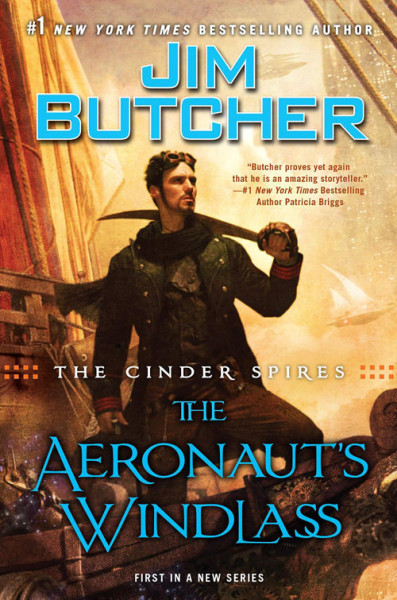
Mark C: Ditto. I trust Jim more than enough for him to lead the way, though I would like to know more history of the world, and see a little more about the ether and the etherealists. I also think it’s a crying shame that Rowl was not featured on the cover in some way – I’m pretty sure he’d agree with me in saying that he was just as much a main character as anyone else! A simple closing comment from me: The Aeronaut’s Windlass is highly recommended.
Mark Y: I don’t think I can add much more than that myself. This is clearly the first book in a series, but, like Rob, a series I want to read more of. I was a little worried initially as to whether the book would meet my hopes, but I’m pleased to say that on the whole I was very, very pleased with this book and not disappointed in the least. Well done, Jim.
The Aeronaut’s Windlass by Jim Butcher
Published by Orbit (UK)/Roc (US), September 2015
640 pages
ISBN: 978-0356503653 (Orbit), 978-0451466808 (Roc)
Review by Rob Bedford, Mark Chitty and Mark Yon – SFFWorld.com © 2015




Nice review. I’ve been watching some of Jim’s talks on YouTube, and he was speculating that later books in the series might feature different characters on the covers, so Rowl is in with a good chance!
Thank you, Phil. I/We look forward to the next book covers. Who will be next? 🙂
As far as I could tell, he has no idea!
I really enjoyed his Alera Codex series as a fun and entertaining read, so I will be checking this out.
Thanks for the multi-part honest feedback. I loved both of Butcher’s previous series (in fact, felt actual grief when the Alera Codex ended), but as you mention, steampunk is not my favorite sub-genre either. I have this on my wishlist on Audible and was curious whether it would be worth the price–now I’m going for it. I am also now following you guys for reviews!