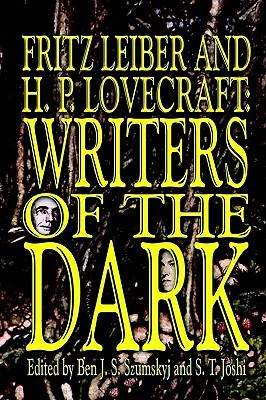
 Randy M. looks at Fritz Leiber & H. P. Lovecraft’s Writers of the Dark as the Countdown to Halloween continues.
Join us in the Countdown to Halloween discussion thread
Fritz Leiber & H. P. Lovecraft: Writers of the Dark, ed. Ben Sumpskyj & S. T. Joshi (Wildside Press, 2003)
This collection includes letters H. P. Lovecraft sent to Fritz Leiber and his wife, Jonquil, one of which praises and critiques an early draft of Leiber’s “Adept’s Gambit,” several pieces by Leiber discussing Lovecraft and his work, and one poem and seven stories by Leiber with ties to Lovecraft’s work. The non-fiction is informative – Lovecraft’s readiness to help beginning writers is one of his more endearing qualities and Leiber’s acknowledgement of and gratitude for that assistance a grace note of his own and matched by his insight into what HPL was trying to achieve. The poem is entertaining and the stories even more so, and one of the best may be the most pitch-perfect Lovecraft pastiche I’ve ever read.
“Adept’s Gambit“: First published Fahfrd and Gray Mouser story, it begins with a curse on Fahfrd that transforms every young woman he comes in contact with into a sow. He is revolted and, naturally, the young women are not especially pleased, though the curse ends when they leave his company. Still, it takes the curse extending to the Mouser for them to seek help from Ningauble of the Seven Eyes. Under the latter’s guidance they take a long trip to a lost city with a mysterious young woman, encounter her sorcerous brother, and visit a strange high house in the mists with nearly deadly consequences.
There is little of Lovecraft in this version of the story, but the draft Leiber sent Lovecraft, only recently recovered and published, contained references to Cthulhu and other Lovecraft inventions. Lovecraft had invited his friends and fellow writers to play in the (rather haphazard) mythos he was building and was enthusiastic about Leiber’s story and his exacting and detailed commentary played a large part in Leiber’s revisions.
The Fahfrd and Gray Mouser stories are often, as in this, lighthearted, in no small part due to the irreverence of Leiber for his characters’ dignity, and their irreverence for everything around them often expressed in banter that seems to stem a bit from Shakespeare and maybe a bit from the movies of Leiber’s youth (the Errol Flynn version of The Adventures of Robin Hood comes to mind). More Lovecraft-like is, “The Sunken Land”.
A lot of Sword and Sorcery flirts with horror, certainly “Adept’s Gambit” does, but The Sunken Land goes directly to the center of it, and Lovecraftian horror at that. After extracting a ring from a fish he has caught, Fahfrd is swept overboard during a storm. Fahfrd catches hold of a passing ship and climbs aboard, finding himself among a crew attempting to sack the darkly fabled island of Simorgya, newly risen from the depths of a sea that had claimed her years before. On Simorgya stands a huge edifice with vast halls on the floors of which sea water pools and along the walls of which carved likenesses of deep sea creatures watch them pass; and Fafhrd begins to wonder if the ring will play a key role in this adventure.
Edit to replace Simorgya with Lovecraft’s R’lyeh and you have a mythos story, and a quite effective weird tale either way.
“Diary in the Snow”: Newly unemployed, Thomas stays with his friend John in John’s remote cabin in Montana. It is winter and the snow is isolating so the two writers can concentrate on their work with little distraction. Thomas has an idea for a weird invasion story of creatures from a dying world trying to gain a hold on this one. When not writing, he wonders about the strange purple light he sees after dark. And he wonders about the one radio station that comes through late at night, with its interesting science programs that he never quite remembers the next day.
“The Dreams of Albert Moreland“: Moreland is a genius at chess, often playing multiple games simultaneously and rarely losing. But Moreland’s sleep is disturbed and disturbing: He dreams of playing a game with an enemy he never sees, with strange pieces of varying powers on a board of vast scale, with the stakes the fate of humanity and maybe more than humanity.
The above stories were included in the first edition of Leiber’s first story collection, Night’s Black Agents, an Arkham House publication.
“The Dead Man”: A doctor meets a man whose body can simulate the symptoms of any disease while under hypnosis. What if the man’s body could be brought to act as though it had any disease then cured by command? Maybe a good deal of the world’s illnesses could be combated with an understanding of how his body works. But there are other, personal issues, and when the doctor presses his experiments too far, there are grave consequences. For all his sophistication and facility with language, when of a mind Leiber could pulp with the best of ‘em and this represents that side of his work.
“A Bit of the Dark World“: Professor Kinzman invites his friends Glenn and Vicki to his home in the canyons outside Los Angeles. The house sits on a ledge below the rim of a gorge, an impressive modern structure that looks out onto the hills and into some caves. Or maybe they are not caves, those spots of blackness on the walls of the gorge. Some people are sensitive to the openings into and out of this world, and they can detect, if not exactly see, what skitters through. And if you can detect what comes through, maybe it can detect you.
“To Arkham and the Stars”: A meeting at Miskatonic University in Arkham, where much arcane lore, like the dreadful Necronomicon, is secreted, where many of the professors and students have delved into the secrets of that book and other tomes of equal disrepute, and experienced events not of earthly origin. There are memories to share and memorials to make. Not a deep tale, and not really a horror story, but a thoughtful story touching on the consequences of such knowledge and experiences, and a more direct tribute to Lovecraft than the previous stories. It also acts as a gentle lead-in to the next story.
“The Terror from the Depths”: A manuscript, in effect an autobiography, by the late poet Georg Reuter Fischer is bracketed by an explanation of its recent discovery at an auction of unclaimed property and a summary of the events leading to how the authorities initially came in possession of it: Fischer was found dead outside his collapsed home in the Hollywood Hills in March 1937, a small casket containing his effects, including the manuscript, in his arms. Fischer wrote of the odd events in his life, his frailness in his early years, his almost morbid attachment to his home, his growing sense of other things at work in the world around him and his unease with the conclusions he has drawn. The manuscript ends only shortly before his death. (Note: Reuter is Leiber’s own middle name, and Fischer is the last name of his co-creator of Fahfrd and the Gray Mouser, Harry Fischer.)
Leiber politely but firmly disagreed with the direction taken by August Derleth, owner and proprietor of Arkham House, the small publisher that kept Lovecraft’s work in print, in producing Cthulhu Mythos stories written by himself or by others. Leiber held that Lovecraft’s work was not about good versus evil, Christian sentiment and symbols were irrelevant in the world he was creating, and his creation was moving toward a science fictional basis when Lovecraft died, all of which Derleth ignored, playing up the mystical and supernatural aspects.
For thirty years Leiber had foresworn writing Lovecraft pastiches in part because of his disagreement with Derleth, but eventually mellowed enough to allow himself this story. Without imitating Lovecraft’s writing, Leiber still manages to organize his materials and write with a formal voice that echoes Lovecraft, building inexorably to a conclusion that cements and solidifies the hints and clues scattered throughout and so creating the best Lovecraft story I’ve read that was not written by Lovecraft. In the process, Leiber suggests uses of Miskatonic University beyond what Lovecraft had created and indicated the influence of Cthulhu and his ilk and followers had spread beyond the hills of New England.
This collection acts as a reminder of the power of two of the leading American fantasists of the twentieth century, of the influence of one on the other and of their mutual regard. A strong, still vital strain of American fantasy was reenergized and redirected if not initiated by Lovecraft, and Leiber’s reading of it informed a good portion of his work.
Other work by Leiber with connections to Lovecraft:
Our Lady of Darkness
Other works influenced by Lovecraft:
Ramsey Campbell: Grin of the Dark
Caitlin Kiernan: The Red Tree & The Drowning Girl
John Langan: House of Windows
Laird Barron: The Croning
H.P. Lovecraft and Others, 27 stories