 In a recent review, I wrote of Isaac Asimov (1920 – 1992) and his importance to my own science fiction reading. In the last century he was one of the ‘Big Three’ science fiction authors (the other two being Robert A Heinlein and Arthur C Clarke) that was available to me when I first started reading the genre, and as a result he holds a special place in my formative reading years.
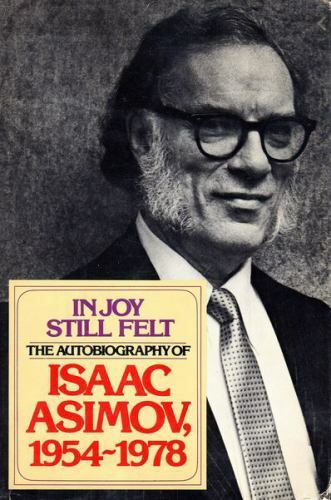
The result of that reread was that I picked up this, an autobiography created from Isaac’s diaries and suffused with his memories.
This is actually the second half – the first, In Memory Yet Green (published in 1979), was a 732 page book that covered 1920 (the year of Asimov’s birth) – 1954. In this second volume (a mere 828 pages), we pick things up in 1954, although Asimov kindly summarises the first volume for us in the front of this one.
Although he had published well – respected science fiction stories such as the Foundation series by this point, the money Asimov made in writing SF was pretty poor, easily outpaced by his salary as an associate biochemistry lecturer at Boston University School of Medicine.
One of the enthralling aspects of the book is to see how Asimov went from relatively humble beginnings in 1954 to being perhaps the world’s best known science fiction writer– certainly the world’s best-known science writer – less than 25 years later. By the end of this book, Asimov has published 200 books (mostly non-fiction)* and is the most prolific author of the late 20th century. The process is fascinating.
You don’t get to publish that many books without being able to write, and Asimov manages to turn what could be just a mundane itinerary into something eminently readable. I must admit that I was not sure about reading a diary, and at its worst I was rather expecting one of those diary summaries that say things like “Monday – wrote a book; Tuesday – edited a book; Wednesday wrote a book…”
Admittedly, there are times, particularly towards the end, when In Joy Yet Felt becomes a little bit more of “wrote a book, started another” annotated list, so that concern seems a little valid. However, the other details peppered throughout were enough to keep me reading. It is how I imagine Asimov would tell it, filled with quips, bonne mots and forensic detail to make it a surprisingly engaging read, chattier than it should be and surprisingly honest.
This honesty is shown through Asimov’s admission of his sales through writing and the consequent growth in income. The first half of this book shows how his yearly income rose from $6000 in 1954 (mainly his university work) to $72 000 in 1962 (mainly books published), after which he stopped mentioning it, “since it is no longer anything but incidental”.
“Oh, that’s just bragging!” said one person I mentioned this book to. And yes, it could be seen as that – even more so when you can add a 0 to give a figure roughly equating to its value in 2026 – but Asimov doesn’t present it like that.
It is more about him registering shock that he is earning that much, especially when comparing it to his income from Boston University (and if you want to read how much academic rivalry was a part of a university lecturer’s job, this is a sombre read, as Boston University initially looked down on Asimov for popularising science in his writing).
This view of science writing for the mainstream is ironic, considering Asimov’s change in writing from fiction to non-fiction over this time and the consequential growth in Asimov’s popularity as an explainer of science. And it therefore should not be a surprise that, as a result, all of this is delivered in a readable manner, which makes even mundane details readable.
Even though Asimov pretty much gives up writing science fiction in the 1960’s until the 1980’s, eschewing such material for the much more lucrative environment of science fact – his science fact articles were a monthly staple of The Magazine of Fantasy and Science Fiction for over 30 years, from November 1958 to December 1991 – he never loses his SF connection.
As a result, throughout the book there are mentions of other authors from the time: lots of others, but in particular Poul Anderson, L. Sprague de Camp, Ben Bova, Carl Sagan, Robert A Heinlein, Arthur C Clarke, Harlan Ellison, Frederik Pohl, Ray Bradbury, and so on, and this is something that science fiction readers will be most interested in, I think. Some of them are clearly life-long friends.
But what surprised me most was that through this book we read the ‘voice’ of Asimov – his thoughts and opinions on things throughout, and it is perhaps this that kept me reading. In Joy Still Felt is more than just a list of events, because around these details Asimov, the consummate raconteur, fills the book with commentary about friends, family, events, fellow writers and publishers that he somehow managed to meet in-between writing all those books.
Monetary details aside, Asimov’s descriptions give the reader an idea of what it was like to be a popular writer in the US in the 1960’s and 1970’s. The book feels like an encapsulation of a time when interest in SF and science was on the rise, with its talk of publishers, other authors, Hugo Awards and the like, and Asimov was part of that means of popularising both.
Away from science-fiction we also find out about Asimov’s political leanings, although this is not given in excessive detail. He does make clear his views on the Vietnam War – the polar opposite of Robert A Heinlein’s – and politicians such as Gerald Ford and Jimmy Carter are generally disliked or generally disapproved of. Asimov’s ire is especially shown towards Nixon, whose involvement in Watergate is almost gleefully monitored by Isaac.
If nothing else, this autobiography shows Asimov was a workaholic, although I don’t think he always saw it as such, more a case of just enjoying what he was doing. He was clearly relishing finding things out and then using his discoveries to write about, in a clear and accessible manner, something in the fields of science or otherwise – The Bible, Shakespeare, Gilbert & Sullivan, for example.**
There was a degree of justification there too – Asimov clearly felt that he had to write to justify his income:
“It may be that this is another reason I spend nearly all day every day at the typewriter. Only by keeping a workweek something like that of my father in the candy-store can I make myself feel I am earning my income and am justified in accepting it.”
This attitude also means that he kept writing in times of stress, such as his parent’s deaths, his divorce from his first wife and even during the coronary he had in 1977. It was his comfort blanket, the place he would go to have fun and relax – and get paid for doing so.
As I read the book I realised that the view that we get of ‘Asimov the person’ is not the jokingly-immodest view that many of his narratives in his books suggest. Indeed, as we progress through the book I noticed that Asimov deals with life-events with increasing sadness – we find that he not only has to deal with the prospect of aging and illness himself, but also the death of family such as his mother and father, as well as many authors and friends that he grew up with.
This openness on the part of the author was another unexpected surprise. There are details here that were surprisingly frank and honest. We have Asimov’s divorce from Gertrude in 1973 and his subsequent relationship with Susan, who he had known for a while before they became a couple – at least according to this book!
To be fair, he also says very little negative about his ex-wife, for which this could so easily have become a platform to do so. In fact he is remarkably sanguine about his divorce to Gertrude, refusing to go into details because Gertrude has “no soapbox on which to stage a rebuttal.“ Instead, he says he will “discuss my own faults only, those that I can see— and there may be many I stubbornly refuse to see.” What a refreshing change from today’s social media, which displays all of the details for everyone to see!
Having said that, there are elements of this book that do not show Asimov in a positive light.
The most noticeable of these is Asimov’s relationship with women.
Domestically, (and reading this from the position of 2026) In Joy Yet Felt shows us the traditional family set-up of 50-odd years ago: Asimov mainly worked (wrote) whilst his wife took care of domestic duties. That’s not to say that Asimov didn’t parent, but for much of the time he buried himself in his writing.
The birth of Asimov’s second child, Robyn (who today oversees much of Isaac’s legacy – the work on the Apple TV series of Foundation, for example) at the beginning of this book also shows a different relationship between the males and females in Asimov’s life. It is clear from the outset that Robyn is the apple of his eye, whilst by contrast, Asimov’s comments about his son David are fewer and seem less enthusiastic. Asimov’s son found academic work hard and of little interest – even his Dad’s writing held little charm, as it sounded too much like his father.
It is at this point that I should perhaps talk about the ‘elephant in the room’. One of the most contentious elements of the book is perhaps Asimov’s comments and behaviour around young women. He comments often about meeting good-looking young women as part of his meetings with publishers and at conventions, in ways that these days may be seen as creepy or at least inappropriate: “I meet a young girl, whom I hug and kiss and make eyes at… though, from my own point of view, it is merely suave behavior in public.”
It also doesn’t help Asimov’s case when he cheerfully admits as being described as a “dirty old man”, and treats such a description with amusement, saying, “… I merely took it to mean that I was over forty and liked women, and that I showed that liking every chance I got. Since this is all true, I am perfectly willing to bear the title; I even use it on myself without qualms.”
Such opportunities seem to happen often in the male-dominant environment of science fiction conventions and Hugo Awards ceremonies that Asimov describes. At times the details of such events mainly read like an all-male society party, although there were occasional exceptions of women seen as equals – Judith Merrill and Anne McCaffrey, for example, both of whom Asimov speaks of fondly.
It doesn’t help that over the course of the book Asimov admits to having joined a number of ‘stag groups’ – groups exclusively for men – The Trap Door Spiders (mystery writers group), The Dutch Treat Club and the Baker Street Irregulars (Sherlock enthusiasts.) He also joined the US branch of Mensa.
Having said that, Asimov’s involvement there all seems pretty innocent – Asimov admits that on one occasion when pornographic films were shown at a Mensa meeting he was not interested. “That night, I watched three short “stag” films one of the Mensa group showed. They were the first such films I had ever seen, and in about three minutes I found my curiosity sated.”
Later he further adds: “To this day I have not seen a pornographic film. I prefer my pornography in three dimensions and with myself and a woman as the only actors and spectators. That’s just a personal predilection, of course. Others can do as they please.”
It seems that Asimov relished the discussion, the argument and the discourse above everything else.
However, at the same time I am also mindful of comments made by Alec Nevala Lee on Asimov in his book Astounding (2018) which are less amusing: “In his younger days, Judith Merril said, Asimov had been known as “the man with a hundred hands. . . . When it went, occasionally, beyond purely social enjoyability, there seemed no way to clue him in.” Decades later, Asimov wrote in the parody The Sensuous Dirty Old Man, “The question then is not whether or not a girl should be touched. The question is merely where, when, and how she should be touched.” And Harlan Ellison remembered, “Whenever we walked up the stairs with a young woman, I made sure to walk behind her so Isaac wouldn’t grab her tush. He didn’t mean anything by it—times were different—but that was Isaac.” (Chapter 14, Astounding.)
I’m pleased to say that things have changed, although still far from perfect.
Looking at the bigger picture, and even with such issues, I am surprised from the perspective of 2026 how little of Asimov’s writing is available today. Considering that Asimov had 300-500 books published in the latter part of the 20th century, those books available are not always easy or cheap to find.
Asimov is not alone in this, admittedly. You could also say the same about Heinlein and Clarke, with Heinlein’s Starship Troopers and Stranger in a Strange Land and Clarke’s 2001: A Space Odyssey their main body of work available now, often limited to those novels that are the basis of modern film and television series, such as the Foundation TV series (VERY different to Asimov’s books!)
In terms of Asimov’s work, I think that the reasons for this absence are perhaps many. Asimov’s fiction has dated and the world has moved on to material that is more diverse, more contemporary and perhaps more relevant to today. As a science-fact writer in particular, many of the things Asimov wrote about have now been replaced or made redundant, based on more up-to-date ideas and data. This is how it should be.
Although I found In Joy Yet Felt fascinating as a commentary on events from the late 20th century, I am sure that it will not be for everyone. After all, its scope is pretty niche, and it is a non-fiction book about writing in what was a relatively small field. It is also very long.***
Nevertheless, In Joy Still Felt reads like it is telling us something of value. It shows us that having a joy in your work, of discovering things and sharing that information with others can be interesting and exciting. It is Asimov in his own words.
In these days of the Internet and social media – what fun Asimov would have had with those! – it is unlikely that we will ever see such a detailed volume of material about the early days of science fiction again, and for that reason In Joy Still Felt, as I suspect the previous volume would be too, is worth a read as a historical document, albeit one that may be a biased view.
Perhaps most importantly, In Joy Yet Felt shows us what I expect from a biography, albeit an authorised one – how Asimov worked and thought, and in my case shows us that our ‘heroes’ can be imperfect humans, capable of enormous acts of generosity as well as mistakes.
For anyone with an interest in science fiction writing and publishing in the late 20th century, this is worth finding a copy and reading. This is not a book that I expected to read cover-to-cover, nor write a review for, but despite all of the issues I’ve mentioned, I am glad I did.
© 2026 Mark Yon
Hardback | Doubleday
IN JOY STILL FELT by Isaac Asimov
April 1980 | 828 pages
ISBN: 978 0385 155 441
*This book lists the 229 books written by Isaac from 1950 – 1987. It is telling that of these 229 only 17 were SF novels, 2 were SF mysteries, 17 were SF short story collections, 15 were anthologies edited by Asimov and 4 were straight mysteries, usually involving The Black Widowers.
**There are 293 footnotes to this volume alone – most reference book titles, admittedly, but there are enough personal details to add to Asimov’s narrative. He loved indexing and insisted to do his own, despite it being seen as a chore by many other writers, I expect.
*** Asimov himself rewrote much of this into a more readable format in a third autobiography -the book I, Asimov in 1994 (published after his death). Although still generally chronological, this was less epistolary and had chapters on key themes, such as his novels, and other writers such as Clifford Simak, Jack Williamson and Robert A Heinlein. This might be easier to get hold of.
There is also a condensed version of all three autobiographies, published in 2002 – It’s Been a Good Life, edited by Asimov’s second wife and daughter into a single volume.