

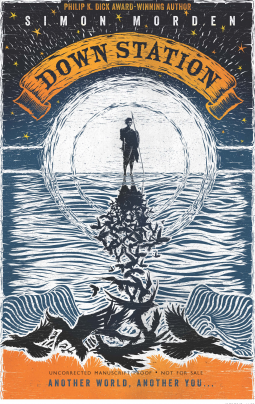
 I think that the simplest thing to say about Down Station is that although the description of its plot may sound like you’ve read this before, one thing that Down Station is not is ‘expected’.
“A small group of commuters and tube workers witness a fiery apocalypse overtaking London. They make their escape through a service tunnel. Reaching a door they step through…and find themselves on a wild shore backed by cliffs and rolling grassland. The way back is blocked. Making their way inland they meet a man dressed in a wolf’s cloak and with wolves by his side. He speaks English and has heard of a place called London – other people have arrived here down the ages – all escaping from a London that is burning. None of them have returned. Except one – who travels between the two worlds at will. The group begin a quest to find this one survivor; the one who holds the key to their return and to the safety of London.”
Though there are elements of traditional Fantasy here, Down Station is stranger, and weirder than I was expecting. And, in the end, I’m not sure that I liked what I read.
The first part of the book starts as you might want. We are introduced to a range of characters who are obviously going to take us through this unknown land. Dilip is a Sikh, whose work experience placement, as part of his engineer apprenticeship, involves him replacing track on the London Underground railway. His mentor, Stanislav, is a gruff East European, whose practical skills help Dilip realise the need for hands-on experience as well as academic learning.
Elsewhere underground, Mary is a ‘troubled’ (ie: sweary, truculent, rude) teen, whose work cleaning the litter from the tracks is part of her social rehabilitation programme and helps her deal with her ‘Anger Management’. Her work supervisor, nicknamed ‘Mama’, is a big, brash lady who supports Mary even when Mary argues with the strict boss supervisor.
It is these characters that the book focusses on when something unusual happens. The Tube is filled with smoke and things suddenly become very hot, even though the Tube is usually quite warm anyway. Trying to escape from what they think is an underground fire (though it is never clearly explained), the characters group together and try to find their way to safety. In doing so they escape through what they think is a service door but instead find themselves at a cold, dark and rainy coastal wilderness – about as far from London as you could be. The rest of the book is about their experiences here, in the world of Down.
Obviously, Down is very different to ‘normal’, and the group discovers very quickly that their urban skills are of little use. There are very few settlements here to be seen, nor humans. They are met by a man who has affiliated himself with wolves, but as they later discover is responsible for capturing newly arrived travellers and putting them into servitude. His attempt at capture leads to the splitting-up of the group. Mary ends up running away deep into a forest, whilst Dilip and Stanislav are captured and taken to a castle.
It is here in the plot that things begin to become very odd.
What seems to happen in Down is that people change into what they want to be, or what best suits their characteristics. The books moves into China Mieville-ian realms of unsettling reality/unreality, with characters becoming gladiatorial fighters, or creatures that can fly. Buildings rise or fall depending on how they are thought of. There are battles as the new arrivals take on the people of Down, but not all is what you expect.
And this may be my issue. My general feeling with Down Station is that it was a disappointment, though I am still trying to work out why. It is certainly different to what a reader might expect to be Fantasy, and this may be why it works (or doesn’t work!) for readers. Certainly there are few of the usual expectations on show. For example, this is a book with a tight focus on the characters, showing a mere three or four in some depth. We do not get to see much of the environment of Down, nor many of the creatures there, other than the key cast. There are people who we are introduced to but seem to play a very small part in what happens. The book generally focuses on Dilip and Mary, which leaves the rest of the cast rather side-lined.
Away from the main group, the people we encounter living in Down are also few in number. We meet Crows, a resident of Down who helps Mary in the forest, (though this may be for his own agenda) and Bell, who imprisons Mama, Dilip and Stanislav, but otherwise very few people, and certainly very few worth a mention.
The consequence of all of this is that my overall feeling at the end of the book was that actually not a lot happens. There is a quest element to it, but it actually seems rather unimportant. (The plot summary at the beginning of this review tells me more about the quest than I remembered the book doing so.) There is a mention of ‘a White City’, but little more than that. There is a solution to the events of the book, but no real resolution (presumably this will happen in the next book), though undoubtedly the characters are changed. Again, this could be the point of the book – but it left me cold, feeling that I’ve been short-changed, with only the beginning of a story that should have more.
What the book does do is perhaps highlight how useless most of us would be in such situations, which is a fair point.
In the end though, my overriding impression was that Down Station involved a series of generally unpleasant characters, with few characteristics I actually liked, who actually didn’t do a great deal. I can see why I should like it, but I’m not sure that I do. Putting it bluntly, if these people are the future of Humanity, then I despair. And that might be the reason why it could be a success. Personally, whilst I applaud Simon’s attempt to be different, I can’t help but feel that there is something missing here, a missed opportunity to be something more than it is.
In summary, Down Station is not going to be everyone’s cup of tea. Whilst some may like it because it tries to be different, others, like me, may be left rather bemused.
One to file as ‘Worth a try, but not to everyone’s tastes.’
Down Station by Simon Mordern
Published by Gollancz, February 2016
ISBN: 978-1473211452
352 pages
Review by Mark Yon




Kind of the way I felt about Lev Grossman’s Magician novels. Unlikable characters doing unlikely things in pursuit of whiny, self-indulgent goals.
Ouch. A tad harsh, perhaps, Gerry. But some could see it as that. Having said that, I liked The Magicians, (even if I accept your point.)
In my ceaseless (obsessive?) quest for brevity, what I intend as pithy sometimes emerges as impolite. I apologize.
No need for an apology, Gerry (though it is appreciated!): believe me, I’ve heard worse! And your point is understood, even with brevity! 🙂