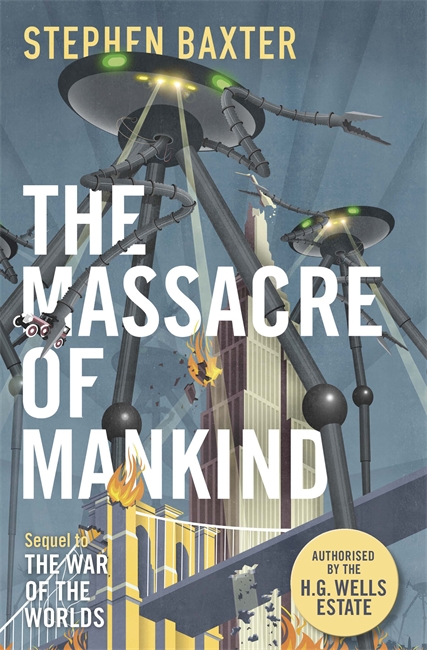
 The Massacre of Mankind by Stephen Baxter is an authorised sequel to The War of Worlds by H.G. Wells, a work that I hope needs no further introduction or explanation. Mark Yon previously reviewed Baxter’s novel for SFFWorld [link] and seems to have enjoyed it far more than me, and I encourage you to read Mark’s review for a counterbalance to my own opinions. For I found The Massacre of Mankind a unsatisfactory read, maybe even more so because the novel does so many things well in its first half. However, the second half of the book is bitterly disappointing as it loses any sense of narrative pull, and revels in exhausting and repetitive scenes of Martian destruction.
Like Wells’ original, the novel is presented in the form of a personal account, this time from the perspective of Julie Elphinstone. Elphinstone is a returning character, the divorced wife of the brother of Walter Jenkins, the narrator of Wells’ The War of the Worlds. Julie’s narrative begins in Manhattan, 1920, thirteen years after the first Martian War, where she has a career as a journalist. Elphinstone is contacted by another returning character, Eric Eden, now a high-ranking officer in the British army, who is trying to make contact with Elphinstone on behalf of Jenkins, who has a mysterious message for her. Well, perhaps it isn’t that mysterious or surprising that when Jenkins does make contact from his sanctuary in Berlin he reveals that he has discovered the Martians are returning to Earth, this time in greater numbers.
Not only do the Martians return to Earth in greater numbers, but also far better prepared than when they first attacked, and they quickly subdue England, creating a cordoned area in the middle of the country from which they can organise and plan their next move. Eden and Jenkins again make contact with Elphinstone, who they ask to penetrate the cordon in attempt to make contact with the Martians, relying on a series of alien sigils that Jenkins believes can be used to negotiate a truce with the invaders. Eden also secretly has Elphinstone infected with blood-born bacteria, a mutant strain of the illness that destroyed the first Martian foray in 1907. Elphinstone infiltrates the Martian stronghold in England, yet fails in both her overt mission to open a dialogue and her secret mission to infect the Martian invaders with the bacteria.
With their foothold in England secured, the Martians launch a further wave of invasions, this time strategically targeting various locations across the entire globe. In the United States, a journalist colleague of Elphinstone, Harry Kane, witnesses an attack on New York, which is temporarily thwarted by magnetic bombs invented by none other than an aged Thomas Edison. There are further accounts of more successful attacks in Melbourne, Peking, Berlin, Constantinople, Durban and St Petersburg. Meanwhile, Elphinstone has yet another idea on how the Martians might be driven away and again breaks through the Martian blockade in England to execute a daring plan with the assistance of a group of resistance fighters.
The last part of the novel recounts the aftermath of the invasion. For a final time, Elphinstone is contacted by Jenkins who has uncovered that not all the Martians fled the Earth at the end of the war, as is generally believed. Elphinstone, and a group of companions that include Eden and Jenkins, travels north to the Arctic where they discover a secret colony of Martians residing in a huge pit, possibly with secret plans to terraform the Earth and make it inhabitable for humans. At the end of the novel, the Martian invasion has inspired the various nations of the world to recognise their shared humanity and to unite to solve the problem of how to coexist, not only with each other and the Martians, but any other mysterious and superior alien minds that might be watching from the hidden depths of the solar system.
Baxter’s novel is most rewarding when read as an alternative history, with the invasion of the Martians in the early years of the Twentieth Century, as recounted in The War of Worlds, serving as its Jonbar point. The Martians have left behind remnants of their alien machinery, which has been studied and utilised by humanity, allowing Baxter to populate his 1920s setting with delightful anachronisms, including airships and groundships and other pieces of advanced technology and weaponry. Baxter also presents a number of intriguing and convincing geopolitical features within this divergent timeline. With the advent of the Martian invasion, World War One has not occurred, and as such Germany has been able to establish itself as a global super power, resulting in an occupied France and a drawn out war with Russia.
Elphinstone is also an endearing protagonist. She is a strong female character, a overt critique of the dated gender politics presented by Wells’ in his original novel. Baxter’s novel is strongest when the narrative is focused squarely on her, particularly in the detailed and evocative accounts of the initial invasion and her subsequent incursion into Martian-occupied England in the first half the novel. This first half of the book is comprised of a number of immersive set pieces told from her perspective and reminiscent of the most effective war fiction. Many of the secondary characters are equally endearing, such as Sergeant Ted Lane who helps Elphinstone battle through the Martian blockade, and Verity Bliss, a nursing volunteer in the English army who accompanies Elphinstone within the Martian cordon as she attempts to infect the invaders with the mutant bacteria.
It’s unfortunate that when the novel moves its focus away from Elphinstone in its second half, it loses narrative momentum almost completely. Much of the later part of the book is comprised largely of vignettes recounting the Martian obliteration of various cities around the globe, and from here proceedings become very repetitive and uninteresting. Baxter forgets his endearing and well-drawn cast of secondary characters from the earlier parts of the book, and instead presents a roster of new characters, who engender no sympathy or affection before they are summarily discarded as the story moves onto the next scene of wanton destruction. In turn, there is no dramatic tension or narrative drive to proceedings, and the novel begins to become tainted with the faint flavour of disaster porn. The book would have been far stronger, tighter and more concise if Baxter had kept his attention on Elphinstone, and her and her companions specific travails against the Martian invaders.
Not only does the second half of the novel lack any narrative pull or dramatic tension, but it also resolves in a way that is as disappointing as the conclusion of Wells’ original War of the Worlds. This fact is even recognised by the characters in the novel, who comment on the deus ex machina nature of the resolution of the events that have unfolded around them. Perhaps Baxter viewed this as homage, or even an ironic wink, towards Wells’ own novel, but is leaves the end of the book feeling flat and deflated. This is very much a story that ends, not with a bang, but a whimper. What’s perhaps most disappointing here is that Baxter teeters on the verge, at various points of the story, of delivering that hit of pure sense of wonder that many science fiction readers crave, only to pull back at the last minute, as if he is too beholden to the limitations of his source material to let his own ideas really break fee.
Perhaps it seems strange or contrary to criticise a sequel to The War of the Worlds for containing too many scenes of Martian fighting machines blowing up buildings. However, while this idea might have been exciting in the earlier part of the Twentieth Century, in the age of Roland Emmerich, the depiction of such destruction is now wearisome, especially on a cycle of rinse and repeat. There is evidence both here and in his previous works that Baxter has enough imagination and skill to write a wonderfully compelling and deserving sequel Wells’ great classic, but he choses to divert his attention to the wrong elements as his novel progresses. What is left is a book that feels like a tripod missing its third leg.
The Massacre of Mankind
Published by Gollancz, January 2017
ISBN: 978 1 473 20509 3
456 pages
Review by Luke Brown