When a street urchin/thief named Nahri accidentally summons a djinn when she’s trying to “heal” a patient, she is pulled on a journey out of 18th Century French-occupied Cairo to places she couldn’t imagine, learning more about herself and how complicated her world is. City of Brass is S.A. Chakraborty’s debut novel and the first installment of The Daevabad Trilogy. In it, Chakraborty takes the familiar coming of age fantasy and adds new spice and zest to the formula for an entrancing novel.
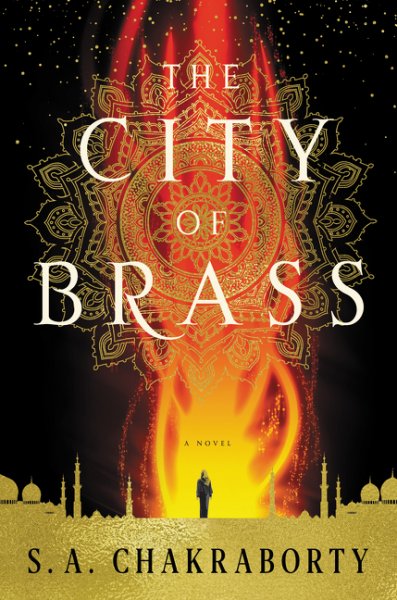
Nahri has never believed in magic. Certainly, she has power; on the streets of eighteenth-century Cairo, she’s a con woman of unsurpassed talent. But she knows better than anyone that the trades she uses to get by—palm readings, zars, and a mysterious gift for healing—are all tricks, both the means to the delightful end of swindling Ottoman nobles and a reliable way to survive.
But when Nahri accidentally summons Dara, an equally sly, darkly mysterious djinn warrior, to her side during one of her cons, she’s forced to reconsider her beliefs. For Dara tells Nahri an extraordinary tale: across hot, windswept sands teeming with creatures of fire and rivers where the mythical marid sleep, past ruins of once-magnificent human metropolises and mountains where the circling birds of prey are more than what they seem, lies Daevabad, the legendary city of brass—a city to which Nahri is irrevocably bound.
In Daevabad, within gilded brass walls laced with enchantments and behind the six gates of the six djinn tribes, old resentments run deep. And when Nahri decides to enter this world, her arrival threatens to ignite a war that has been simmering for centuries.
Spurning Dara’s warning of the treachery surrounding her, she embarks on a hesitant friendship with Alizayd, an idealistic prince who dreams of revolutionizing his father’s corrupt regime. All too soon, Nahri learns that true power is fierce and brutal. That magic cannot shield her from the dangerous web of court politics. That even the cleverest of schemes can have deadly consequences.
After all, there is a reason they say to be careful what you wish for . . .
Nahri has been surviving the streets of Cairo most of her life, profiting on her ability to heal others through sensing their illness and being something of a fortune teller. Two things stand out immediately in Chakraborty’s novel: the character of Nahri and the sense of place. 18th Century Cairo comes across as a place where only the select few can succeed and the masses are largely fending for themselves in the streets. In Nahri, that harsh survivalist instinct comes across quite strongly and helps to make for a fascinating character. When she summons Dara, the powerful djinn warrior by chanting a spell in a language she can understand despite never seeing, Nahri’s life changes irrevocably. Dara insists that Nahri make a journey to the Daevabad, the magical, legendary City of Brass which gives the book its title.
The journey on the flying carpet (yes, an actual flying carpet) takes up only about a half of the novel and allows for the two characters to grow, reveal themselves to the readers and themselves. Over the course of their journey, Nahri and Dara encounter monsters and creatures out of Egyptian myth, some familiar for their echoes of creatures out of more widespread mythologies, others fascinating for their lack of familiarity.
Meanwhile, in Daevabad, the city is already in the midst of royal/political chaos with divisive conflict amongst religion and races. We get a glimpse into Daevabad through Prince Ali leading up to Nahri and Dara’s arrival.
Nahri is an orphan so it isn’t too much of a spoiler to reveal that she learns a little bit about her family and who her parents are once she arrives in Daevabad. She also learns more about the history of the djinn, the people as a whole as well as Dara, the djinn who led her to Daevabad. Although Nahri may be quite young, she asserts herself quite well once in Daevabad after a little bit of a learning curve.
Chakraborty brings City of Brass to a wonderful, unexpected, and rewarding conclusion that manages to resolve much of what was laid out in the early portion of the novel while also giving readers a great foundation to consider for the sequel.
This is an impressive debut novel and what’s more amazing is that Chakraborty has said this is the first novel she ever wrote. Damn. There’s a lot to like here, even some things to love and admire. As I said in the opening of this review, Chakraborty does a wonderful job of building empathy and likeability in her protagonist, serving to make Nahri a difficult character against which to root. In her early twenties, she could easily come across as too headstrong and pushy, but because Nahri has spent much of her life on the streets, there’s a rough edge and maybe even youthful wisdom that makes her a delightful character. Dara is a mystery throughout much of the novel, frustrating Nahri with what he refuses to reveal about himself. Despite that, there’s an undeniable charm to him and a lovely chemistry connecting the two characters.
City of Brass is an extremely accomplished novel, a showcase for a writer who loves story, understands the power of classic stories, and how great stories managed to balance that classic sense with modern sensibilities and new infusions. This might be the best genre debut of 2017.
Highly Recommended
© 2017 Rob H. Bedford
Review copy courtesy of the publisher, Harper Voyager
The Daevabad Trilogy, Book 1
Published November 2017
http://www.sachakraborty.com/
Excerpt: https://www.tor.com/2017/10/19/excerpts-s-a-chakraborty-the-city-of-brass/