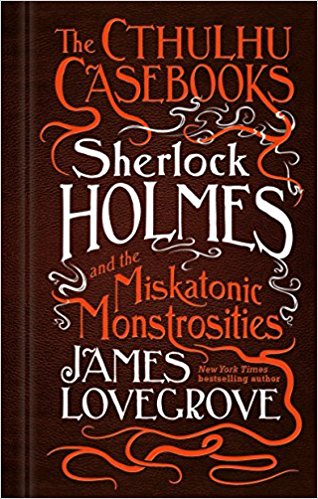
 Last year I really enjoyed the first in this series (review HERE), which seemed to capture the essence of Sherlock Holmes’ Victorian London and suffused it with Lovecraft’s Cthulhu Mythos. It was much more successful than I was expecting it to be, and so I picked this one up with some anticipation.
From the publisher: It is the spring of 1895, and more than a decade of combating eldritch entities has cost Dr John Watson his beloved wife Mary, and nearly broken the health of Sherlock Holmes. Yet the companions do not hesitate when they are called to the infamous Bedlam lunatic asylum, where they find an inmate speaking in R’lyehian, the language of the Old Ones. Moreover, the man is horribly scarred and has no memory of who he is.
The detectives discover that the inmate was once a scientist, a student of Miskatonic University, and one of two survivors of a doomed voyage down the Miskatonic River to capture the semi-mythical shoggoth. Yet how has he ended up in London, without his wits? And when the man is taken from Bedlam by forces beyond normal mortal comprehension, it becomes clear that there is far more to the case than one disturbed Bostonian. It is only by learning what truly happened on that fateful New England voyage that Holmes and Watson will uncover the truth, and learn who is behind the Miskatonic monstrosity…
As the second book in the series, this one does what’s required of a sophomore novel, in that it takes the characters further than the first one did and broadens the scope of the imaginary world we are visiting. In this one we move away from London to involve that American icon of eldritch educational learning, Arkham’s Miskatonic University.
There is relatively little preamble here. Set fifteen years after the first, there’s a brief reintroduction made before we are launched into this new story. Watson’s rather dour matter-of-fact descriptions keep the story fairly grounded in its rather fanciful developments and things happen that definitely change our perspective and our understanding of Holmes in this alternate version. Having made the rather startling proclamation that the supernatural is real in the first book (not the sort of thing usually expected from this icon of deductive reasoning!) this book examines the revelation further and tests Holmes’ understanding of reality further.
At the beginning of this novel it is clear that the constant battle for order has worn down Holmes and Watson. They are tetchy with each other. Holmes resents the intrusions made by the popularity of Watson’s mundane accounts, and the disappearance of the fictional Holmes fighting Moriarty at the Reichenbach Falls had been at Holmes’s request. Watson, usually the voice of reason and the ardent supporter and benefactor of Holmes, finds himself wishing for a life away from Holmes and the cases he accumulates.
At this point Holmes and Watson are invited to investigate an American patient held in Bedlam Asylum, one whose insane rantings involve phrases of Cthulhu-ian language. The patient, Bostonian Zachariah Conroy, is abruptly kidnapped by what Holmes and Watson believe to be a nightgaunt, a huge bat-like creature under the thrall of one with connections to the Outer Gods. Tracking the creature, our two heroes are led across the Rainham Marshes to a lonely farmhouse where they are discovered and held by the owner of the nightgaunt, Nathaniel Whateley.
Here the book takes an abrupt left turn by becoming a journal within a journal. For the next two hundred pages we are given a manuscript that is an account allegedly written by Conroy. We discover how Whateley and Conroy met at Miskatonic University and how the pair fell in league with other. As his experiments on animals become more and more extreme, Conroy is expelled from Miskatonic U and, in order to pursue his studies further, agrees to accompany Whateley on a trip up the Miskatonic River to discover new and unusual species to experiment on.
As you might expect, this does not end well but eventually leads back to the present (1895, anyway) and Holmes and Watson’s predicament. There’s a nicely unexpected twist towards the end of the book and things are set up nicely for the final book in this trilogy.
The book’s a lot of fun, and I’m pleased that James has managed to continue the style and tone of the first. Interestingly, the fact that nearly half of the book does not directly involve Holmes and Watson was not an issue. The journey upriver, in true Heart of Darkness style, is as gruesome a horror story as you might expect and works admirably well as a Lovecraftian tale rather than a Holmes and Watson one. There’s even an element of Mary Shelley in there too. James cleverly echoes the style of HPL in this part of the book with physical horrors as well as cosmic ones. I liked the interesting little observations made on racism and class here too, reflecting Lovecraft’s own background and culture.
So, despite the absence of Holmes and Watson for a significant portion of the novel, did I enjoy this one as much as the first? Hell, yes. The pages turned as fast as they did with the first and there’s a set-up that makes me eager to read the next novel in the series now. (Unfortunately not due until this time next year.)
If you liked the first book you will not be disappointed with this one. Well done James for managing a difficult task again.
Sherlock Holmes and the Miskatonic Monstrosities by James Lovegrove
Published by Titan Books, November 2017
Book 2 of The Cthulhu Casebooks
460 pages
ISBN: 978-1783295951
Review by Mark Yon