
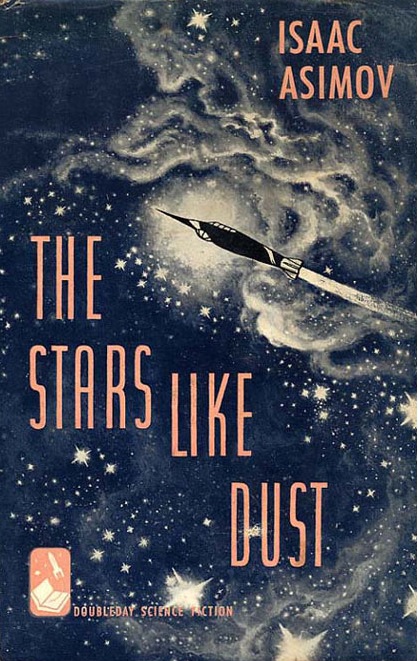
 As part of our ongoing commitment to reading older Science Fiction at SFFWorld, my latest read is one of Isaac Asimov’s earliest novels.
In terms of context, The Stars, Like Dust is one of the so-called “Galactic Empire” novels. Like the more-famous Foundation series, it is set at a time when people are spread across the galaxy on hundreds of planets. Of the so-called Empire trilogy (Pebble in the Sky (1950), The Stars, Like Dust (1951) and The Currents of Space (1952)) The Stars Like Dust is the ‘middle’ book, written after Pebble in the Sky but actually set chronologically in the galaxy before it.
The setting is that humans have spread throughout the galaxy, approximately 10 000 years in the future. Mankind is settled on over 1000 planets.
This story begins on Earth with an assassination attempt on young student Biron Farrill, who finds himself drugged in his bedroom with a small radioactive bomb set to go off in his closet. As the son of the Rancher of Widemos, it seems that his removal is part of a covert coup. We then find that his father has been kidnapped and killed by the Tyranni for being the ringleader of an attempted revolutionary movement.
Assisted by older mentor Sander Jonti, Biron, under the alias of Biron Malaine, is given passage to Rhodia, where he can be mentored by the Director of Rhodia, the seemingly ineffectual Hinrik V.
On Rhodia, Biron meets Artemisia, the daughter of the Director, and her uncle Gillbret. Gillbret tells of a rebellion planet he once visited and the three of them together try to rediscover it, having narrowed the locations to one of five possible places, with the hope that they can work together to overthrow the Tyranni.
A mysterious ancient artefact may also be important, being described by the Rancher as “the most dangerous document he knew”, something dated from “between the fifteenth to twenty-first century.” “The matter is death for the Tyranni and death for us as well; but it would mean final life for the Galaxy.” Unfortunately, it has disappeared from Earth.
Pursued by Tyranni commissioner Simok Aratap, they escape using a Tyranni warship and travel to the planet Lingane, where Biron meets the Autarch. The Autarch has discovered that a rebellion planet may be in the difficult to navigate Horsehead Nebula. They travel to the planet, but find nothing living there. There is a confrontation between Biron and the Autarch. Afterwards, Biron, Gillbret and Artemisia, as well as the Autarch’s aide Tedor Rizzett, are captured by Aratap and interrogated for the whereabouts of the rebellion planet.
The ending to the tale is that there is really no rebellion planet but that the revolution is being masterminded at a place closer to home, by people they know but not under suspicion. Revealing themselves to Biron and Artemisia, their leader knows of the secret ancient Earth document – the Constitution of the United States.
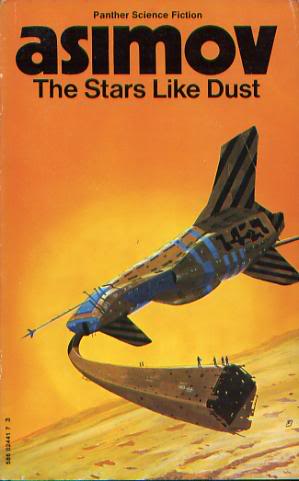
Reading through the above synopsis, it is clear that there’s not a lot of originality here, though to be fair this predictability may be due to the familiarity created over time. It’s a typical space opera, with simple characters to love and hate, combined with a chase to create tension and a grand reveal at the climax that even at the time of its original publication may have seemed a little overblown.
From the perspective of the twenty-first century, the climatic event at the end – the revelation that the American constitution is the most-deadly weapon of all – is clearly meant to be a crowd-pleaser. To a contemporary audience it rather reads as a rather simplistic, even jingoistic, point slapped on as an afterthought. Whilst this total belief in democracy may be a reflection of the general mood after World War II, today it feels like a simplistic “get-out” which may sit uneasily with contemporary readers.
Generally though, the lines of logic throughout the novel are rather confused. Simok Antrap is shown not as a maniacal servant of tyranny, but instead as a quiet and intelligent administrator trying to do his job in difficult circumstances and bring order from chaos. At the same time, there are signs that democracy has not always been the salvation it is expected to be, for many parts of the Earth are radioactive waste from a nuclear war in the past – so much for democracy. And yet the ending of the whole novel centres on this point.
Asimov himself has been quoted as saying that the ending was a mistake, rather foisted on him by the story’s original publisher, H. L. Gold of Galaxy Magazine. In the end it may be the reason for Asimov being quoted as saying that The Stars Like Dust is his least favourite published story, though he never changed it, even when he had the chance to do so in novel rather than magazine form. To me it rather spoils what otherwise is a typical space opera of politics and romance.
Up to that point, though, there’s a lot to like. Whilst the inevitable romance is somewhat chaste and predictable, and the action of the “one bound and he was free” variety, The Stars, Like Dust is still an often charming and entertaining tale, with signs that science fiction is in transition. Its unsophistication is a throwback to the pulp stories of the 1930’s and 40s, but there are elements that show that things have moved on. It’s not The Stars My Destination, but its weariness of war and the author’s determination not to have everything end in a big battle show that things in science fiction are becoming more thoughtful and sophisticated.
Many of the bigger ideas here – the expansion of humans across the galaxy echo the novel’s more famous sibling, The Foundation Trilogy, and much of the attraction of The Stars Like Dust may be because it covers the central themes of Asimov’s more famous work but from a slightly different perspective, at an earlier time. There is a broad canvas here – all the galaxy is ours, so to speak – but the writer focusses on a much smaller story, as he did in the first three Foundation novels. This is not the only similarity. The two leads in Stars, Like Dust seemed reminiscent in tone and manner to Foundation and Empire’s Toran and Bayta Darell, with Gillbret being a similar template to Ebling Mis. Asimov hasn’t exactly strayed far from his archetypal outline.
In short, The Stars, Like Dust is an entertaining read – a mystery plot with a frenetically paced chase and with enough of a sense of awe to still engage the reader. Despite its misjudged ending, there’s a dated charm and naivety that makes it still readable. It is not Asimov’s best, but Asimov’s critical judgment of his own work may be a little harsh. It’s not Asimov’s best work, by a long way, but there’s a lot here to enjoy.
The Stars, Like Dust by Isaac Asimov
Published 1951 by Doubleday.
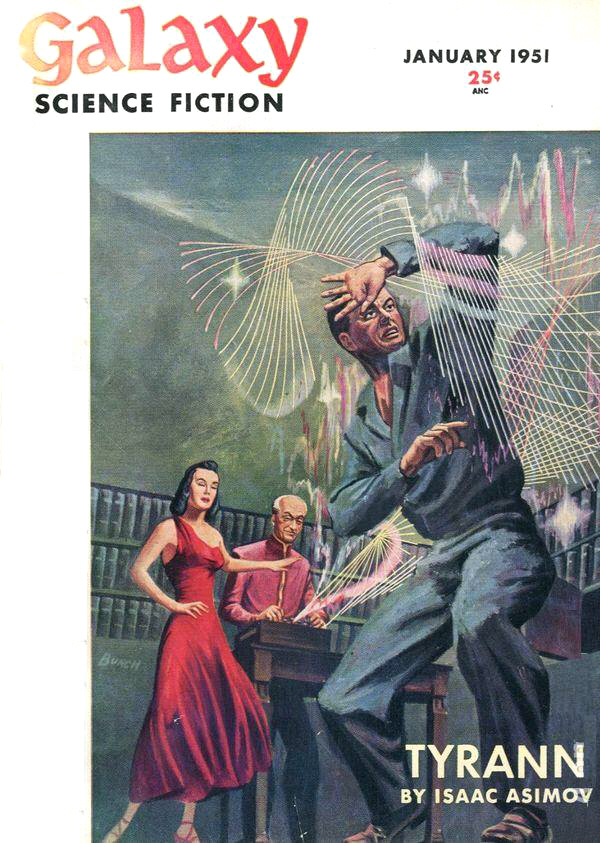
Originally published in the January – March 1951 issues of Galaxy Magazine as Tyrann.
218 pages
Review by Mark Yon




You say, “At the same time, there are signs that democracy has not always been the salvation it is expected to be, for many parts of the Earth are radioactive waste from a nuclear war in the past – so much for democracy.”
What?
Democracy is not a shield against nuclear weapons; it’s an idea which can transform civilizations. (Not that what we have in North America today is actually a democracy.)
And unless you’re old enough to actually remember WWII or its immediate aftermath, you might not appreciate the “jingoistic” tone of the times. Remember, much of the Western World’s male population had been engaged in a sometimes brutal war, which affected the civilian populations as much–and sometimes more–than the military.
And parts of the U.S. today are infected with a more severe form of jingoism, where any statement, no matter how ludicrous, is greeted with uncritical applause. The constitution being a Deus ex machina seems mild by comparison.
My point was that when the story appeared in the 1950’s, at a time when democracy was seen as the salvation/transformer of civilisation by many Allied countries, the story shows that there has been a nuclear war in the future, creating places that are still radioactive. The inference is that therefore democracy, which in the 1950’s is seen by some as the process which preserves peace following WW2, has not worked at some point or has led to nuclear weapons being used by it or against it.
Or at least that was my interpretation of it.