
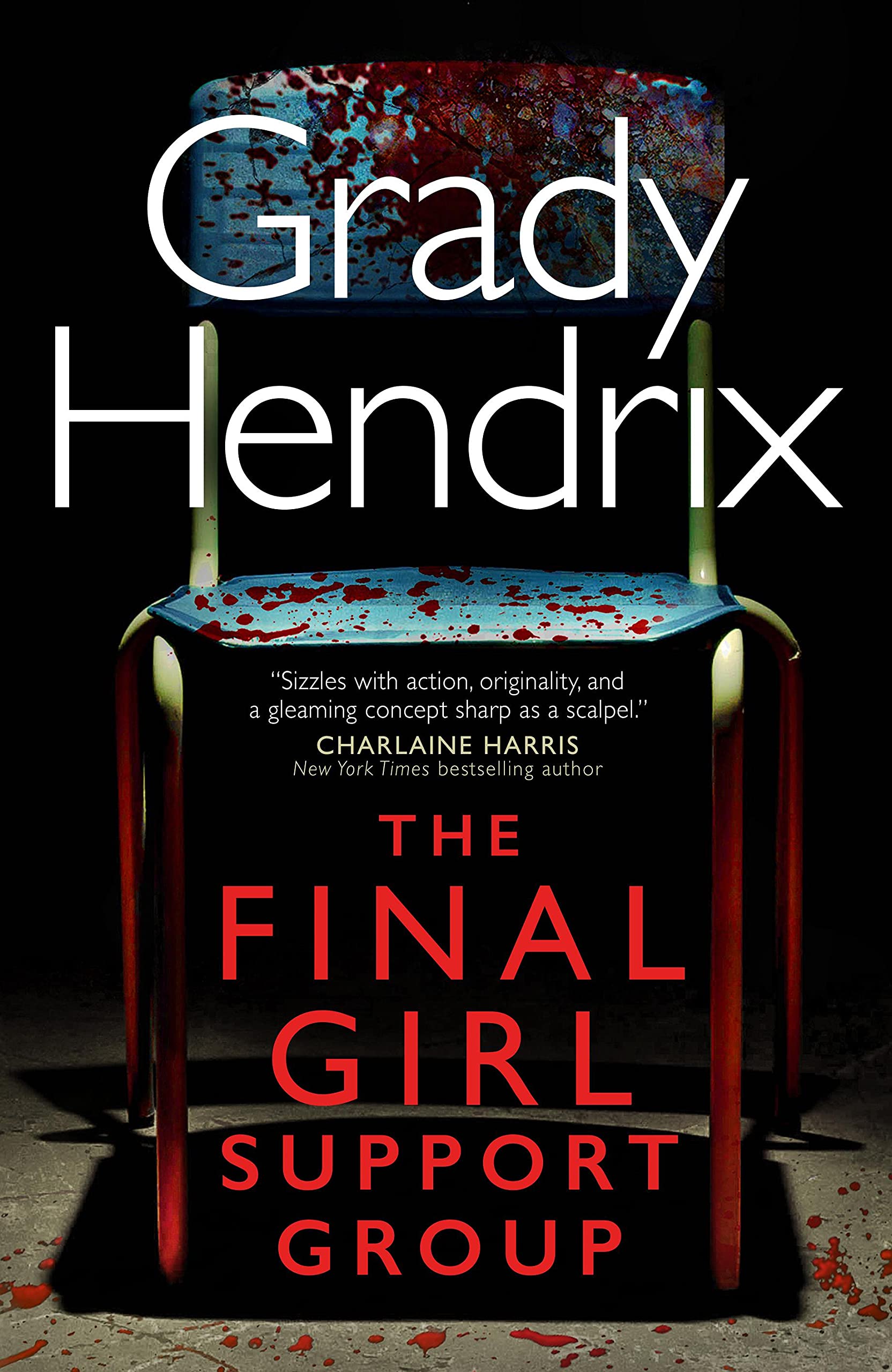
 Ever since I read We Sold Our Souls I have found that picking up a Grady Hendrix novel is a treat. There’s something about his style which is seemingly effortless and yet at the same time ferociously clever.
His books to date have taken on different aspects of the Horror genre. We Sold Our Souls looked at Lovecraft through the lens of a 1980s rock band, and his last book The Southern Book Club’s Guide to Slaying Vampires (reviewed by Rob HERE) seemed to me like a cross between Buffy the Vampire Slayer, Steel Magnolias and The Stepford Wives.
I must admit though that his latest involved a key horror theme that despite reading and watching the stuff for many years I hadn’t realised existed – that of the ”Final Girl”. This is the character often left at the end of a story or a film who is left to save the day, vanquish the villain (usually male) and then pick up the pieces. Think Laurie Strode in Halloween, Ripley in Alien/s – you get the idea.
It’s obvious now I think about it – but I hadn’t realised that it was a meme, like Mary-Sue and all the rest.
The novel premise of Grady’s latest book is that six of these final girls, traumatised and broken by their different experiences of this phenomenon have created, with therapist Dr. Carol, a group to help support each other. I must admit that my initial impression from the title was that this was going to be some sort of jokey self-reverential story.
Each girl has gone their own separate ways and dealt with their issues in different approaches. Much of the book is about telling what happened to them as backstory. As the book puts it, “Dani became self-sufficient, Adrienne got into self-help, Marilyn married up and buried her head in the sand, Heather got high, Julia went activist. Me? I learned how to protect myself.”
The “me” here is Lynnette, who is the narrator of the story. Amongst all of this backstory there is a framing ongoing narrative in that one of the girls, after years of protection, is killed. The others go into survival mode as others are also killed. The killers clearly know all about them, their habits and daily lives, even their alternative escape procedures. Lynnette is nearly killed and goes into hiding, to find that all of her escape plans have been altered by someone who knows them.
As the book continues, this chase becomes more frantic and also more interesting as Lynnette tries to discover who the perpetrator/s is/are, before she gets killed herself.
I must admit that I wasn’t too impressed with the characters at first. The book begins with one of the group’s irregular meetings. It is nasty, argumentative and fractious, and their lack of social skills and self-centred moaning did not entirely enamour me to them. But this was, of course, deliberate. As the story unfolds and their respective backstories are revealed, I realised that this dysfunctionality is intentional. From all of this unpleasantness, I found that I actually began to like them, or at least understand the reasons for their behaviour. By the end Grady manages to turn our opinion as readers, whilst he is building up the tension.
More interestingly, the book raises interesting questions, as it examines the culture that got us to this point and the idea of how do you survive in a culture of social media and constant surveillance? When all of the media hoo-ha has gone away, how does life carry on for the victims?
To develop this further, each chapter is prefaced with newspaper articles, social commentary, film reviews and the like, because – surprise, surprise – each of the girls have been made ‘famous’ by their stories. Some have even been turned into the most successful slasher movies of their day. As much as the book is a spotlight on the girls, it is also an intelligent reflection on our society. It doesn’t do well.
As this is Grady, such articles do not miss covertly mentioning some of the most famous horror franchises of their day, giving us variations on Friday the 13th, Halloween, A Nightmare on Elm Street, The Texas Chainsaw Massacre and even Scream (referred to here, amusingly, as “Stab”.) Fans will appreciate them, but you don’t have to get the references to grasp the story.
Entertaining, engaging and fiendishly clever, The Final Girls Support Group is a book that will draw you in and keep you reading long after it has got dark. (Or at least it did me.) Fans of the horror genre will not be disappointed. An unreservedly recommended novel, which would be a great beach-holiday read for the Summer.
The Final Girl Support Group by Grady Hendrix
Published by Titan, July 2021
ISBN: 9781 096 064
400 pages
Review by Mark Yon




The title absolutely drew me in when I saw it in my newsletter headline. Thanks for your review– I’m definitely going to check it out!
Thanks, Annie: hope you enjoy it!
“…the book raises interesting questions, as it examines the culture that got us to this point and the idea of how do you survive in a culture of social media and constant surveillance?”
Celebrity culture, the building and maintaining of the platforms for it, have chewed up and spit out everyone from Marilyn to Elvis to Michael to Whitney and beyond, and what Grady seems to be discussing taps into that.
Great review, Mark. I’m really looking forward to reading this one.
Thanks, Randy. And yes, absolutely. Hope you enjoy this one!
Why would you spoil major plot points in a review? I’m ticked off. Thanks for literally nothing.
Apologies, Jean. We are very careful NOT to give major plot points out in our reviews. The plot mentioned in the review pretty much all appears in the first 50 or so pages of a near-400 page book, with a lot of what happens in that part of the book and elsewhere in the book deliberately not mentioned in the review. I am sorry that you feel that way, but most of what you’re seeing there is out on the book jacket cover or in the publicity sent out by the publishers. The information given sets the scene and gives readers a flavour but shouldn’t spoil the book at all. If you think what’s been given here as spoilers here, then you really haven’t read the book. Apologies again if you think it does.
Enjoyed the book a lot, Hendrix is one of my favorite authors. However, I can’t help but feel like there was something missing in this one. Not sure what it was. Maybe the lack of supernatural (except for a small reference towards the end.) Still, a great read and he’s getting plenty of recognition for it that’s deserved.
Hi David. Thanks for your comment. It’s a good point, and perhaps one we should have raised in the reviews. This one IS more about “the Horror” than “the Supernatural”, but then I think that most of them are. “We Sold Our Souls” definitely had a Lovecraftian element to it and “Southern Book Club” had… well, vampires!