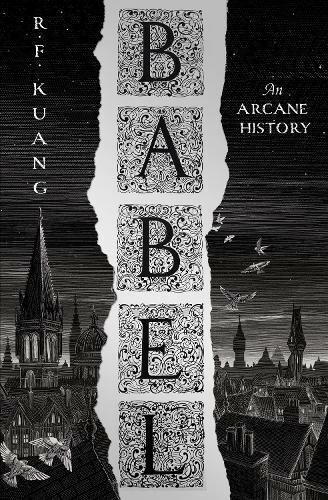
 An orphan boy found in a plague-ridden Canton is brought by a mysterious benefactor to London in 1836 and then Oxford. Centre of study and learning, the city’s centrepiece is perhaps the tower of the Royal Institute of Translation, colloquially named Babel after the Biblical reference.
Now renamed Robin Swift, the young boy takes up a position of a scholar in Oxford at the Royal Institute. He meets other students in their shared work on translating other languages such as Robin’s native Chinese into English. With Lettie from England, Ramy from India and Victoire from Haiti, together they explore the city together whilst working and learning in the tower of Babel.
It sounds like heaven to Robin, but when mysterious things happen and secrets are uncovered about Professor Richard Lovell, his enigmatic guardian, Robin, Ramy, Victoire and Letty see the dark side of the city and even some unpleasant truths about the British way of life. It seems like an impossible task, but can Swift and his friends bring down the British Empire?
My first impression on reading the first part of Babel was a surprising one – that it was like “Hogwarts for Grown-ups”, though perhaps more Lev Grossman’s The Magicians rather than HP. My reasoning for this was that Babel has throughout its initial pages a clear and detailed love for academia as seen by Robin – the buildings, the learning, even the lifestyle, something that Robin comes to admit in his first year in Oxford.
There is a real joy of learning and academia, combined with a student life that is seductively attractive. With Oxford’s cobbled streets, inns, cafes and bookshops, Kuang manages to infuse these details throughout the main plot as JK Rowling did with Hogwarts. Its gaslit cobbled streets, narrow alleyways and monumental buildings creates a magical image of a Victorian Oxford steeped in ancient history and books, of course!
There is more to this, of course. The magic element of the book uses this idea that much of the translator’s power comes from combining words that are similar, yet different, engraved on silver. The quote: “Traduttore, traditore: An act of translation is always an act of betrayal” has an important meaning here, as translators struggle to match a statement in one language with an equivalent from another. I found the process fascinating.
Much of the rich backstory and history threaded through the novel are presented through the many footnotes throughout. I know that they will annoy some readers as much as please others, but I thought that these were the best I have read since Susanna Clarke’s Jonathan Norrell and Mister Strange.
Although all of this is great, the book’s main strength is its characterisation. Robin Swift is very much a modern take on a Dickensian hero. Like in many a Dickens novel, we have a young orphan whose journey to adulthood is fraught with mystery and danger. As the story progresses, we get told that despite how the world of privilege appears on the surface all is not well, and that beneath the veneer of cultured society there is the racism and cultural injustice that such a society thrives upon.
The book works at different levels, though, and the key points of the novel are what turn this novel into something more than a Dickensian pastiche. The supporting cast are filled out with details nicely as well, although some are a little too unsubtle in their portrayal. Kuang does well to turn some characters around, where those who have been perceived as good may not be and vice-versa. The theme of things being lost in translation is an engaging one, and one the author manages well.
By the end, it becomes clear that this privileged academic life and even the Empire is little more than a poisoned chalice. It’s an anti-Imperialist standpoint, a contemporary view on a book set in a Dickensian or Victorian past. The setting allows the author to question the role of the British Empire in colonialisation, and whether such empires are a benefit or a boon. In her angry mode, Kuang unleashes scorn and anger on the challenges of racism, poverty and inequality that this society exhibits.
We have none of Rudyard Kipling’s imperialistic flag-waving here, but instead the opposite. Although silver provides many benefits to the world, its mining and usage creates inequality. The characters find that beneath their life of comfort and privilege, there is a darker, crueller world of subservience and slavery, emphasising that contrary to the view of the arrogant English to many other places “colonialism is bad”.
Although I did feel that the anti-imperialist point that “colonialism is bad” is put across a little too strongly and a little too often for my liking, I felt that this was a much more measured and consequently a better-balanced novel than the author’s previous series.
Whereas in the Poppy War books I felt that the righteous anger was rammed home with all of the subtlety of a house brick, with Babel I felt less pistol-whipped by the constant repetition of referencing to bad things that happen. As a result, the understandable outrage at injustice feels more appropriate and more realistic and made me feel that whilst the author was trying too hard, the point is a well-explained and valid one.
There were other issues with the book in that I found that as the book widens its view to take in China and the Far East, the events away from the tower and Oxford seem a little less convincing than the ones focused upon the city. There’s the odd plot element that seemed rather coincidental, although these were relatively minor. On the whole, the detractions are far outweighed by the positives, a book that is thrilling, gripping, literate and intelligent.
In summary then, Babel is a book created to tell an exciting tale of communication, academia, love and friendship, linguistics and anti-imperialism, but at the same time deals with treachery, betrayal and deception. It is perhaps a Dickensian-style novel of a character’s progress through life but written for the woke generation. It reads like a revised, updated version of a Charles Dickens novel, where Phillip Pullman’s Dark Materials meets David Copperfield, perhaps. As it bridges old perspectives with new, I can see why this one has been popular with those who rarely read genre fiction as well as those who do.
Personally, I found it to be, and despite those minor quibbles, a very good read.*
BABEL by RF Kuang
Published by HarperVoyager, September 2022
547 pages
ISBN: 978-0008501815
Review by Mark Yon
*Update: Since writing this review it has been announced that BABEL has won the Best Novel Award at this year’s Nebula Awards (for books published in 2022)., and also the Best British Fiction book for 2023.