 What are dreams? Alternate realities, glimpses into ‘another place’, where our minds go free, or our brains trying to make sense of the previous wakened hours?
Whatever they are, they have been a science fiction and fantasy staple for decades, from Roger Zelazny’s Amber series to Elric’s Moonbeam Roads connecting the Multiverse, to Neil Gaiman’s Sandman and lately Brandon Sanderson’s Stormlight Archive series and Richard Swan’s Empire of the Wolf books.
Perhaps I should also mention the ubiquitous Stephen King’s book and film Dreamcatcher or the movie Inception.
I’m sure that there are hundreds of other examples, both in and out of genre. Dreams are clearly something which fascinate us – a connection between the real and unreal, as they hold possibilities somewhere between hope and despair. They may seem real, but are just our imagination. As Roy Orbison once sang,
“In dreams I walk with you.
In dreams I talk to you.
In dreams you’re mine, all of the time.
We’re together in dreams, in dreams.”
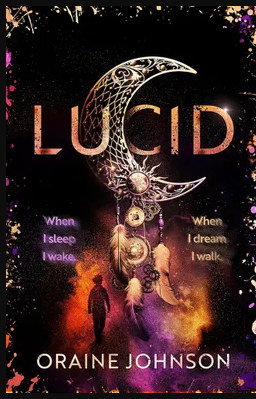
The relevance of this? Well, here we have Lucid, the debut novel from young author Oraine Johnson. It’s a story set in a near-future Birmingham (in the UK), a tale of urban fantasy with a touch of an action-adventure thrown in. But most of all, it’s a detective mystery combined with these somnambulistic archetypes.
Joe Jacobs is a typical teenager living in a near-future Birmingham. (For non-UK readers, that’s the second-biggest city in England.) He lives with his adopted Mum, detective Elizabeth Jacobs, but is also at present going to University, attending lectures by Professor Grey.
In his leisure time he hangs out with his lifelong friend Sam West, who, like his other friend Aleyah is a geeky outsider. Bonded by their common interests, the three of them deal with all of the interests and tribulations of life put upon teenagers – skateboarding, coursework, fashion, films, computer games, music, not to mention racism, sexism, bullies, gangs and possible romantic relationships. It made me rather think of Spiderman’s Peter Parker to some extent – or perhaps more Miles Morales, as Joe is a person of colour, but with a Birmingham (Brummie) accent.
Joe has his own personal issues as well. He is an orphan, which has caused him trauma from childhood and for which he has been until recently having counselling. He also takes medication for panic attacks.
All of these challenges mean that when he starts having blackouts and experiencing hallucinogenic visions it is initially unclear whether this is a new challenge or just something that is a consequence of this. Is Joe is having episodes created by stress and struggling with being a teenager, or could they just be him badly reacting to his medication?
When Joe’s mum (ex-detective but still involved with the police force) becomes involved in a murder case near to where they live, this creates more tension, not just because she has to reluctantly work with ex-colleague Detective Kukadia, but because Joe sees things in his dreams.
It may be connected to a strange gift arrives on Joe’s birthday: a dreamcatcher that hums with otherworldly energy. There’s no sender, and no explanation, just an eerie inscription: ‘We Are Such Stuff As Dreams Are Made On’.
As things progress Joe, his friends and family become not only dragged into events, but are also put in danger – something that perhaps only Joe can sort out.
It might be worth pointing out that there are issues in the novel that may be triggering for younger readers – the book deals with mental health, hospitals and institutions, not to mention neurological disorders which may be problematic for some readers.
My first thought on finishing this book is that it is surprisingly visual. Johnson spends a lot of time relating in prose things that would work well on a television or cinema screen or graphic novel – emojis, transcripts of speech and phone/text-speak, the language of teenagers today. As you might expect! This grounds the book in a degree of reality, necessary for what happens next.
Oraine also adds in noises and sound effects in prose to the text, to visualise this further –‘boof’, ‘bzzzggggrrrrr’ and ’bang-bang’, amongst others.
I guess in a world where much is communicated through visual means, from videos on Tik Tok and YouTube to programmes streamed on Netflix and the like, that it shouldn’t be that much of a surprise, but it might be to some readers. I have seen this before – L E Modesitt Jr’s Recluse novels do the same.
Interestingly, it was so filmic that as I read I found I was allocating main characters to specific actors – I saw Professor Grey as Morgan Freeman and Detective Kukadia as Luther, a character played by Edris Elba, for example.
We also get, in the finest traditions of Netflix and the like, a cliffhanger ending.
This visuality also meant that there was a fluidity to the prose. The pace of the book is fast, which means that you don’t have to think about things too much, as they move along swiftly. The downside of this is that some of the minor characters are skimpy in their details as we focus on the actions of Joe, his friends and his mother. Most crime books do this, I think – you need to worry less about the background details as they are recognisable from any police procedural you may have seen or read.
It was pleasing to read an urban fantasy not set in a major American city or even London, like Ben Aaronovitch’s Rivers of London series; This has some nicely developed local colour, which makes places recognisable and yet slightly different. Think of it as a modern-day Peaky Blinders but more genre elements.
This works up to a point here; gunfights in the hospitals of Birmingham and fights in Birmingham across the gangland city centre pushed credulity a little, although again I am aware that there are even weirder things also going on in the book at the time!
In short, Lucid is a good debut novel – a fast-paced and likable debut, with enough to make it different from many similar novels. Its readable prose, agreeable characters and rapid delivery will keep those pages turning, particularly for younger readers who I think will find this very appealing.
© 2025 Mark Yon
Hardback | Gollancz
LUCID by Oraine Johnson
August 2025 | 432 pages
ISBN: 978 1399 610 155