One of the recent discussions about Science Fiction I’ve had with non-genre readers has been about what readers want from Science Fiction. “Why do sci-fi writers explain things SO much?” was the question.
This made me think. Personally, I think that it is part of the SF heritage. Modern SF came from a group of readers and writers, often male, who were often also would-be inventors and engineers – they wanted to know how future things would work. It’s not entirely coincidence that Amazing Stories, widely regarded as the first major SF magazine (first published in 1926) was brought to life by publisher Hugo Gernsback, also known for his pioneering work in radio technology.
I think that because of this interest in science and technology, SF writers felt that they had to explain their inventions in their stories to their readership, although admittedly this was often done with a fair bit of flim-flam, Doctor Who ‘timey-wimey’ trickery. Often this did boil down to “Oh, you don’t need to know about that now…”
Moving forward, by the late 20th century this interest in science and technology had evolved. Many of those early SF readers had now become scientists, lecturers and engineers, and the writers often had a science degree. Result? Those writers wanted to show that their stories although fiction were based in science – or at least current science thinking. It created a sense of reality for things that were quite unreal. (What would aliens from a oxygen-deficient planet be like? What would it be like to live at, near or even inside a black hole? etc.)
Readers appreciated that to tell their stories many of these writers had done the maths and the academic legwork, if you like. And that focus on science in fiction still holds with many of the older writers still writing today.
And what does all of that have to do with this book?
Well, I have noticed that many who would consider themselves SF readers today don’t want those details that older readers expect – the details are difficult to understand, perhaps, too esoteric. More importantly, they feel that such extraneous minutiae slow down the plot: “Why do I need to know how a spaceship works? It just does – get on with it!” It’s rather akin to driving a car, I think: Do I need to have to know how my car works, as long as it does what I need it to do?
I was reminded of this as I read Charlotte’s take on a near-future mission to Mars, and indeed of Andy Weir’s recent success story, The Martian, of which this is similar. (I guess that we can also mention Project Hail Mary too for the same reason.) For that reason, I’m going to mention Weir’s novel a lot here.
My point is that Charlotte’s story is of the new style – a novel that manages to get its plot across without feeling the need to explain all of those scientific details. It reminded me how far things have changed.
Charlotte’s story involves three basic plot strands. We begin with Alyssa Wright, who is an astronaut involved in the most ambitious space flight in history: a one-way mission to Mars. Her story is the main focus of the novel pretty much from the start. When disaster strikes, she begins to uncover a conspiracy that threatens her life – and the lives of everyone on board.
On Earth, in Hong Kong, Kai, a coder, vanishes from his home, leaving nothing behind but a cryptic warning and his cat. Pursued by violent forces, his sister Jai finds herself on the run, in possession of the one thing capable of saving him.
Thirdly, what creates further plot tension is that some of the crew of the Argo spaceship, heading toward Mars, realise that someone may be sabotaging the mission from the inside.
All of this is pretty typical techno – thriller. The telling of the tale is well done on the whole and at times quite exciting. It rather goes without saying that it felt like it would make a good film or TV series – Charlotte is also a television producer, and it shows in the characterisation, as well as in the book’s pacing. Even the first chapter reads like a pre-credit scene. I expect to see this on a screen soon!
But what is most interesting is that this book reflects those changes in SF I’ve already been writing about. Mars One is less about the science, less about the explaining of things, and more about just telling a story. It is a fairly big book, at nearly 600 pages, and as a result there were plot elements that seemed extraneous, but generally it does that writing trick of giving the reader just enough detail to make the story work without giving copious details of the nuts and bolts of the things.
Interestingly, whilst Mars ONE has, like The Martian, an accessible tone that probably makes it readable to non-genre readers, unlike The Martian it shows that humans that can let us down. Whilst Andy’s story was a positive one – about how by working together, an astronaut’s life can be saved – Charlotte’s story suggests that humans do not always perform as positively as we would like them to. The Martian shows the reader that when a group works together, problems can be solved. By contrast, Mars ONE has treachery, skullduggery and betrayal, not to mention a side-swipe at corporate business and the media.
Whilst the general plot of Mars ONE isn’t particularly new – I’m thinking that writers such as Ben Bova, Stephen Baxter and Pamela Sergeant were writing similar ideas decades ago – it’s done with enough verve and energy to make this an entertaining and contemporary read. Unlike those that have dated, this one feels like ‘now.’
Having said that, it’s not perfect. I felt that towards the end there were perhaps too many plates spinning, with some of those all too-common coincidences for the sake of a plot. Most problematical was that the main villain of the novel, once uncovered near the end of the book (no spoilers here!) , just didn’t work for me. This meant that the ending, in comparison with the rest of the book, felt disappointingly weak, although it may work for you if you don’t think about it too much.
In short, Mars ONE has definite Andy Weir-type vibes; it is accessible and reads fast and well, all those things that new readers to SF relate to. I would not go as far to say that Mars ONE is better than The Martian, although fans of that may like this as a more contemporary upgrade. (The Martian is, after all, 12 years old now!) Mars ONE is a more straightforward action-centred novel set in a space-centred setting.
With all of the general uptake in interest at the moment in space travel, perhaps due to the success of books like Atmosphere by Taylor Jenkins Reid and Orbital by Samantha Harvey, not to mention in the launch of the Artemis II spaceship, this one couldn’t have been released at a better time. Despite my niggles, I think that this should mean that Mars ONE will do very well.
© 2026 Mark Yon
Hardback | Bantam Books (Penguin)
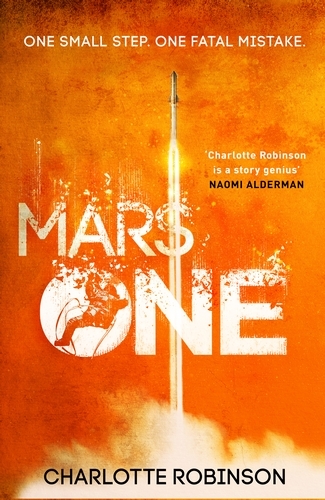
MARS ONE by Charlotte Robinson
April 2026 | 568 pages
ISBN: 978 0 857 50734 1