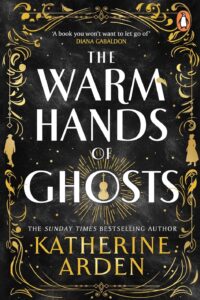
 I wasn’t quite sure what to expect with this one. Arden manages to combine real events – the Halifax explosion, The Battle of Passchendaele – with fictional characters and a fair degree of myth & legend.
Laura Iven is a Canadian veteran nurse, having already been to the Western Front and assisted the wounded and dying there. Injured herself, she has returned in January 1918 to Halifax, only to find the Nova Scotia area was devastated in December by a munition ship filled with explosives blowing up in the harbour. At least 1,782 people were killed – including her parents.
Not only that, but her brother Freddie has been reported as missing, presumed dead after the Battle of Passchendaele in November.
Laura refuses to believe that her brother is dead and arranges to return to the private hospital near the front lines, not only to help the wounded but search for her brother at the same time. With the help of her friend and patron Mary Borden and Penelope (Pim) Shaw, who has lost her son in the fighting, Laura returns to the ongoing slaughter.
What the reader knows, but Laura doesn’t, is that Freddie is still alive. After the Battle of Passchendaele, he wakes to find himself trapped with Hans Winter, a wounded German soldier. Against all the odds, they form a bond and claw their way to an escape.
All of this is developed nicely in the first half of the book – so much so that the first half of the book could be given as a straightforward historical novel. The book has much to say, that war is hell, that death is pointless in war and gives fairly graphic details (based on real soldier’s experiences) about what it was like to fight in such conditions. I was reminded of books such as Robert Graves’ Goodbye to All That and Erich Maria Remarque’s All Quiet on the Western Front, which Arden does well to imitate in her depictions of trench warfare.
Back in Belgium in January 1918, Laura hears stories of the trenches being haunted by the dead, with their ghosts moving among those still living. There’s also a rumour of a strange violin-playing hotelier in No-Man’s Land who invites soldiers to join him and whose wine gives soldiers the gift of oblivion.
The book emphasises the dichotomy between the generals away from the Front and the soldiers dying in droves in the trenches.
It also gives us a view of the war from the perspective of women. At times this portrayal of strong women seems a little too forced, but generally it works fairly well as a fresh take on a fairly ignored element of the WW1 front line.
There’s also a lot of guilt on show here too – guilt at having to kill, guilt at surviving whilst others did not. It is possible that the ghosts seen are part of that unable to leave their places of trauma.
The occult element becomes more covert towards the end of the book. Many of the strange events happening are based on legends from the actual trenches in the First world War, and I liked the way these were added to our fictional story.
Interestingly, by the end the supernatural elements are more eerie than scary: the horrors of war seem to be much more visceral than anything the supernatural can portray. Instead, the ghosts here seem to be often tortured, but at the same time benign and helpful.
Most of this develops in a way that seems logical. However, the ending seemed a little at odds with what had gone before, where all of that horror and creeping menace so effectively nurtured to this point is suddenly concluded in relatively few pages and a mightily convenient plot point whose ending seems rather at odds with what has happened previously.
Nevertheless, The Warm Hands of Ghosts has a lot to offer the reader. Whilst I’m unsure if it is completely successful, I liked the way that the book combined facts and myths with fiction. One for your historical fiction reader who likes something a little bit eerie, perhaps.
© 2026 Mark Yon
Hardback | Century
THE WARM HANDS OF GHOSTS by Katherine Arden
March 2024 | 400 pages
ISBN: 978-152 9920 031