John Gwynne has become one of the leading writers in Heroic, Epic Fantasy today. He is a recipient David Gemmel Morningstar Award and he’s an international bestseller. The Wolves of War is the first of the Wolfheart Chronicles duology that builds on Slavic myth, set at a time historians have called both the Dark Ages and the Viking Age. As has become a staple of Gwynne’s work, the novel features battles, heroes, some monstrous creatures and of course, clashing ideologies of humanity and at its core, heart and emotion.
The Clans once lived freely, honouring their gods and traditions. Then the northern invaders unleashed a tide of blood and fire. Now the Clans are a conquered people.
Ivan cares not for wars or kings. His only concern is the safety of his family, especially his daughter Halia, whom he would protect with his life. Halia has been trapped in her own body since birth, yet at night she has dreams of running with wolves and speaking with fae creatures of the forest. Many believe her cursed, but Halia’s awakening powers may be the only way she and her family can survive the coming storm.
For the wolves of war are stalking the horizon. Two princes have become mortal enemies, and an iron-toothed witch haunts the shadows. As mighty nations clash, Halia must master her strange magic to protect those she loves. To do so, she must accept a terrifying truth.
Sometimes, the only way through the darkness is to embrace it.
Vikings have conquered Kyviv, Ukraine and we see the story through four primary points of view: Dagmar, a Viking mercenary charged with finding holy artifacts; Halia, a young disabled girl “trapped in her own body” who has very a strong connection to wolves; her father Ivan who are just regular people trying to live their lives; and Ingvar, the son of the Viking conqueror who stormed the lands of Kyviv. It isn’t immediately clear how their storylines will intertwine, but that’s fine. The relatively slow burn gives Gwynne the opportunity to flesh out these primary characters and those in their orbit.
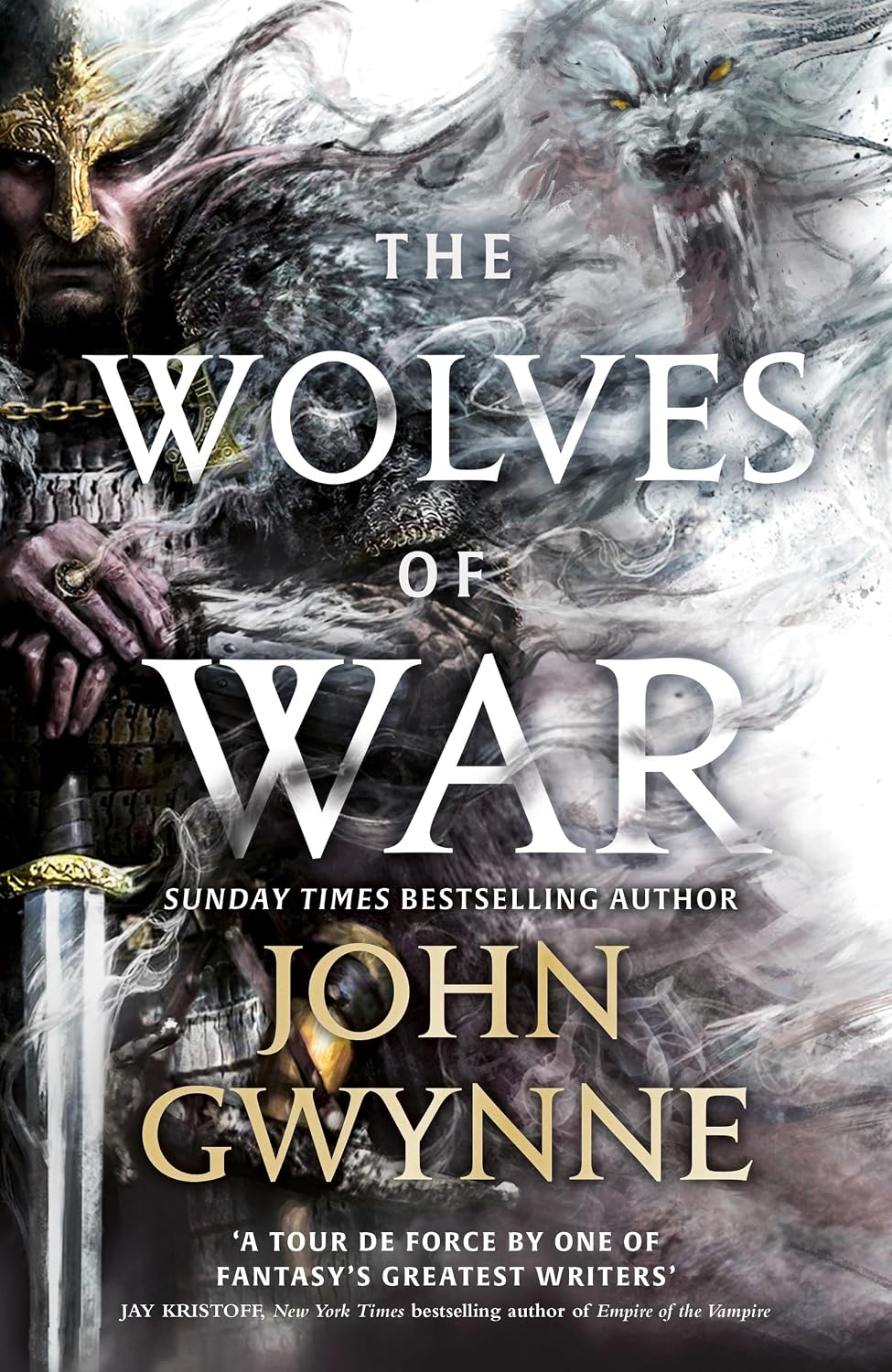
Gwynne has demonstrated great skill at telling stories of ordinary folk compromised by powers far beyond their control or comprehension. Here in The Wolves of War that concept is fully on display especially with Halia, Ivan, and their family. They are a very proud family and a very loving family and that love is not on display any stronger than with Halia. Her siblings, her parents, adore her, care for her and know she’s a precious person. Her POV chapters proved the most compelling, between her frustrations with her disability and how people viewed her, to the strengthening connection she has to wolves and other realms. John Gwynne has noted Halia is inspired by his late daughter Harriet, who passed away in 2021 unexpectedly, so this is a very, very personal character and novel for John. Her journey of self-discovery, aided by the family nanny(?)/wise-woman(?) Root was a great and compelling exploration.
That familial and fatherly love (and paternal shadow) is a thread through all the characters. Ingvar is driven by the shadow of his father, trying to live up to the greatness. Dagmar feels great affinity for his “found” family and even the mythical Perun – whose treasures are a focal point of the story – is closely tied to that of his son’s own fate.
I felt emotionally invested in these characters, compelled to keep the pages turning. I was fascinated by the exploration of the mythology Gwynne featured, for the strigas that hold witchy powers to the forest-dwelling leshies, to the rusalka of the water to the goddess Iaga. Despite their fantastical nature of these and other creatures, Gwynne did a wonderful job of imbuing them with a sense of reality, a sense of awe and fear, and also the mystery of being misunderstood. Balancing that out is one of the human antagonists, Yakun was well-drawn, too. A very hateful character, but his bigotry and prejudice was all too real and indeed, all too human.
As much as I enjoyed the measured pace at which Gwynne introduced these characters and made them familiar to me, I found their initial lack of connection a bit of a hurdle at the outset that may have benefited from the ever-present character list so common in Epic Fantasy novels. I suspect the finished version of the book will have a glossary along these lines It also took me a little to get past the fact that two prominent characters have very similar sounding and spelled names in Ingvar and Ivan. All that said, Gwynne has enough of a powerful storytelling voice that I was pulled along the narrative and thoroughly enjoyed the ride, attempting to anticipate how these storylines would eventually converge.
The Wolves of War is a wonderful fantasy novel, filled with heart, action, awe, magic and great narrative drive. As it was drawing to a conclusion, it was very clear (and welcome!) that this was just the first part of a larger story, and I am on board for where Gwynne takes these characters.
Recommended
© 2026 Rob H. Bedford
Trade Paperback | 496 pages
Orbit Books | November 2026
Author Website: https://www.johngwynneauthor.co.uk/
Excerpt: https://www.polygon.com/wolves-of-war-fantasy-book-excerpt/