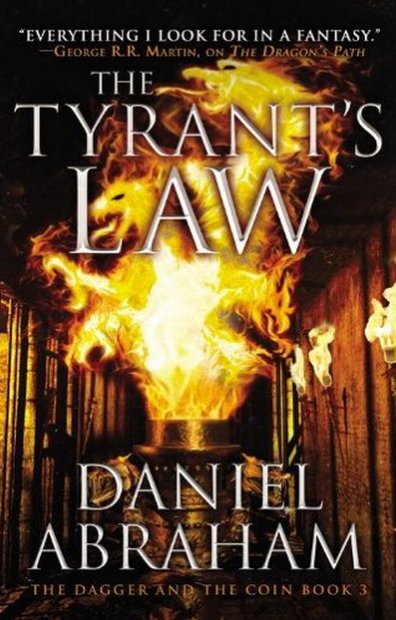
 The Tyrant’s Law by Daniel Abraham
Book Three of The Dagger and the Coin series
Published by Orbit UK, May 2013 (Review copy received.)
ISBN: 9 781841 498928
502 pages
Review by Mark Yon
And so, with book three of the series, we return to the increasingly complex world of Geder Palliako, Cithrin bel Sarcour, Clara Kalliam and Captain Marcus Wester. And as this is the third book, please be warned: if you haven’t read the previous books, here below be spoilers!
At the end of book two (The King’s Blood) things were moving along mightily quick, heading into the Great War. Now in The Tyrant’s Law, we find things developing further and casting a wider net. This is not a book to start the series with. However, the many readers who have read and enjoyed this series so far will not want to wait to continue.
What we get more of here is a sense of the Epic, in that the eleven races of human, previously mentioned but not given too much detail, are fleshed out more. We see more of their nature and actions, as the consequences of what has happened before ripple out wider and begin to both affect them and draw them into the conflict.
Clara Kalliam, formerly Baroness of Osterling Fells is having to deal with her families disgrace (in The King’s Blood) and her grieving at the death of her husband Dawson Kalliam. Ostracised, she finds herself outside the social circles whilst secretly helping position her sons and her daughter in law. This means that we see all the cultural wranglings of court.
On the military front, Geder Palliako, having removed Dawson in The King’s Blood, is now the Lord Regent of Antea, and fully in charge of dictating the events of the war between Antea and the other nations, but is still relying on the stewardship of Basrahip, the acolyte of the spider goddess whose abilities have led to Geder’s rise to power.
Elsewhere Marcus is in league with Kit, attempting to reach the temple of the spider goddess and fulfil a promise to assassinate the deity there, whilst rueing his apparent betrayal by his colleague Yardem and pining for Cithrin’s company (as too is Geder, just to complicate things further.) Cithrin herself is working for the bank in new territories, again with another mentor. Under the tutelage of Magistra Isadau, she is gaining experience negotiating for the Medean Bank in Suddapal. When Suddapal is taken over by the Antean army, Cithrin and Isadau become involved in a secret mission in helping refugees escape the beleaguered city.
All these narratives are in separate chapters as before, but as the plot thickens they connect and divide throughout. Much of the fun of the book is seeing how these characters separate and follow their own narrative paths, developing as they do before affecting each other again. As before in the series, not everything goes the way we as readers might suspect. Loyalties are rekindled, new characters divide up the fellowship, and further division. And throughout there is still the insidious influence of deities and revelations of dragons.
As we read through book three of the series, I think that we are now starting to see the full intent of Daniel’s story. The books have gradually widened in scope since The Dragon’s Path, where the focus was very much on establishing characters. By The Tyrant’s Law we are better aware of other races and visiting a much wider travelogue of places than we have up to this point. It is in this book, more than any other to date, that I now realise how complex and alien these other racial groups are.
And dragons. Though much foreshadowed in earlier books, it is here that they start to become most important.
So far each book has had a few jaw-droppingly shocking moments – Geder’s increasingly mercurial rages to date, and Dawson’s sudden and violent death in The King’s Blood, for example. There are definitely key moments here in The Tyrant’s Law, though I must admit I didn’t find them quite as shocking as in previous books. What does work though is the unusual way that such events are delivered in a deliberately low key, matter-of-fact manner, whilst their impact and their consequences are quite profound. They are not overwrought, they are not particularly over-emotional, but they do leave a lasting impression.
By the end of the book things have again opened up new revelations that make the reader want to know what happens next. It is a credit to Daniel that the narrative pull of the series has increased as the characters have become more solid, the world become more unusual and the situations more complex. We have a way to go yet in this tale, and yet it still has a hold on the reader.
Rob Bedford, my reviewing colleague at SFFWorld, has said in the past that these books were rapidly becoming his most eagerly-anticipated Fantasy series. Whilst The Tyrant’s Law is a little bit steadier in pace and subtler than what has come before, I can only agree with him.
Mark Yon, April 2013