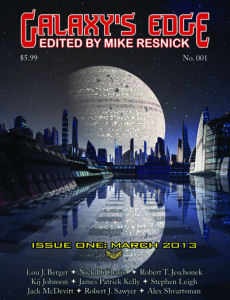
 Galaxy’s Edge, Issue One: March 2013
Edited by Mike Resnick
Published by Phoenix Pick (www.ArcManor.com )
Contributions by Robert J Sawyer, Kij Johnson, Barry Malzberg, Jack McDevitt, James Patrick Kelly, Daniel F. Galouye and others.
ISBN: 978 1 61242 125 4
108 pages
www.GalaxysEdge.com
Review by Mark Yon
It’s a difficult time out there in the magazine market. Print sales generally are declining. Those traditional stalwartsF& SF and Analog have both gone bi-monthly to some degree, with increasingly more copies sold digitally. People are talking of the e-revolution and how the electronic media means that the print copy may be increasingly irrelevant. Online magazines and blogs are increasingly making access to reviews and fiction more immediate and less reliant on traditional means – and often for free.
So it’s a brave move to try and publish a new magazine in such a climate and yet here we have one from Phoenix Pick. Whilst it is free to read online, and available in electronic format for computers, tablets and the like, my copy was a good-old-fashioned ‘tree-copy’. There are, however, links to the various sections online throughout this review.
And I enjoyed it a lot. Its size is a little unusual, being bigger than digest size, but 4-5 cm less tall than A4. The print is black and white throughout, apart from the matt finish cover. Pages are printed in two columns per page.
The magazine starts well, with an enthusiastic introduction from Mike Resnick in The Editor’s Word, telling ‘the Untold History of the Science Fiction Magazines’. Mike covers an eclectic variety of topics here, from The Shaver Mystery to the idea of prediction in SF (care of Astounding Magazine) to the divisions in SF caused by the Vietnam War, to the importance of Unknown magazine, to characters such as editor Horace Gold, Edson McCann, The Shadow and Doc EE Smith’s Lensman. Well, they’re not all entirely new topics, but these boisterous anecdotes are told with hearty panache and great fun, and I must admit I haven’t heard all of it before. The general feel was like hearing a gossipy conversation from an old master, and it settled me into the rest of the magazine nicely.
No magazine is without its stories. We have a mixture of old classics and new tales here. Of the new tales, we have Nick DiChario’s Creator of the Cosmos Interview Today, Lou J. Berger’s Just a Second,Alex Shvartsman’s Requiem for a Druid, Stephen Leigh’s The Bright Seas of Venus, Robert T. Jeschonek’sThe Spinach Can’s Son. They’re all solid, entertaining tales, and generally fairly short. None outlast their welcome. Of them, I enjoyed Alex Shvartsman’s story of Conrad Brent the Druid the most. It is an urban fantasy, very entertaining, with more than a touch of Harry Dresden or Kevin Hearne’s Atticus O’Sullivan about it.
Of ‘the old stuff’, there’s some good stories here, with generally more quality than filler. Hugo and Nebula Award winner Robert J Sawyer’s The Shoulders of Giants is from 2000, Kij Johnson’s Schrodinger’s Cathouse is from 1993, Jack McDevitt’s Act of God is from 2004 and is solidly entertaining, telling of the consequences of scientists being able to create pocket universes. James Patrick Kelly benefits from a reprint of what he admits what is his most famous story, Think Like A Dinosaur, first published as the cover story of the June 1995 Asimov. There’s a nice introduction from Jim to put the story in context, and the time travel story itself is a good one. Of these, I enjoyed Robert Sawyer’s tale of future exploration and Jim Kelly’s time travel story the most.
I also enjoyed the magazine’s serialisation of the first part of a rather forgotten classic, Daniel F. Galouye’s first novel, Dark Universe, from 1961. It was a Hugo nominee in 1962 (losing out to Robert A Heinlein’s Stranger in a Strange Land), and is a post-apocalyptic tale of human survival below ground with no light. It has some interesting ideas which it examines through the story. ‘Darkness’ and ‘light’ have become mythic or even quasi-religious in stature, and the survivor’s senses have changed, with hearing more acute to accommodate for the absence of light. Taking up 24 pages of the magazine, the first five chapters are here, with the rest in Issue Two. Some readers may be a little annoyed with this, as each magazine is intended to be self-contained, and to read the rest of the story you need to buy the next edition. But it is a good read, if feeling a little like a less humorous version of Walter Miller’s Canticle for Leibowitz, (1955-60) and I can imagine many readers wanting to read the rest as soon as possible, including me. It might also, as the book reviewer suggests, be worth a comparison with Hugh Howey’s WOOL.
On the non-fiction, we not only have Mike’s Introduction (mentioned earlier) but also From the Heart’s Basement, from multiple Hugo and Nebula Award nominee Barry Malzberg. Written in the style as if part of a club meeting letter (or as Barry puts it, ‘being in a big f_______ing club’), it’s all about the advantages of being in a secret club, in a tone rather reminiscent of old SF club newsletters. It’s relatively short, but good fun. Most amusingly, yet not perhaps surprisingly, I enjoyed the comment therein, no doubt made as a joke, ‘Write (not tweet) for details.’
Book reviews are by college instructor Paul Cook. There’s some good points made in all of the reviews and pleasingly not all the reviews are glowingly positive. Ernest Cline’s Ready Player One (a book I had issues with) is taken to task as Cook says that nothing in the book is ‘remotely new or inventive’. Whilst personally I will say that I thought that (to some extent) the use of old tropes was partly the purpose of the book, I take Cook’s point. Similarly, with Jack McDevitt’s Firebird, where McDevitt is accused of missing a great opportunity. Whilst I don’t agree with all the points made, I enjoyed reading Cook’s take on the previously mentioned books, John C Wright’s Count to a Trillion, Hugh Howey’s WOOL, Nancy Kress’sAfter the Fall, During the Fall and a big collection of pulp adventure tales by Otto Penzler (whose collections I also recommend.)
The last item in the magazine is an article Something Different by Horace E. Cocroft, about the importance of economics in SF novels, Star Trek and even Middle Earth. This reminded me of Analog’sAlternative Viewpoint. It’s a nice, but brief, summary of ideas about why sound economics are an important part of world-building, whether Fantasy or SF, and will be food for thought for many a writer.
In summary, Galaxy’s Edge is an entertaining read, and one which passed an afternoon nicely. Whilst the market out there is difficult, there’s a lot to like, with many more hits than misses in its combination of new and old material connected together by some lively discussion. It’s a tough place to be out there in publishing at the moment, but Galaxy’s Edge is something I’d definitely read again.
Galaxy’s Edge is published six times a year. The next issue is due in May 2013.
Review by Mark Yon, April 2013.