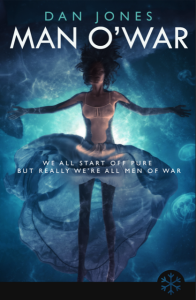
Man O’War, the debut novel by science fiction author Dan Jones, hits bookstores in March 2018. In this fast-paced thriller set in a near future, jellyfisherman Dhiraj Om finds a pleasure robot called Naomi in his nets one night, and is in turn caught up in a web of corruption that leads from London’s seedy underworld to the Niger Delta.
Welcome to SFF World, Dan, and congratulations on Man O’War. What was the most challenging aspect of writing the book?
Thanks Juliana! In terms of the plain old mechanics of writing the story, I pretty much flew through it. I started it in September 2015, and was finished in April 2016. Once I had my essential story thrashed out, it just fell out of me. That’s not to say it wasn’t without challenges. The biggest hurdle for me was to create a believable vision of the Niger delta, without actually having been there. I relied upon a lot of desk research, news reports from Nigeria, as well as first-hand accounts from people who have lived and worked in that part of the world, in order to create this representation. By an amazing coincidence, one of our mutual friends from SFF Chronicles spent a period of his working life in the delta working in the oil industry. I pretty much bit his hand off when he told me that! In comparison, writing the London scenes was easy, as I know the city inside out, but I really had to work hard to make the Nigerian scenes believable and not fall into the swamp of caricature. I really hope I do that part of the world justice.
You work for the UK Space Agency, having managed technology strategy for the aerospace, space robotics and cyber security sectors. How much influence did your work have on your novel?
Quite a reasonable amount actually, but not in the ways you might think! I think a lot of SF writers are able to conjure up explainable, plausible, functional technologies and capabilities for their stories, but the robotics systems seen in MOW really are my personal vision of where robotics technology will have evolved to in the mid-22nd century, and that’s absolutely based on what I know from inside the industry today. But at a basic systems engineering level, a robot is still a combination of materials, sensors, software, manipulators and mobility systems, so I’d expect any SF writer to be able to write realistic robots without knowing the ins and outs of the techy stuff. For Man O’War, the robotics technology underpins great slabs of plot, so it has to be plausible and believable, without being too technical.
Where I really was able to draw on my work was in all the corporate speak of the upper echelons of industry and government, and all the regulatory frameworks, funding avenues and ways in which businesses are forced to operate, and how and where businesses choose to “lubricate” the frameworks. I see those conversations on a day-to-day basis, I’ve taken part in them, and I’ve been on both sides of the table, as well as being an objective intermediary. I don’t think it’s much of a leap at all to believe a businessperson, frustrated with the constraints of the corporate system in which they operate, to seek “alternative” means of making their visions a reality. In fact I used the 1980s Al-Yamamah deal as a sort of baseline for whether or not such corrupt business practices were plausible – it’s an astonishing story, and certainly made me feel that the sort of things going on in Man O’War aren’t overly fantastical.
How did you go about creating your vision of a future world? Can you see some of this happening in our own near future?
I often think SF stories set in the future often overtech the pudding and introduce a huge raft of whizzy gadgets that aren’t really feasible. The Star Trek universe will have us launching colony ships in fifty years from now! Ain’t gonna happen, I’m afraid. I guess that’s fine for space fantasy, but perhaps not so much for a harder SF. My opinion is that the future world of the next hundred years or so really won’t look too different from our world now; we’ll still have cars, planes, hospitals, schools, roads, ships and so on – but all these platforms will feature new tech, some of which won’t even be visible to the naked eye. But a car will still essentially look like a car. The reason that this future world will be not too visually dissimilar to our own present is that, even while technology accelerates with Moore’s Law and the like, the really big technological questions – aviation, the motor car, the internet – have already been solved, meaning we’re really just tinkering around the edges now with those things. One reason for that is the inverse relationship between the proliferation of technology development, and the ability of governments to regulate it. Regulation frequently can’t keep up with the amount of new technologies, and tends to be quite conservative to be on the safe side (nobody wants to be the one who rubber stamps a new piece of kit which then ends up causing a raft of fatal accidents, or takes over the world), so commercialisation retards as a response. And this unwillingness of regulatory bodies to take big risks is what really kicks off the whole story in MOW.
In the real world, the next “big leaps” we’ll see are likely to be in areas like medicine, cyber security, which aren’t really things you can see. Even the adoption of robotics is likely to be visually subtle, at least at first. Sorry, I’m getting a little carried away now! Can you tell I do this stuff for a living?
To answer the second question, I think almost all the technology in Man O’War could be realistically implemented within the next hundred and fifty years: autonomous cars (which IMHO aren’t quite as close to being fully adopted as some people think they are. Like I said, no one wants to be the company whose autonomous car causes the first accident causing multiple fatalities), autonomous boats and ships, advanced bionics and prosthetics, significantly faster air travel, next generation offshore energy platforms, humanoid personal assistants and, of course, the sex robots. The one area I would say is purely science fiction is the idea of artificial emotional intelligence, but who knows?
Man O’War dabbles almost entirely in grey characters. A crime boss is capable of acts of honor, an upstanding citizen can turn to unspeakable acts; no one seems exempt from crossing lines in one direction or another. Was this on purpose? What leads you to write characters that are not necessarily good or bad, but perhaps something in-between?
I’m glad you picked up on this! I think we’re all grey really, aren’t we? I didn’t necessarily want to create sympathetic characters, or ones we can easily root for. I was more interested in creating characters that are understandable and realistic. This is supposed to be a real-world thriller, so I wanted the characters not to be cyphers, or typical archetypes. The six POV characters are all protagonists, and they’re also all antagonists. It’s human nature for good people to fall, and for bad people to redeem themselves, or for people to carry out unspeakable acts in the name of causes they truly believe in, or for people to realise their mistakes and want to change. On the face of it, I suppose the characters do seem like archetypes: D’Souza the violent gangster, Tilda the tough detective – but underneath the exteriors they’re all people, and people always have the capacity to surprise you, sometimes in good ways, and sometimes not. Hopefully that keeps readers on their toes!
You have an incredibly diverse cast of characters. Which was your favorite to write, and why?
Firstly, I think if one is writing a story set in a 22nd century (or any century, for that matter) London then it’s axiomatic that the cast of characters is going to be racially, sexually, physically and characteristically diverse. Of the six POV characters, I think D’Souza was most enjoyable to write, though I ended up being most emotionally invested in Tilda’s story, which I didn’t expect when I conceived her character.
Overall, Spidermen was the most fun character to write. There are a number of grotesques peppered throughout the story like Collarface and Leatherdick, but with Spidermen I really decided to go all out. Even though he’s the crown prince of the grotesques, I tried to give him enough humanity under his gruesome exterior to make him interesting and hopefully a little sympathetic.
Besides Man O’War, you have published a number of short stories. Which is your personal favorite of those?
I have a soft spot for A Warm Heart, which was part of Woodbridge Press’s fantasy anthology Journeys. AWH was pointed out by quite a few reviewers as being among their favourite stories in the collection, and when that collection contains stuff by Adrian Tchaikovsky, John Gwynne and Gail Z Martin – as well as your good self, I might add! – it’s difficult not to feel pretty pleased with that. It’s about a trainee assassin sent to complete his first kill, who ends up questioning the morality of his job – I think I definitely have a thing for morally grey characters!
Journeys is definitely an amazing anthology and I was glad to be a part of it! Have you always gravitated towards science fiction? Who are some of your favorite authors?
I’m going to sound like a blasphemer now, but I rarely read science fiction. The last SF I read was Jo Zebedee’s Inheritance Trilogy (which is arguably more space fantasy then SF anyway), and the last classic SF I read was Stranger In A Strange Land, and that was about two or three years ago as well. So not a great deal. Having said that, I adored The Martian. I thought it was just brilliant, a tremendous book.
I read more fantasy than SF, and I’ve a soft spot for magical realism, and my favourite writers are Haruki Murakami, and Umberto Eco. I just finished reading Sarah Perry’s The Essex Serpent, which left me open-mouthed in wonder and feeling utterly inadequate as a writer, and Stephen King’s IT, which is simply masterful storytelling. I’m currently reading Margaret Atwood’s Hag Seed. None of which is exactly science fiction, but there you go, I still end up writing the stuff. I suspect my day job has something to do with that…
If you could project yourself into the world of Man O’War, what would be your dream job?
Great question! One of the jobs that wouldn’t put me at risk of grievous bodily harm, probably, which admittedly doesn’t leave much. Working in the pub in Tilbury where the jellyfishermen go? Wouldn’t be far to get home for me. Though even that’s mostly run by robots. Still, it’s better than gun-toting Marxist revolutionary, or black market engineer. I reckon it’s not easy to get life insurance in that game.
What are you working on now? What can we look forward to next?
My next novel, Hole In The Sky, is slowly nearing completion, and should be finished in the Spring. That’s another SF set a in a near-future world, but it’s far freakier than Man O’War, and it has splashes of fantasy and horror thrown in, just for fun. Hole In The Sky is about a psychic engineer able to create designs for life from his subconscious mind, which is quite a useful skill, as the vast majority of non-human biological life has been wiped out by an event known as The Crash. It’s all to do with identity, transhumanism (again) and free will. It draws on some of the work I did in cyber security, so there’s my job interfering with my writing again.
I’m also trying to complete a quartet of supernatural fiction novellas, each one set in one of the world’s great cities: London, Athens, Madrid, and Warsaw. I hope to release them as a set at some point this or early next year.
* * * * * * *
Interview by Juliana Spink Mills – SFFWorld.com © 2018