

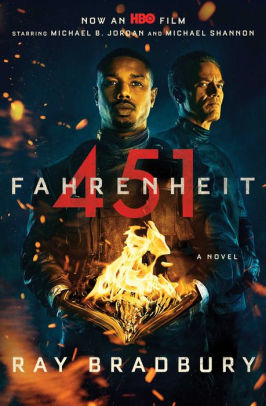
 With the success of television productions such as Hulu’s The Handmaid’s Tale (based on the novel by Margaret Atwood) it is perhaps not a surprise to see a version of this classic novel (which I reviewed HERE last year). Like Handmaid’s Tale, Fahrenheit 451 was once a staple of high school English curriculums, both in the US & the UK.
Clearly then aiming for relevance with teenagers and older readers alike, Fahrenheit is that dreaded thing – a ‘reimagining’ of a classic.
As the book was written over 65 years ago, to have relevance to a contemporary audience it has had to move from the focus of its literary origin to something that incorporates elements of modern-day society – social media, emojis and the like.
Much of the basic plot remains. Guy Montag is a ‘fireman’, whose job is to burn books. As part of the Salamander fire service, he is mentored by Captain Beatty, who, about to be promoted, sees Montag as his replacement. Like the original novel, the story is how Montag comes to realise that the books are not things to be burned but to be treasured. He eventually moves to the view of that of the book-readers (here referred to as eels’) and attempts to leave his world for a future saving books, not destroying them. On the story’s journey it deals with the role of the media, the consequences of a subdued society, outsiders and portrays a dystopian society with a kind-of ‘look what can happen next’ kind of view, a science fiction trope so popular in the 1960’s.
The visuals are very reminiscent of Blade Runner (the first movie) with messages and live television projected onto buildings for the attention of the hyper-attentive, near-future audience. Emoji’s fly across the edifices, as ‘events’ are shown in real-time.
It’s not a bad version, but keeps to the original versions too faithfully in some ways and not faithfully enough in others. There are scenes in it straight out of the Truffaut film version (1966), that despite the modern visuals, give nothing particularly new.
Where the plot has changed – no emotionally suppressed wife, but instead a whole society kept pacified by drugs, for example – and the fascist militia style activities of the Salamander firemen has been ramped up from something much subtler in the original novel, though admittedly present in the 1966 movie. ‘Fake news’ is now (perhaps unsurprisingly) given a front seat.
Much of the attention is now upon the movies’ ‘star’ (and producer) Michael B. Jordan. Previously perhaps best known as Adonis Creed in the Rocky franchise movie Creed (2015) and his role in Black Panther (2018), this is clearly a tale close to his heart. Like Handmaid’s Tale, the plot’s relevance to modern American society, although if you didn’t realise it, is sledgehammered home by fireman marching and chanting upon the streets of the unnamed city.
Of the remaining cast, rent-a-baddie Michael Shannon, as Montag’s boss Captain Beatty, portrays his role with the attitude we have come to expect. As good as he is, it is really not that different from every other nasty character he has shown us. By contrast, Sofia Boutella as Clarisse seems rather wasted as Clarisse. Where the dynamic between Montag and Clarisse is paramount in the 1966 movie, here it seems not that important really. As a known offender in this version, she seems to have been around for a while before she becomes important to the plot, but in both the book and the 1960’s movie her relationship with Montag is much more sudden and intense. And that to me seems more likely.
But here’s the difficult thing. In this future world of social media, where comments are stripped down to a basic number of letters, words and emojis, how is it that the younger generation can read? Surely, with wall-to-wall CNN and 24/7 Fox News, the need to actually read would have declined? When the general public read newspapers with a reading age vocabulary of 9, If they read at all, how is it that Montag has been taught to read in a world more visual than textual? More importantly, even if he does understand the words why would he, or anyone else, want to read, Dostyevsky?
There’s a moral there, in the value of reading and in the joy of luxuriating in the sheer verbosity and richness of language, but Fahrenheit 451 sidesteps it. In this version it has rent-a-baddie Michael Shannon as Montag’s boss Captain Beatty, morally conflicted by the need to write – he has hidden a pen that he sneaks out from hiding at night to write down trite phrases to show his contradiction – but throughout I kept feeling that the plot just didn’t work. With books now so easily available electronically on our phones and our Kindles, does the original premise still actually work?
Whereas in the original story and the 1966 movie the story’s focus was about preserving language and literature, here the ending is more to do with Montag’s fight for personal freedom. It is perhaps an understandable change, but is it one which makes the original novel redundant?
When the book was first published in the 1950’s, the use of text and the need to read was paramount in our lives. For news, for information, for our jobs, for entertainment. As much as I hate to admit it, this movie touches on the paradox that whilst it promotes books and language, it is possible that it is shown the written medium is less important that it used to be. Modern audiences increasingly watch, not read – which rather makes the point of this movie redundant.
In short, whilst the good intentions of the movie Fahrenheit 451 are to be appreciated, the actual execution leaves the watcher wanting and raises questions that makes you question its validity.
The problem with adapting a classic is that there is often a feeling that perhaps some classics should be left alone as classics, remaindered in the literary recesses where those ‘in the know’ will appreciate it for being ‘of a certain time’. It works best as a literary form of the 1950’s, not a visual one for the 21st century.
A songwriter once wrote that “nothing fades as fast as the future, and nothing clings like the past”, and perhaps this seems somewhat appropriate here. As much as the flashy hyperkinetic version respects the original, in the end the new version is surprisingly conservative. If the film’s intention is to introduce the novel to a new audience, then I fear that its aim will not be realised. More worryingly, the iconic ideas of the novel, once so original and so startling, have now become replaced by the reality of 2018.
Fahrenheit 451 is a worthy effort, not a disaster (unlike some of the reviews would have you believe.) But I came out of it wondering whether it was worth it. And that can never be a good thing.
Fahrenheit 451
TV Series, May 2018 by HBO Films
Starring Michael B. Jordan, Michael Shannon, Sofia Boutella
101 minutes
Based on the novel by Ray Bradbury (1953)





Nice review, Mark. I saw this a couple of weeks ago and wasn’t all that impressed. I thought criticism I saw in the mainstream was a bit harsh, but all the same something about this version felt … well, under-cooked (*cough*).
Randy M.
Of all things to remake… let’s pick a movie whose underlying dangerous premise has already come true. F451 should never have been remade as a simple “attack against books” story, because that war is over. At heart it’s a story about the attack on information and creativity, and the movie should have rebuilt itself to take on today’s reality of digital information, commercialized art and corporatized channels.
This movie should have been called EMP, “based on the novel Fahrenheit 451 by Ray Bradbury.”