 In his latest review, Randy picks up on something that seems appropriate for this time of year:
Mary decided she would be the jockey Willie Shoemaker. [Her outfit] consisted of baggy pants tucked into a pair of go-go boots, a baseball cap, a patchwork shirt, and a piece of thin curtain rod for a jockey’s whip. She walked past us once then looked over her shoulder. In the high nasal voice of a TV horse-racing announcer, she said, “And they’re off. …” We clapped for her, but the second she turned away again, Jim raised his eyebrows and whispered, “And it’s Cabbage by a head.”
— from The Shadow Year
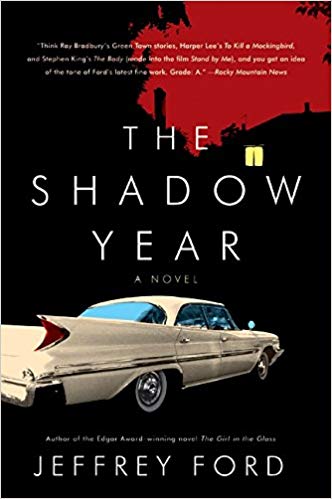
In the late 1960s on Long Island, the narrator, his brother Jim and sister Mary negotiate a year made bad by their father’s absence as he works three jobs, and coping with their mother’s love of wine and family illness, including Mary’s possible psychological issues since she seldom talks except in voices other than her own and is obsessed by numbers. But mainly the year is made bad by the disappearance of one of the narrator’s classmates, their conviction that he was killed, and the fear the killer may kill again.
As the year goes on, Jim enters Junior High and works on Botch Town, a model in their basement of the town they live in; Mary goes to class with the “special” students; Mr. Softee hates the kids he serves, who find ways to torment and confound him; Mr. Krapp grimly tries to teach his class, including the narrator, and maintain some kind of decorum and dignity; Nan and Pop, who live in the attached garage converted into an apartment, do what they can to guide and protect them; and the police continue their investigation, even dredging a nearby pond, but can’t seem to solve the disappearance. The kids, though, have an idea: They’ve seen a long, old white car with a pipe smoking driver who appears to stalk the neighborhood. And then they notice that Mary’s long bouts of running her numbers lead her to move the figures in Botch Town until they reflect the movements of their real life counterparts, including the long white car. Can they catch the killer in the act? How do they avoid being the next victims? And why does the figure of one boy who no longer lives in their neighborhood lay beside his family’s abandoned house?
Blurbs on the book make comparisons to Ray Bradbury and Stephen King, among others. Usually such comparisons are hyperbolic, but The Shadow Year falls into whatever category of fiction is occupied by Bradbury’s Something Wicked This Way Comes and his Green Town stories; and while I haven’t read King’s “The Body,” it wouldn’t be hard to draw parallels with the movie based on it, Stand By Me, not least in its moments of humor – see the quote above. Ford’s humor often feels like King’s and also that found in A Christmas Story (also mentioned in blurbs as well as the novel it’s based on, Jean Shepard’s In God We Trust, All Others Pay Cash). Ford writes believable situations from a time when suburban children were likely to be free-range, and the humor and tension in the novel arise from the circumstances and environment around the children and the way they interpret and react to them. Besides the entertainment value of the funny moments, they also mitigate the nostalgia the author feels for what was his era of childhood, making this a coming-of-age novel that balances wistful memory of the past with a honesty about its limitations and failings.
The Shadow Year is a fine mystery with a streak of the paranormal, and maybe better as a novel about children for adults who remember, if only vaguely, their own childhood. Ford’s clear eye for the ways kids cope with and compensate for loving but flawed parents and his knack for the telling detail, from the smell of pipe smoke emanating from library books to the weakness in the knees before an unwanted fight to Nan’s exercise routine, offer a mostly comforting verisimilitude without sentimentality. Taking place from the end of one summer through the next makes The Shadow Year one of those novels, like Something Wicked This Way Comes reading especially suited to the transition between summer and fall.
Stories of similar interest:
Dandelion Wine by Ray Bradbury
IT by Stephen King
The Snowman’s Children by Glen Hirshberg
“Ghost Summer” by Tananarive Due (from Ghost Summer)
The Shadow Year by Jeffrey Ford
Published by William Morrow & Co., 2008
289 pages
ISBN: 978-0061231520