The origins of the werewolf legend are explored, as well as demonic possession, witchcraft, ancient gods, queer love, the life of a succubus, as well as a thinly veiled Joan of Arc in Cameron Sullivan’s centuries spanning historical dark fantasy debut, The Red Winter. The main character, Professor Sebastian Grave of Larnaca, a famed monster slayer, is our first-person narrator (for the majority of the novel) and he’s telling the story from distance of over 200 years for the main narrative, and he then recounts events 20 years prior to that. Sebastian wasn’t alone – and hasn’t been for the majority of his long-lived life. Sebastian is joined with a powerful spirit named Sarmodel, The Red Winter largely unfolds the tale of their battles against a monstrous creature inspired by the original “werewolf” story, but it is so much more than that.
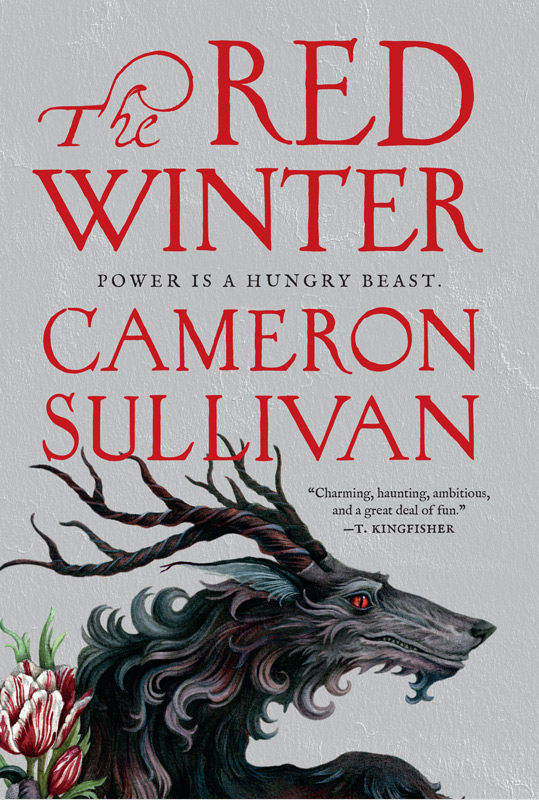
In 1785, Professor Sebastian Grave receives the news he fears most: the terrible Beast of Gévaudan has returned, and the French countryside runs red in its wake.
Sebastian knows the Beast. A monster-slayer with centuries of experience, he joined the hunt for the creature twenty years ago and watched it slaughter its way through a long and bloody winter. Even with the help of his indwelling demon, Sarmodel – who takes payment in living hearts – it nearly cost him his life to bring the monster down.
Now, two decades later, Sebastian has been recalled to the hunt by Antoine Avenel d’Ocerne, an estranged lover who shares a dark history with the Beast and a terrible secret with Sebastian. Drawn by both the chance to finish the Beast for good and the promise of a reconciliation with Antoine, Sebastian cannot refuse.
But Gévaudan is not as he remembers it, and Sebastian’s unfinished business is everywhere he looks. Years of misery have driven the people to desperation, and France teeters on the edge of revolution. Sebastian’s arcane activities – not to mention his demonic counterpart – have also attracted the inquisitorial eye of the French clergy. And the Beast is poised to close his jaws around them all and plunge the continent into war.
The Red Winter tears the heart out of history with this dark retelling of the hunt for the Beast of Gévaudan. Lifting the veil on the hidden world behind our own, it reimagines the story of Europe, from Imperial Rome to Saint Jehanne d’Arc, the madness of Gilles de Rais and the first flickers of the French Revolution.
The Beast of Gévaudan has returned in 1785, despite Sebastian thinking he vanquished the creature after it terrorized the countryside and ate several people. Jacques Avenel d’Ocerne, the son of a former “acquaintance” and lover the Baron of d’Ocerne, finds Sebastian and urges Sebastian to help vanquish the monster, despite Jacques’s negative thoughts about Sebastian. Sebastian is hesitant, with Sarmodel urging Sebastian to kill the young Jacques. Sarmodel is nourished on the lifeblood of living creatures. Sebastian finds his patience tested by Jacques and surprised that his old lover would ask for him to return based on how Sebastian left the Baron two decades prior to Jacques’s arrival at Sebastian.
Two narratives… Sebastian and Jacques in 1785 bickering despite sharing the same goal, ensuring the Beast is taken down permanently. The other narrative is 1766 as Sebastian recounting the events leading up to and immediately following the encounter with the Beast. If that wasn’t enough to keep straight, Sullivan intersperses a narrative in the 1400s from the point of view of Livia, the succubus Sebastian keeps within his “personal employ.” This particular historical narrative gives a supernatural bent to the story of Joan of Arc and also features Sebastian and Sarmodel in slightly more supporting roles. Again, Sebastian is very long-lived.
I liked the dynamic between Sebastian and Sarmodel, which allowed for humor to be brought to what is otherwise a potentially dark and bloody story – monster hunting isn’t exactly peaches and roses after all. I’ve long enjoyed stories where the protagonist has a “familiar” or similar character (see – Bob the Skull in the Dresden Files or Vlad Taltos and Loiosh in Steven Brust’s Vlad Taltos novels). Sullivan pulls off this humorous and emotional banter and dynamic very well. In addition to the welcome humor, this dynamic weave into the story also provides a way for Sullivan to relay character information about Sebastian without just info-dumping it to the reader. The conversational method between Sebastian and Sarmodel effectively adds the historical weight to them.
I found the footnotes throughout, particularly in the chapters we get from Livia’s point of view to be quite humorous and effective. Conversely, I found the “Livia” chapters an unneeded distraction from the narratives Sebastian was telling. The story was told quite well and it provided some additional historical context, but for me reading tastes, I would have likely enjoyed the novel even more than I did.
What I found the most fascinating was the Beast itself. It was not what I was expecting to be, nor was I expecting the breadth of its powers to be so… vast. But given that this novel uses one of the original Werewolf legends as a starting point, it worked quite well in the long run.
Overall, Sullivan has an assured voice to the point I found it surprising that this was his debut novel. I enjoyed the novel and found Sullivan’s prose to pull me in quite potently and the story to be very immersive in the best ways. Since Sebastian is very long lived, the ‘modern’ framing of the story is 2013 and the story reaches as far back as the 1400s, there is very much room for Sullivan to reveal more stories about Sebastian and his “joined” supernatural entity, Sarmodel. The Red Winter is not framed as the start of a series, but it feels like it could be an installment something larger and the fact that it works either way is a smart move on Sullivan (and the publisher’s) part.
Recommended.
© 2026 Rob H. Bedford
Hardcover | Tor Books
February 2026 | 544 pages
https://www.cameronsullivanbooks.com/
Review copy courtesy of the publisher, Tor Books