 So, this is one (another one!) that I was inspired to read by Jo Walton. To paraphrase her comments, this is one of her favourite reads of all time, yet one that few readers know of – even well-read ones.
This sounded like a challenge to me – so I picked it up and off I went.
It is a read that begins deceptively simply. In traditional Young Adult style, we read about the life of young teenager Lola Hart. She seems to live a fairly privileged lifestyle with her family in a near-future Manhattan. Her mother is an out-of-work English Professor, her father a scriptwriter for film. There’s also Cheryl, her younger sister, nicknamed ‘Boobs’, who like many siblings her age is both loveable and typically annoying.
When we begin the novel, we read that Lola (nicknamed ‘Booz’) has just moved into her own room and received a diary – this diary – for her twelfth birthday. She is very excited about this initial excursion into adulthood and her comments are all about her family, school and other innocent elements of her life. She also endearingly names her diary Anne (after Anne Frank, I think.)
It’s not long though before we realise that things outside Lola’s life bubble are not great. Her mother struggles to find employment as a lecturer and proof-reader after being let go a few month ago, her father is a scriptwriter, forever going to meetings about scripts that never seem to sell. Glimpses of the news tell of riots in cities, and an ineffectual President regarded by her parents as a buffoon but who is often on the news telling viewers that everything is going to be alright.
It clearly is not. As Lola gets older through the novel, through her epistolary diary comments, we witness both the coming of age of the writer and the simultaneous decline of society around her. Her family are forced to downsize and move apartments, Lola ends up having to share a room with her sister again and a friend is sent to ‘Kure-A-Kid’ for rehabilitation after being caught playing truant from school one too many times. She comes back a very different person from the rebellious young teen who is Lola’s best friend.
As events swing into motion, Lola’s move to Harlem has consequences. We see the loss of innocence created by the degradation of the society around Lola. She finds herself having to change her worldview and become a harder person to survive.
At the same time, her ‘friends’ at her private school shun her and she falls into a friendship with a local girl, Iz, and her gang-friends Weezie & Jude. As Lola spends more time with them, the language she uses in the diary increasingly shifts to street slang that reminded me of the complex languages in Iain M Banks’ Feersum Endjinn, Anthony Burgess’ Clockwork Orange and even Robert Heinlein’s The Moon is a Harsh Mistress. By the last half of the novel there is almost a total transition into youth-speak, a patois which reflects Lola’s movement into gang culture, stealing, fighting and shooting – but also tells of her first serious love affair.
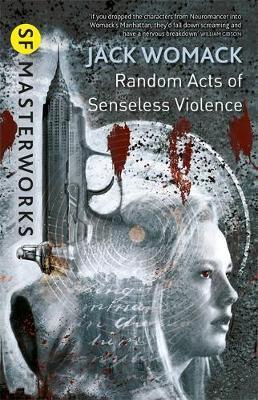
What I guess I would’ve thought of as unthinkable in the 1990’s – science fiction! – now seems much more ‘real’. This is not a future of spaceships and robots but a dystopian alternative of social decline, street violence, unemployment and active unrest. Along the way we have social comment on society, politics, race, sexuality and prejudice. Womack was one of the vanguards of the cyber-punk movement in the 1990’s – which might explain why William Gibson (Neuromancer) is a fan, to the point that he writes an introduction in this edition of the book.
In places the plot becomes a little stereotypical, although at the time it reads as if real (from my own limited experience, of course!) But then we are 25 years or so into the future of when the book was first published, which might make this fiction appear more realistic. It actually made me wonder whether this would be a different story today, with the proliferation of social media now. In the end I thought that the basic plot would not change – if anything, social media would perhaps make the changes that happen even quicker than what we read here. The end would be the same, even if the journey may be slightly different.
By the end, Random Acts of Senseless Violence shows how quickly and easily society can decay (the book takes place over a matter of months) and how a ‘nice girl’ becomes dependent on the relationships of group friends and at the same time becomes someone who survives through violence. It is brutal (and therefore perhaps not for Young Adults!) and yet understandable.
This is an impressive book. The diary format made it difficult to stop reading, each entry getting to a point where the reader wants to know what else could happen to Lola. Seeing things through Lola’s diary means that seemingly throwaway comments have consequences throughout. It helps that we get to know and like Lola, at first so identifiable as an admittedly naïve young girl with all of those little quirks that are so typical of the young teenager. Unlike, say a Heinlein teenager, it is clear that she doesn’t know everything, though she does have endearingly naïve opinions at first.
This changes as we follow the story. As the book progresses, we see a different Lola evolve and at the same time mourn the gradual decay of the world around her. Wiser through experience, in the school of hard knocks, Lola survives, but who we see at the end is not who we began the novel with. It is scarily prescient and, although published originally in 1993, it is a book for our times. It is remarkable to think that this book is over 25 years old.
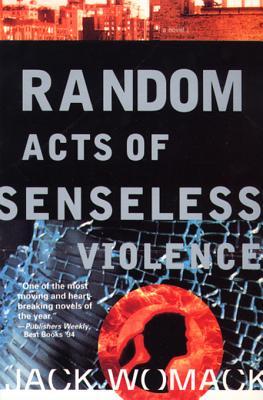
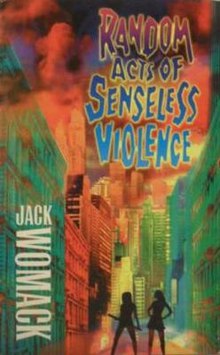
I must admit that I agree with Jo Walton – I am surprised that the book has not received wider notice, amongst science fiction readers, if not a wider audience. Wikipedia notes that, despite Womack winning awards and critical acclaim before this novel, Random Acts of Senseless Violence seems to have passed everyone by. Jo Walton suggests that there are a number of reasons – its original awful cover art, its off-putting title, its low level of publicity, for example. Despite it being one of William Gibson’s favourite Womack novels, this seems to have gained the novel little recognition.
I must admit, I wasn’t sure about this novel until I started to read it.
Random Acts of Senseless Violence is a book that reaches beyond its title. It is skilfully written, cleverly plotted and deceptively intelligent. It drags you in and doesn’t let go, even when, kicking and screaming, you want to look away. I was unexpectedly moved by this, a book that deals with uncomfortable truths and makes you want to rage at the unfairness of it all. At the end you will come up for air… and mourn the loss of Lola’s innocence, and the life she deserved to live.
In short, Random Acts of Senseless Violence is a novel that has a remarkable resonance for our times. It is quite memorable, and I think will be one I keep recalling long after I’ve finished it. In short, this book deserves to be better known. Ignore the off-putting, yet apt, title and read this book.
Random Acts of Senseless Violence by Jack Womack
First published in 1993.
This edition by Gollancz, 2013.
ISBN: 978-0575132306
260 pages
Review by Mark Yon