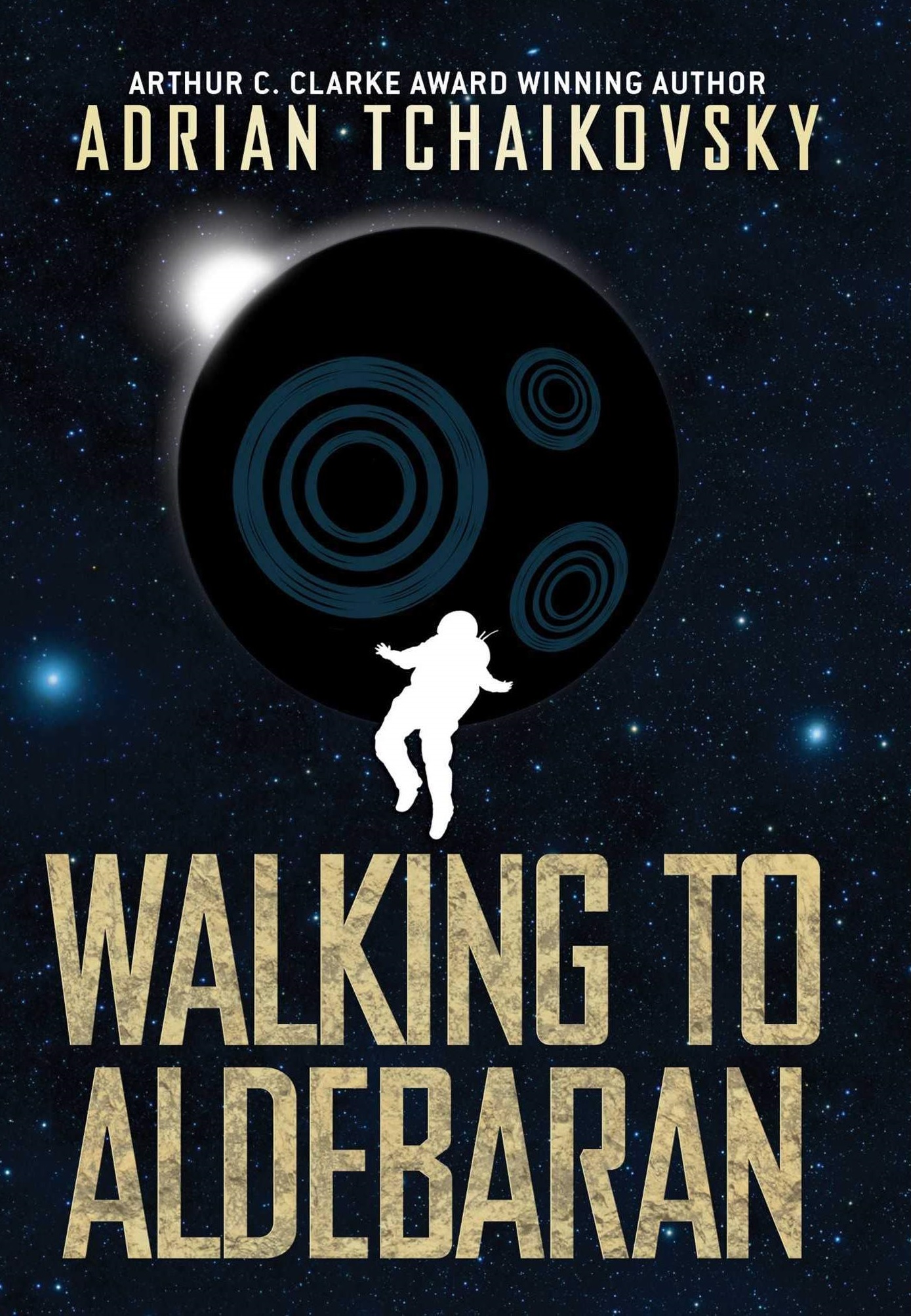
 Some have noticed (about time too!) that Adrian Tchaikovsky, once mostly recognised for his Fantasy novels such as his Shadows of the Apt series, has been making his presence known in other areas of the genre as well. His winning of a Clarke Award (for Children of Time in 2016, reviewed HERE) has helped. This novella further secures that reputation for writing science fiction.
Gary Rendell is an astronaut who is stranded in ‘The Crypts’, an ancient relic that is millions of years old, lying in Space near Neptune.
Told in the first person, Gary tells us how the alien artefact was discovered, how humans travelled to it and how he ended up being separated from the rest of his exploration team. He meets various aliens, dead and alive, whilst wandering around a maze of different environments telling the reader his story and trying to find both a way out and the rest of his team.
To say that this one hits the ground running is an understatement. The beginning is rather manic, to say the least, and seems to perhaps reflect the somewhat panicked state Gary finds himself in. His inner voice narrating the story at first reads like something from a person high on medication, rapidly paced and unfocussed.
It’s also rather overbearing in its blokey style, talking of ‘footy’ and other British cultural references which portray a ‘man of the people’ persona very well. It made me think of the rather chummy style of Mark Watney in Andy Weir’s The Martian, which I assume is deliberate. (I must admit that I don’t care if I read of something being ‘shonky’ again, though, for example.)
At its best, such a style explains things without going into those hard science details but at other times it comes across as condescending. This didn’t sit too well with me at first, and may not with everyone, although by the end the reason for this over-friendly nature makes sense.
From discovering Gary lost in the Crypts at the start, we then backstory to their discovery and how humans encountered them, first by robot satellite, then by human exploration. The originators of the Crypts and their reason for being is never explained although in Gary’s narrative he suggests ideas whilst at the same time meeting friendly aliens, and some not so!
Despite the lack of food, the lack of direction and the lack of company he is able to communicate with, it all seems rather cheerful considering the situation Gary is in. What this really means is that the voice of the narrator may not be entirely truthful. This unreliable narrator technique is uncovered when a twist is revealed about midway through the story.
Does the story work? It manages to convey a real sense of time, character and place in a hundred or so pages, which is impressive. The middle part covers a lot of detail in a short space, for example. What Adrian does here is tell us a good old-fashioned exploration story from the perspective of an astronaut, with a twist. At first it reads like a traditional Analog-type story although by the end this is revealed not to be the case, and is really a version of a much older Fantasy story.
Much of your enjoyment of the tale will be whether you can accept the twist or not. My first thoughts were that this was a good story, whilst the twist made me realise how clever Adrian was.
If nothing else, the story shows that Adrian’s SF is as good, if not better than his Fantasy work. Whilst short, Walking to Aldebaran is memorable and something which ultimately does not feel like you’ve wasted your time reading. For anyone who hasn’t tried Adrian’s SF (see also Children of Time, Dogs of War etc), or doesn’t want to immerse themselves in a full-blown novel, this is not a bad place to start.
Walking to Aldebaran by Adrian Tchaikovsky
Published by Solaris, June 2019
ISBN: 978-1781087060
140 pages
Review by Mark Yon