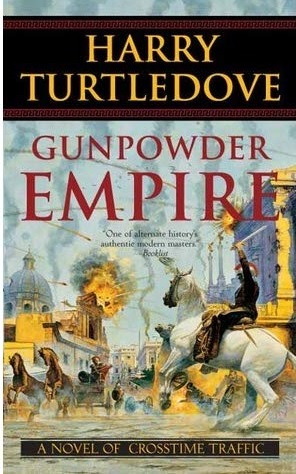
 If science fiction can be considered to be a physical landscape as well as a literary type, then in the realm of “what if?” lies the alternate history novel. For what is the interest in such tales, other than to extrapolate what could happen, rather than what did? Gunpowder Empire is the first in a series from the doyen of the alternate history story, Harry Turtledove.
We begin the novel in late 21st century Los Angeles. Teenagers Amanda and Jeremy Solter are breaking up from school for the summer, and with their parents about to spend the summer working away – not in a foreign place but in an alternate universe.
Jack and Melissa Solter (Mom and Dad) work for Crosstime Traffic, a company that specialises in supplying much needed resources from alternate universes to the places in need on Earth. The Solters spend their summers in the city of Polisso in a universe where, although it is the 21st century, the Roman Empire still exists.
This is therefore a Roman Empire but one that is different. The Roman soldiers now have gunpowder (hence the book’s title) and fight with guns and cannons as well as swords, bows and arrows. However where somethings have changed, other things have not. Slavery still exists and the emancipation of women is yet to happen in this Roman world.
Polisso – on the Solter’s world a village in Romania, here a city – lies on the border between the Roman Empire and an emerging one, that of the Lietuvian. The Lietuvian Empire is what would be seen as Poland and Lithuania on our world. There are often border skirmishes between the Romans and the Lietuvians, but usually the world is at peace.
Much of the first part of the book shows the family as they travel to Polisso and settle into a routine, selling gaudy watches and Swiss Army style penknives for grain, which is returned to their modern home. When Melissa becomes sick, Jack returns with her to Earth to get medical care that she wouldn’t receive in Polisso, and as a result the teenagers are left to hold the fort, so to speak, expecting their parents to only be gone for a few days.
Unfortunately, the time travel network mysteriously goes off-line, leaving Amanda and Jeremy stranded without external communication. At the same time, the Roman authorities begin to grow suspicious of their trade and the family are watched carefully, just as the Lietuvians set siege to the city.
My first impression is that this is more straightforward than the usual Turtledove fare and perhaps more enjoyable because of it. The emphasis is on telling a story, not creating something with complexity. We do not have the broad sweep of characters or the epic scale of events we normally read in Turtledove’s novels. The focus is on Jeremy and Amanda and mainly set in the city of Polisso.
The narrative has the feel of a Heinlein juvenile (Tunnel in the Sky is the obvious one), or a similar author – it is not a coincidence that the book is dedicated to Heinlein, Andre Norton and H. Beam Piper, who are clearly an influence. There is a lot of telling rather than showing here, but it is not unbearable.
There are differences to the juvenile templates created by Heinlein, Norton and Piper, but on the whole they are subtle ones. Turtledove’s teenagers are perhaps a little more whiny than Heinlein’s, who just got on with it. But then you could say that such behaviour reflects modern society, that we have moved away from being more hands-on and practical to a more esoteric lifestyle, perhaps. How a modern millennial would cope without electricity and their mobile phone/computer is an interesting point of comparison to make.
Some points are shown well, although there are issues with others. The teenagers of Turtledove’s narrative may not be your typical young adult of the future. Their background is clearly middle-class and with a fairly privileged lifestyle. The fact that they have bothered to learn Neo-Latin (not something our games console/social media obsessed culture would care about) at times makes them feel a little like Heinlein’s super-capable protagonists (although to be fair there are times when they are obviously not).
More overtly there is an ongoing idea of Amanda’s issues with the concept of slavery as an accepted part of society, which is not subtle. The two youngster’s ability to deal with people using animal furs is also a little overwrought – surely you would accept it as a fundamental part of life, even if you personally disagree with it. Think of a vegetarian’s reaction to omnivores, which does not usually generate the need to be sick (like wearing fur here does in this story.) Whilst these are valid points, they are ones that could be dealt with more subtly.
Of course, the main point of the story is that, despite all of the challenges that come their way, it should not be a surprise to find that Amanda and Jeremy survive. Some might even say that they are perhaps better for the independence that such a situation could create, with the caveat that it’s a hell of a way to get an education. Though the path to learning may be a little different, the outcome is something that by the end readers will welcome.
In summary, Gunpowder Empire is a great read. It’s not particularly original, though it reads nicely and encapsulates much of what readers want in an alternate history by focusing on the tale rather than obscuring it with complexity. It’s a great introduction to anyone who hasn’t read alternate history before and wants to try some before moving onto the bigger stuff.
Gunpowder Empire by Harry Turtledove
Book 1 of the Crosstime Traffic series
Published by Tor 2003
292 pages
ISBN:
Review by Mark Yon