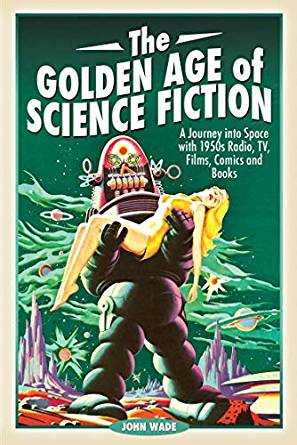
 ‘For everyone who understands the true significance of the words ‘Klaatu barada nikto’.
Subtitled ‘A Journey into Space with 1950’s Radio, TV, Films, Comics and Books’, that’s a pretty good summary of the book. Written in a personal style, John Wade describes the importance of some of these cultural genre icons from the 1950’s.
Why the 1950’s? Well, Wade claims that for him it was a ‘Golden Age’ of the genre. Personally, I’ve always thought of ‘The Golden Age’ being based on the age of the reader, rather than specific years. (The Encyclopedia of SF states that it is 12, although I always thought of it as 14 myself.) However, here’s the author’s reasoning:
“Let others tell you that the golden age of science fiction was the 1930s, when the pulp magazines began; the 1960s, when a 20-year-old Julie Christie riveted the attention of every schoolboy I knew in A For Andromeda and the Gerry Anderson puppets thundered onto the small screen; the 1970s and 80s in which Star Wars reinvented the genre; or even the present day, when so many blockbuster science fiction films are being made in widescreen, with Dolby sound and 3D.
For me, the super-accuracy and amazing technical quality of today’s films….pale into significance besides stories of people who built rockets in their back gardens and flew them with their nephews and cooks to lost planets, or tales of aliens who wanted to take over, if not our entire world, then at least our bodies. I grew up in the 1950s, when all this was happening. For me the decade has to be the true golden age of science fiction.” (page xvi)
It is selective, but then it never describes itself as comprehensive. What it does is describe what it was like for a youngster in Britain in the 1950’s who revelled in such matters. It is also very British. Discussions are mainly based upon British cultural references – the BBC’s Journey into Space serial from the 1950’s rather than say Dimension X from the US, the Eagle comic’s Dan Dare rather than Superman, although all of these are mentioned.
“I don’t intend to cover every film, book, magazine or television production of the decade, though. This is not, after all, an encyclopedia of the genre. It’s much more a personal account of science fiction in the 1950s as I discovered and revelled in it, sometimes from American imports but equally from home-grown British writers and productions.” (page xvi)
I used to read coffee table books like this all the time. I still have my beloved A Pictorial History of Science Fiction and The Illustrated Book of Science Fiction Ideas and Dreams, edited by David Kyle from the 1970’s, for example, and it does remind me very much of those books.

Unlike Kyle’s books, however, The Golden Age of Science Fiction is not coffee-table-book-sized, instead being a comparatively slim hardback novel size instead. But the quality of the paper is good heavy stock, and the pictures throughout are good quality and usually in colour.
The book has five chapters. Generally they start well but it is obvious by the last chapter that the material does not highlight John’s particular strengths.
The first chapter explains how John got hooked to the genre in the first place – not through movies or television, as I suspect it often was in the USA, but through radio. The story of ‘Jet’ Morgan in the BBC Radio serial Journey into Space, which was broadcast in 1953 but explained space exploration in 1965. It lasted for three series and fifty-eight half-hour episodes and was a must for any young budding space enthusiast. John describes here the series and gives a potted biography of the series creator, Charles Chilton.

He then goes onto another now relatively forgotten pioneer of British SF radio, Angus McVicar, who wrote a number of programmes for the BBC’s Children Hour radio. There were then turned into six novels, starting with The Lost Planet. McVicar seems to be mainly forgotten today, but it is clear that he was influential at the time – I remember my Dad having at least one of the books in a small town in England.
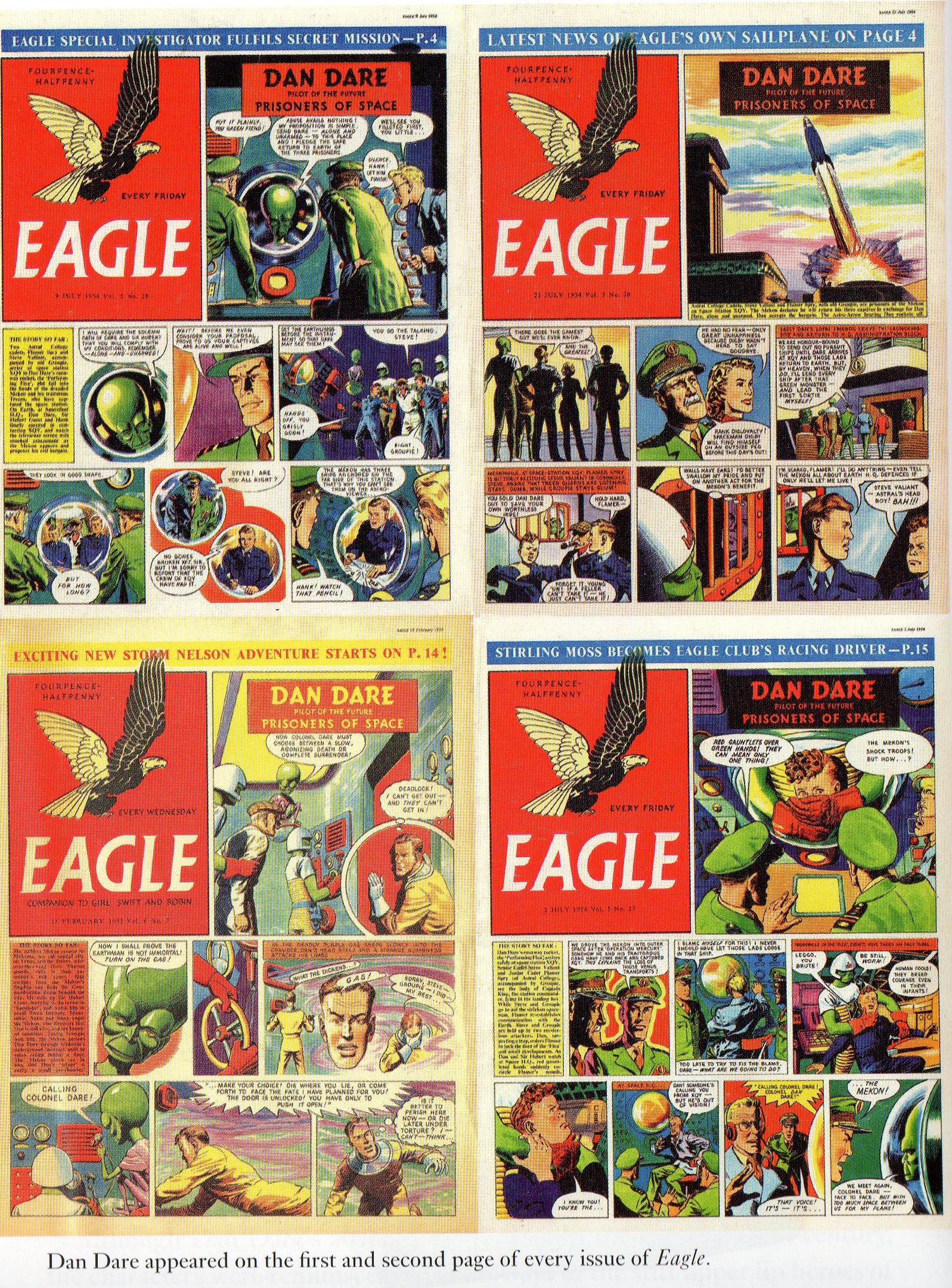
And then we have the more famous Dan Dare, whose influence I have talked of before. (LINK, LINK and LINK.) I guess he could be classed as the ‘Tom Corbett’ of British SF. Though much more famous in his comic incarnation in the Eagle comic (see below), John here talks of the radio show version, first transmitted on the difficult to obtain Radio Luxembourg.
US radio is given a couple of pages at the end of the chapter.
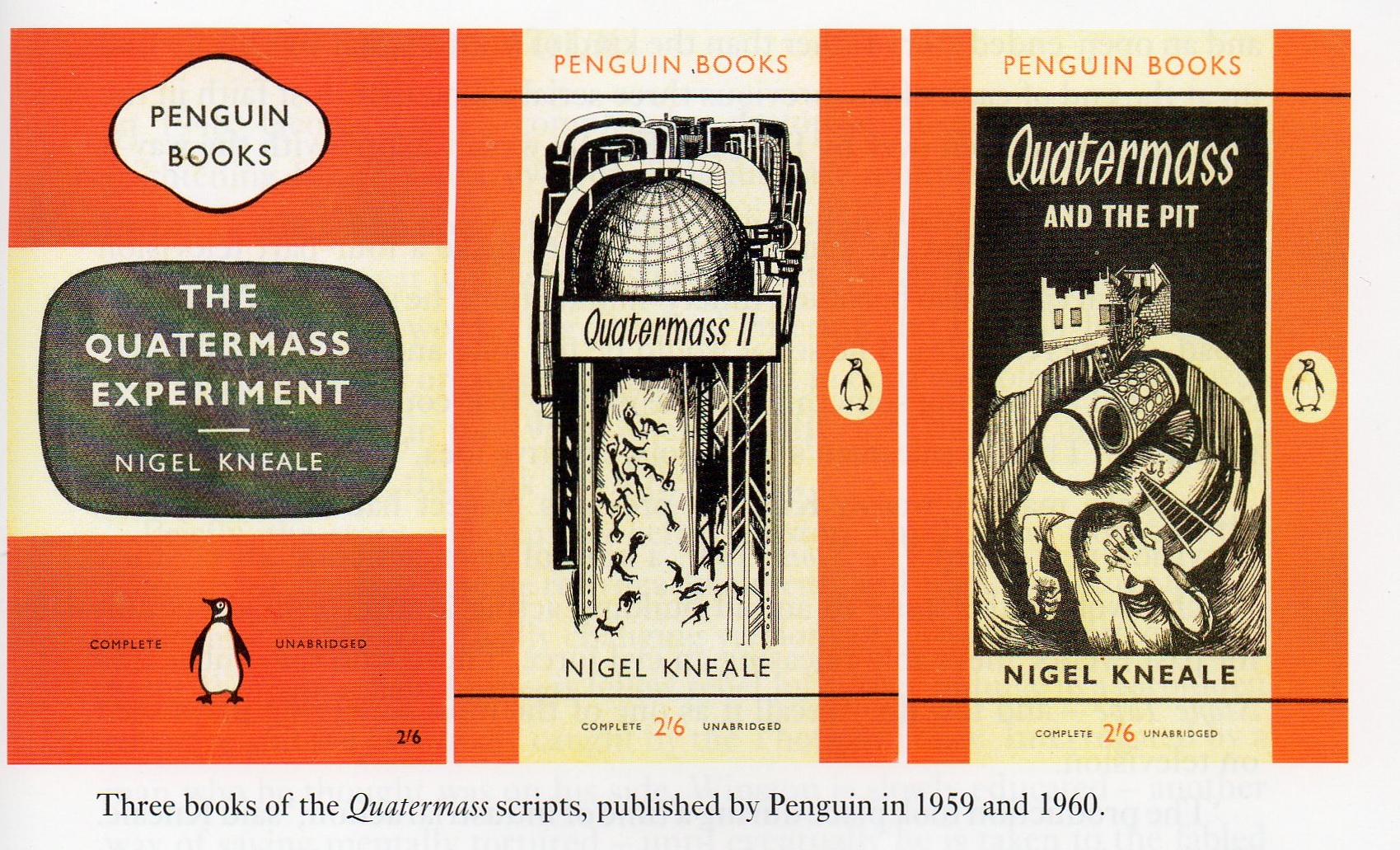
In the second chapter John looks at British television, although TV was a rare and expensive item in the 1950s – beyond the reach of most households. Nevertheless, John explains and discusses those television genre events that were major discussion points to the general public – Nigel Kneale’s Quatermass, a BBC adaptation of Orwell’s 1984, starring a young Peter Cushing, and an adaptation by the relatively new ITV network of HG Wells’ The Invisible Man. Again, brief mention is made of American TV series such as The Adventures of Superman, starring George Reeves, Captain Video and Tom Corbett Space Cadet.
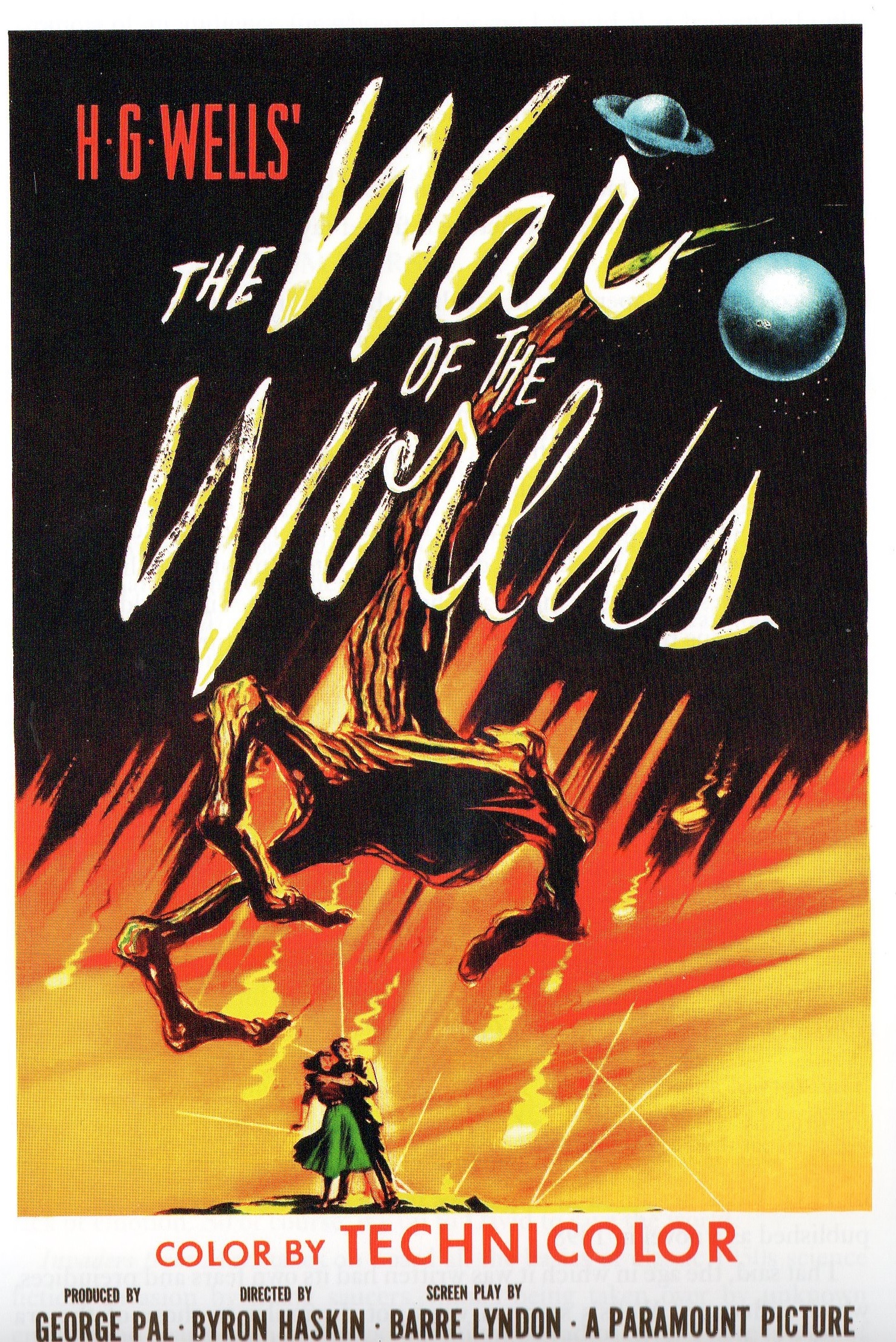
Chapter Three discusses Film. John mentions the trigger points that may have led to a growing appetite for science fiction films (The Second World War, atomic bombs, the Cold War, UFOs) and the genre stereotypes that resulted. The films mentioned are the usual iconic ones, in chronological order – The Day the Earth Stood Still (1951), Invaders from Mars (1953) and The War of the Worlds (1953), It Came from Outer Space (also 1953), This Island Earth (1955), Invasion of the Body Snatchers (1956), Forbidden Planet (1956), The Incredible Shrinking Man (1957) and The Fly (1958) which were also a key element of my own interest in the 1960s and 70s. This is perhaps the strongest and most enthusiastic chapter in the book.
A secondary group of films mentioned in less detail includes Journey to the Centre of the Earth (1959) and Plan 9 from Outer Space (also 1959). There’s also a nice, if uncritical, list of other movies to choose from at the end of the chapter, from Abbott and Costello Go to Mars (1953) to Zombies of the Stratosphere (1952) that should keep most genre film fans busy for a while.
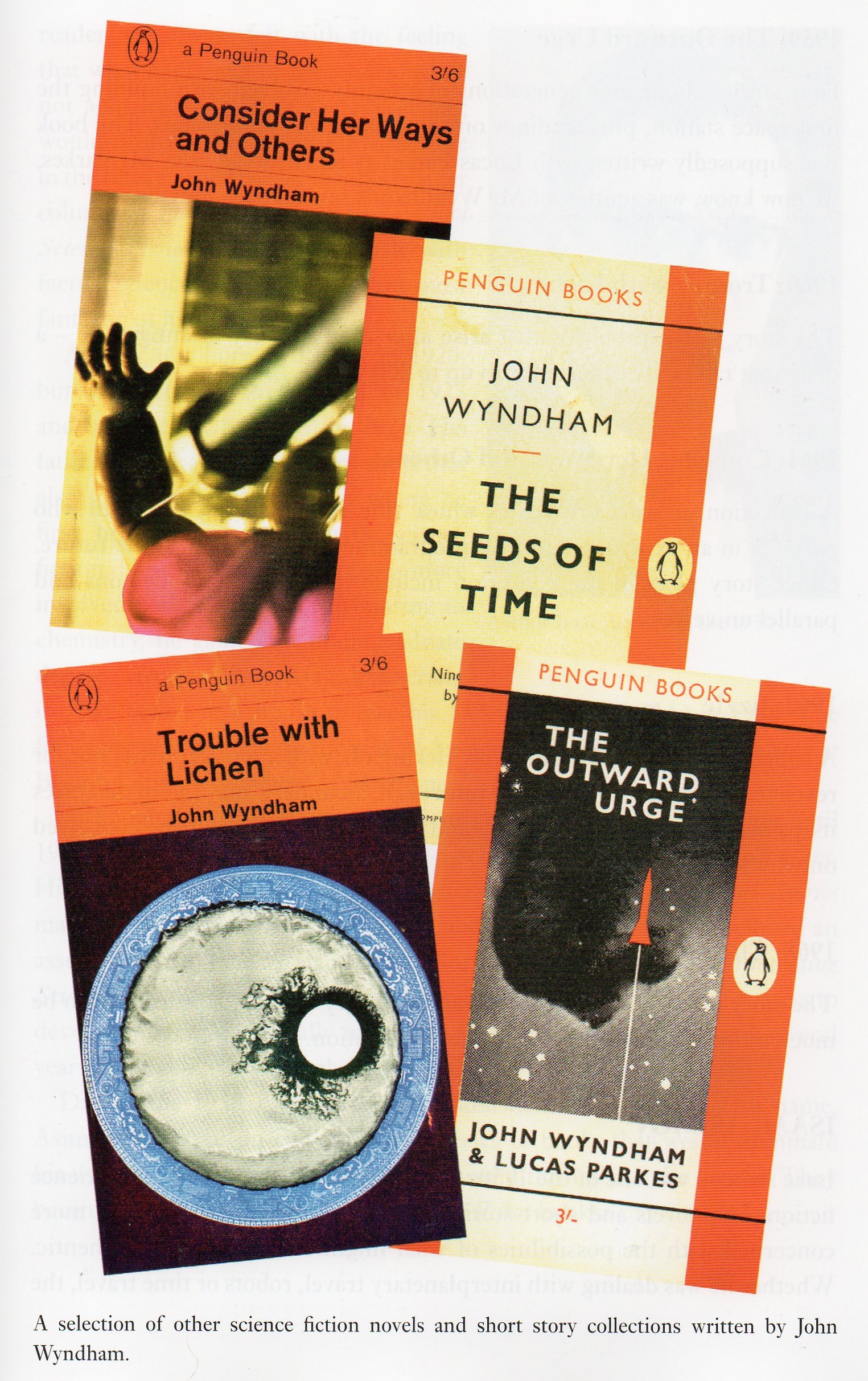
Chapter Four looks at influential authors. It shouldn’t be any surprise that it is totally male-dominated and includes the usual suspects – Arthur C Clarke, Asimov, Heinlein, and Bradbury in some detail, whilst others such as Brian Aldiss, Philip K Dick and A E van Vogt are in much shorter summaries. I was most pleased to see the first part of the chapter give some detail to the work of John Wyndham, whose influence on British literature in the 1950s and in bringing SF to the mainstream can perhaps only be compared to that of Bradbury and Heinlein in the USA. There’s some lovely book covers reproduced in this chapter as well.
The final chapter is about Science Fiction Comics and Magazines, but with that British slant. Lots on Dan Dare and the comic The Eagle (mentioned earlier) but very little on American comics such as Superman. This lack of detail extends to the genre magazines, with brief details on The Magazine of Fantasy and Science Fiction, Astounding (before it became Analog) and Galaxy Magazine. It doesn’t delve too deeply – no real mention of the British New Worlds magazine, which was around at the time, for example. Again, there’s some nice pictures but really there’s little more than a fairly superficial glance over them and a few scant comments about other issues such as Super Science Stories, Thrilling Wonder Stories and Vargo Statten Science Fiction Magazine.
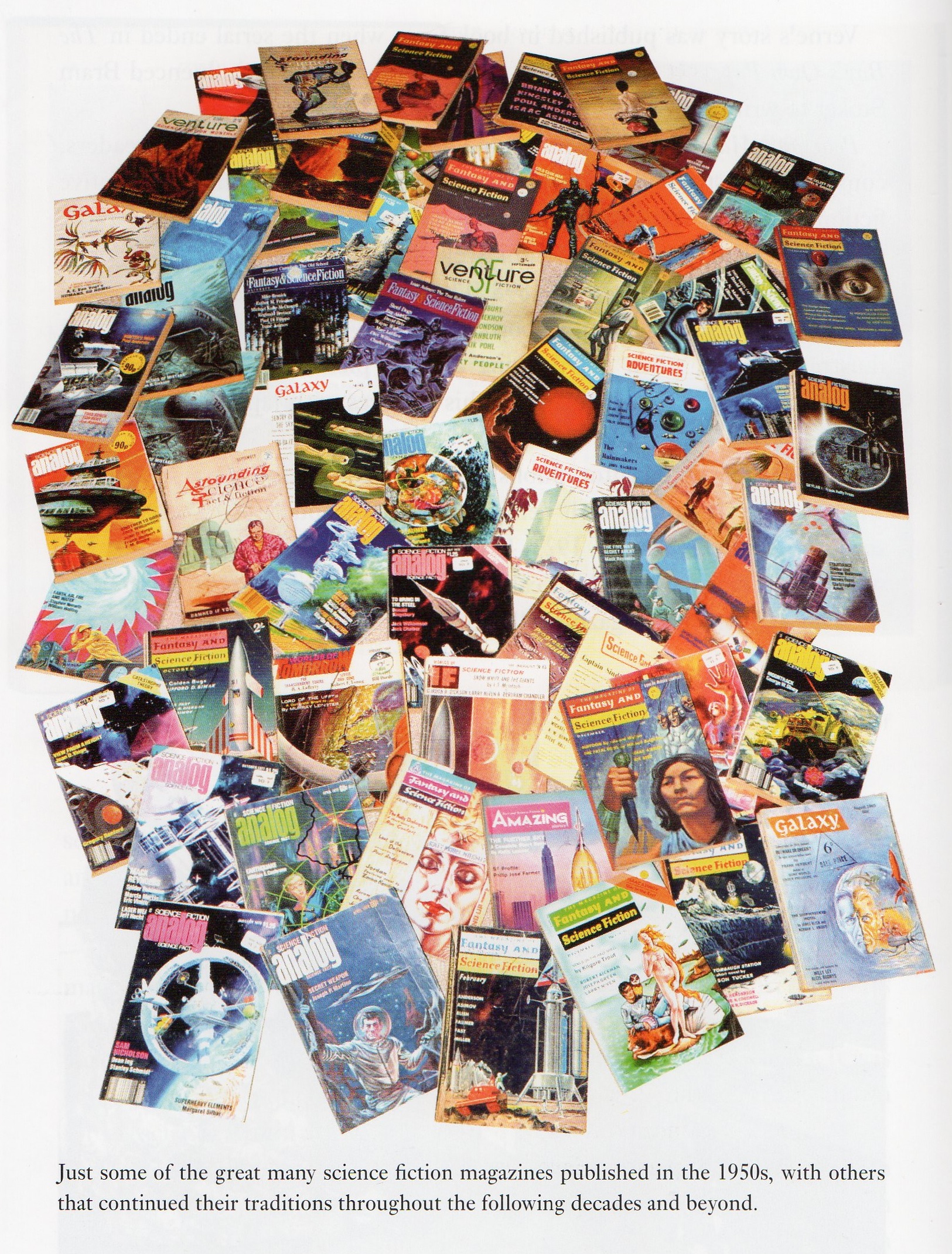
It certainly doesn’t get into the murky world of fandom like some of the TAFF materials over at David Langford’s Ansible does, or Peter Weston’s With Stars in my Eyes, nor is it well connected enough to give an overview, like Sir Arthur C Clarke’s Astounding Days memoir. (For a detailed analysis of the magazines I would wholeheartedly recommend Mike Ashley’s History of the SF Magazines series, but they are eye-wateringly expensive.)
There’s a list of possible reads at the end of the chapter but it is clear by this stage that they were not major influences or of major interest to the author as a young English boy in the 1950s. To be fair, most of these magazines from across the Atlantic were difficult to get, as I found even in the 1970’s, so the coverage reflects that.
Nevertheless, despite the narrative appearing to run out of steam in the end, The Golden Age of Science Fiction is a nice memento of what it must have been like to be a fan at that time. Reading it did bring a smile to my face, reading of the breathless enthusiasm that radio programmes brought or the impact of movies like Forbidden Planet and The Day the Earth Stood Still had upon a young and impressionable young man. It is clearly written by a fan who wishes to commit to paper their experiences that others may also share, or at least bring the spotlight to bear on aspects that otherwise might go unnoticed. The book may not have depth, but it does have heart. The pictures of old Penguin paperbacks, movie posters and items from the Dan Dare museum (yes, there is one!) are lovely.

Even though I was born after the 1950s, I recognise and appreciate that feeling – that initial “Oh, wow!” moment that this book conveys. I am sure most of us have had it at some point. There are parts of this book I recognise as being part of my childhood as well – those key films mentioned in detail are my ‘go-to list’ of movies I will watch again and again. But despite not being there in the 1950s, this book is a nice little summary of a certain time. It shows the importance of the genre seventy years ago, but also the longevity of the genre – as well as perhaps highlighting that the importance of British SF didn’t start with 2001: A Space Odyssey and Doctor Who, or those American imports Star Trek and Star Wars.
For those who were there in the 1950s (not many left now, sadly!) I’m sure that this would bring a host of memories back, whilst for those (like me) who were not, it’s an intriguing glimpse into our genre past. For readers in the US it’d make an interesting alternative version of the importance of science fiction to those brought up with the works and memoirs of Asimov, Campbell and Heinlein.
Most of all, The Golden Age of Science Fiction is a lovely reminder that the lure of science fiction, for those who get that ‘sensawunda’ feeling, goes back a long way. Regardless of age or place or time, its importance in culture should be appreciated.
The Golden Age of Science Fiction by John Wade
Published by Pen and Sword History, 2019
ISBN: 1526729253
210 pages